

39
2
19. In Situ Mouldability—Composites provide the possibility of in
situ moulding of any part, such as a metallic insert, bulkhead,
lug, nut, bolt, washer, etc. The in situ moulding provides a
strong bond between the metallic insert and the composite
without requiring any secondary process for the bonding of the
metallic inserts. Secondary operations not only increase
production time (due to operations such as machining, drilling,
etc.) to fit the metallic inserts, but they also weaken the
composite structure. The in situ moulded metallic bulkhead in
the composite fuselage of an aircraft is shown in . Fig. 2.11
20. Amenable to Pigmentation and Colouring—Most of the composites may be pigmented by mixing a pigment into the matrix. Also,
all composites may be painted many desired colours. Sporting
goods, leisure equipment, etc. that are made out of carbon
fibre-reinforced composites are usually painted to improve their
aesthetic look rather than keep their inherent black colour.
21. Heat Resistance—Polymeric composites are heat- resistant up
to the service temperature of their matrices. Heat resistance is
different from HDT. Heat resistance implies that the structural
integrity of a composite remains intact upon continuous
exposure of high temperature without delamination and loss
of mechanical properties. Composites made out of hightemperature matrices (such as PMR-PI, PEEK, PEI, PAI, etc.)
have high temperature resistance. PMR-PI composites may
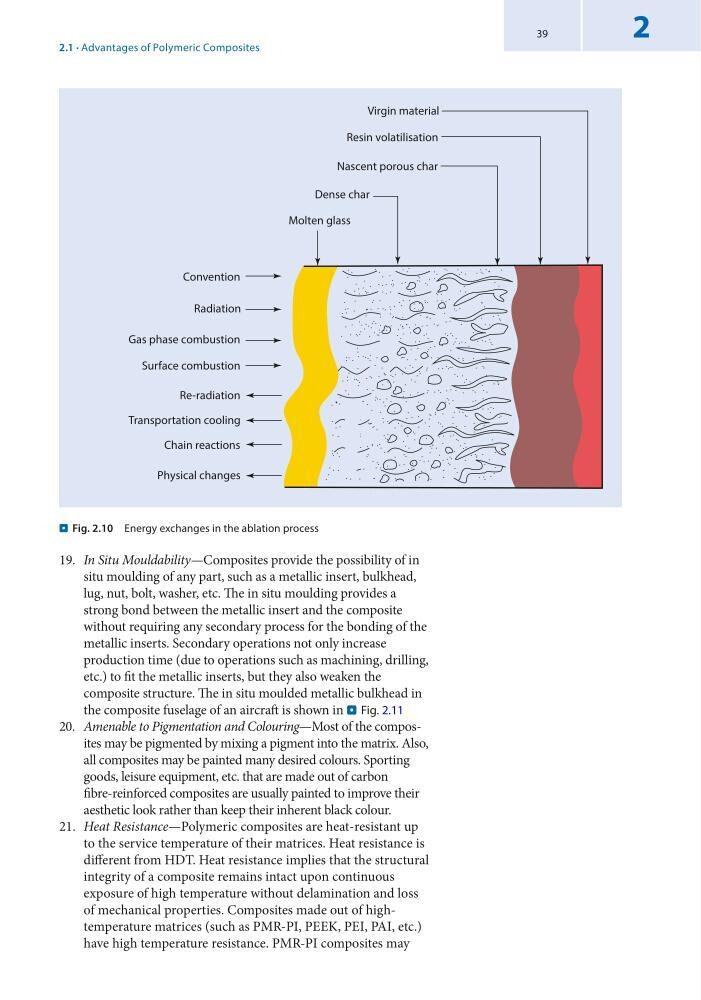
Molten glass
Dense char
Nascent porous char
Resin volatilisation
Virgin material
Convention
Radiation
Gas phase combustion
Surface combustion
Re-radiation
Transportation cooling
Chain reactions
Physical changes
. Fig. 2.10 Energy exchanges in the ablation process
2.1 · Advantages of Polymeric Composites
2
19. In Situ Mouldability—Composites provide the possibility of in
situ moulding of any part, such as a metallic insert, bulkhead,
lug, nut, bolt, washer, etc. The in situ moulding provides a
strong bond between the metallic insert and the composite
without requiring any secondary process for the bonding of the
metallic inserts. Secondary operations not only increase
production time (due to operations such as machining, drilling,
etc.) to fit the metallic inserts, but they also weaken the
composite structure. The in situ moulded metallic bulkhead in
the composite fuselage of an aircraft is shown in . Fig. 2.11
20. Amenable to Pigmentation and Colouring—Most of the composites may be pigmented by mixing a pigment into the matrix. Also,
all composites may be painted many desired colours. Sporting
goods, leisure equipment, etc. that are made out of carbon
fibre-reinforced composites are usually painted to improve their
aesthetic look rather than keep their inherent black colour.
21. Heat Resistance—Polymeric composites are heat- resistant up
to the service temperature of their matrices. Heat resistance is
different from HDT. Heat resistance implies that the structural
integrity of a composite remains intact upon continuous
exposure of high temperature without delamination and loss
of mechanical properties. Composites made out of hightemperature matrices (such as PMR-PI, PEEK, PEI, PAI, etc.)
have high temperature resistance. PMR-PI composites may
Molten glass
Dense char
Nascent porous char
Resin volatilisation
Virgin material
Convention
Radiation
Gas phase combustion
Surface combustion
Re-radiation
Transportation cooling
Chain reactions
Physical changes
. Fig. 2.10 Energy exchanges in the ablation process
2.1 · Advantages of Polymeric Composites