

254
9
finding flaws before they are visible and lead to creep or catastrophic failure [19–21]. Defects that are commonly detected using
the eddy current technique are fatigue-induced cracking, thermal
deterioration, vibration or mechanical damage, fretting, etc.
Electrical currents are induced in carbon fibre-reinforced composites by the following two possible conduction paths when an eddy
current probe is placed over them.
5 Resistive eddy current path in which the induced eddy current
passes from one fibre to another fibre at the point of fibre
contact. At low frequencies, this conduction path becomes
appropriate.
5 Resistive capacitive eddy current path in which an interfibre
capacitive path for an induced eddy current is present in
addition to the resistive path. At high frequencies (>15 Hz),
this conduction path becomes appropriate.
Changes in resistance in an eddy current probe can be used to
determine the volume fraction (V f ). Eddy current techniques also
may be used to detect cracks in CFRC and for the determination of
the layup order in cross-plied CFRC.
9.4.4 Acoustic Emission Testing
Acoustic emissions may be defined as elastic waves spontaneously
generated within the volume of the material due to the release of
stored elastic energy as it undergoes plastic deformation, phase
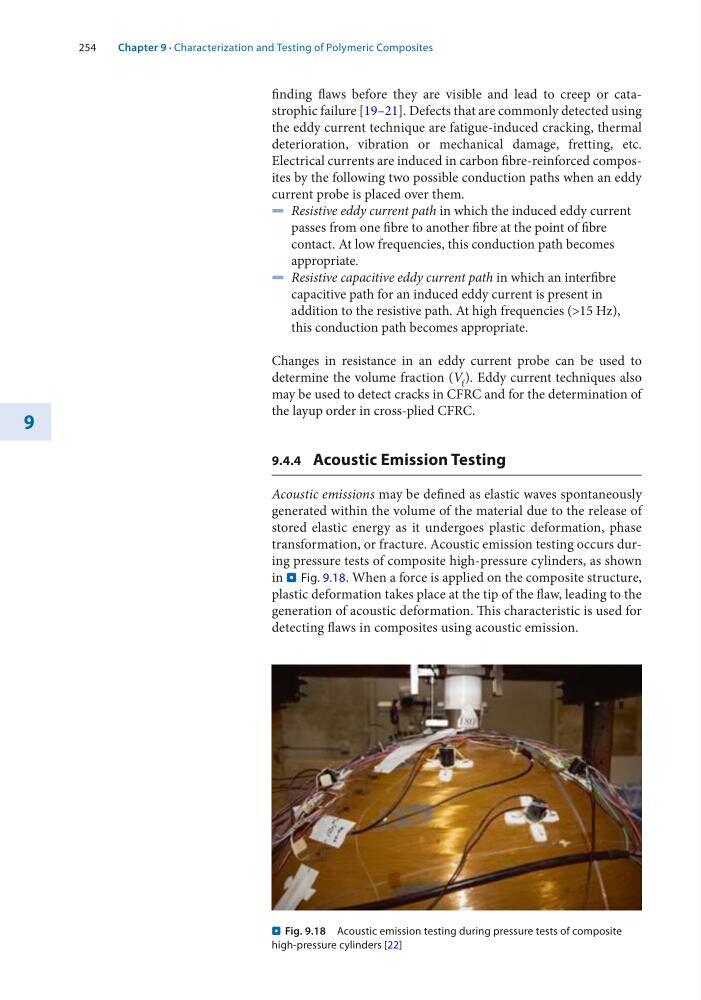
transformation, or fracture. Acoustic emission testing occurs during pressure tests of composite high-pressure cylinders, as shown
in . Fig. 9.18. When a force is applied on the composite structure,
plastic deformation takes place at the tip of the flaw, leading to the
generation of acoustic deformation. This characteristic is used for
detecting flaws in composites using acoustic emission.
. Fig. 9.18 Acoustic emission testing during pressure tests of composite
high-pressure cylinders [22]
Chapter 9 · Characterization and Testing of Polymeric Composites
9
finding flaws before they are visible and lead to creep or catastrophic failure [19–21]. Defects that are commonly detected using
the eddy current technique are fatigue-induced cracking, thermal
deterioration, vibration or mechanical damage, fretting, etc.
Electrical currents are induced in carbon fibre-reinforced composites by the following two possible conduction paths when an eddy
current probe is placed over them.
5 Resistive eddy current path in which the induced eddy current
passes from one fibre to another fibre at the point of fibre
contact. At low frequencies, this conduction path becomes
appropriate.
5 Resistive capacitive eddy current path in which an interfibre
capacitive path for an induced eddy current is present in
addition to the resistive path. At high frequencies (>15 Hz),
this conduction path becomes appropriate.
Changes in resistance in an eddy current probe can be used to
determine the volume fraction (V f ). Eddy current techniques also
may be used to detect cracks in CFRC and for the determination of
the layup order in cross-plied CFRC.
9.4.4 Acoustic Emission Testing
Acoustic emissions may be defined as elastic waves spontaneously
generated within the volume of the material due to the release of
stored elastic energy as it undergoes plastic deformation, phase
transformation, or fracture. Acoustic emission testing occurs during pressure tests of composite high-pressure cylinders, as shown
in . Fig. 9.18. When a force is applied on the composite structure,
plastic deformation takes place at the tip of the flaw, leading to the
generation of acoustic deformation. This characteristic is used for
detecting flaws in composites using acoustic emission.
. Fig. 9.18 Acoustic emission testing during pressure tests of composite
high-pressure cylinders [22]
Chapter 9 · Characterization and Testing of Polymeric Composites