

252
9
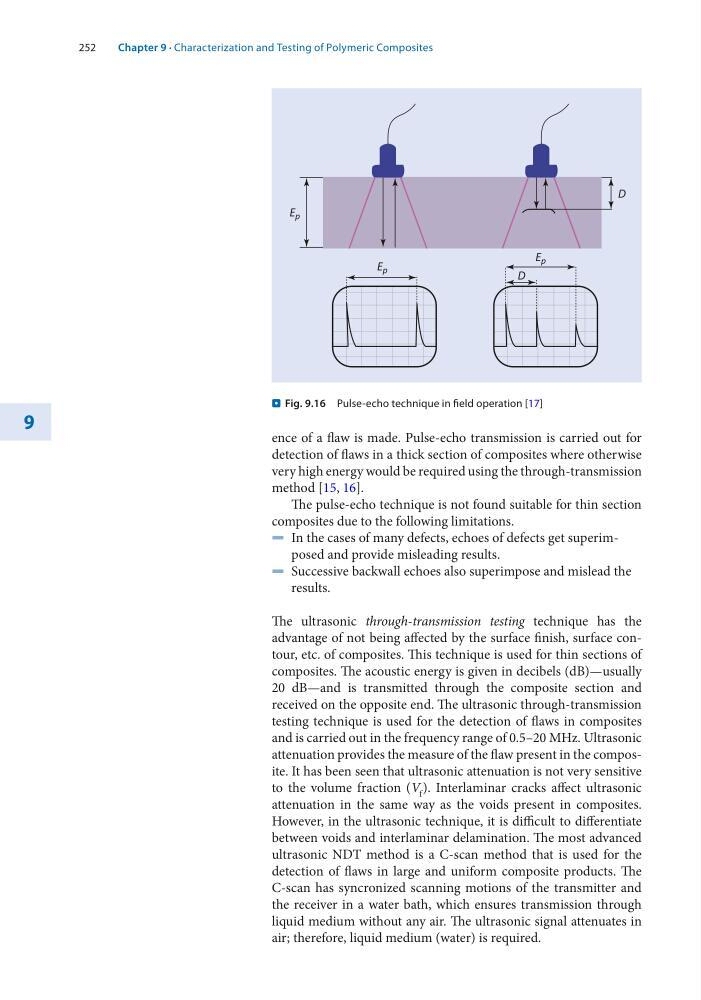
ence of a flaw is made. Pulse-echo transmission is carried out for
detection of flaws in a thick section of composites where otherwise
very high energy would be required using the through- transmission
method [15, 16].
The pulse-echo technique is not found suitable for thin section
composites due to the following limitations.
5 In the cases of many defects, echoes of defects get superimposed and provide misleading results.
5 Successive backwall echoes also superimpose and mislead the
results.
The ultrasonic through-transmission testing technique has the
advantage of not being affected by the surface finish, surface contour, etc. of composites. This technique is used for thin sections of
composites. The acoustic energy is given in decibels (dB)—usually
20 dB—and is transmitted through the composite section and
received on the opposite end. The ultrasonic through-transmission
testing technique is used for the detection of flaws in composites
and is carried out in the frequency range of 0.5–20 MHz. Ultrasonic
attenuation provides the measure of the flaw present in the composite. It has been seen that ultrasonic attenuation is not very sensitive
to the volume fraction (V f ). Interlaminar cracks affect ultrasonic
attenuation in the same way as the voids present in composites.
However, in the ultrasonic technique, it is difficult to differentiate
between voids and interlaminar delamination. The most advanced
ultrasonic NDT method is a C-scan method that is used for the
detection of flaws in large and uniform composite products. The
C-scan has syncronized scanning motions of the transmitter and
the receiver in a water bath, which ensures transmission through
liquid medium without any air. The ultrasonic signal attenuates in
air; therefore, liquid medium (water) is required.
E p
E p
E p
D
D
. Fig. 9.16 Pulse-echo technique in field operation [17]
Chapter 9 · Characterization and Testing of Polymeric Composites
9
ence of a flaw is made. Pulse-echo transmission is carried out for
detection of flaws in a thick section of composites where otherwise
very high energy would be required using the through- transmission
method [15, 16].
The pulse-echo technique is not found suitable for thin section
composites due to the following limitations.
5 In the cases of many defects, echoes of defects get superimposed and provide misleading results.
5 Successive backwall echoes also superimpose and mislead the
results.
The ultrasonic through-transmission testing technique has the
advantage of not being affected by the surface finish, surface contour, etc. of composites. This technique is used for thin sections of
composites. The acoustic energy is given in decibels (dB)—usually
20 dB—and is transmitted through the composite section and
received on the opposite end. The ultrasonic through-transmission
testing technique is used for the detection of flaws in composites
and is carried out in the frequency range of 0.5–20 MHz. Ultrasonic
attenuation provides the measure of the flaw present in the composite. It has been seen that ultrasonic attenuation is not very sensitive
to the volume fraction (V f ). Interlaminar cracks affect ultrasonic
attenuation in the same way as the voids present in composites.
However, in the ultrasonic technique, it is difficult to differentiate
between voids and interlaminar delamination. The most advanced
ultrasonic NDT method is a C-scan method that is used for the
detection of flaws in large and uniform composite products. The
C-scan has syncronized scanning motions of the transmitter and
the receiver in a water bath, which ensures transmission through
liquid medium without any air. The ultrasonic signal attenuates in
air; therefore, liquid medium (water) is required.
E p
E p
E p
D
D
. Fig. 9.16 Pulse-echo technique in field operation [17]
Chapter 9 · Characterization and Testing of Polymeric Composites