

250
9
9.4.1 Radiography
Radiography provides a good overall understanding of polymeric
composites. It detects vital parameters, such as general fibre orientation, fibrewash, kinks, wrinkles, and foreign objects. Translaminar
cracks, which are aligned parallel to the direction of X-ray beam,
are also easily detected in by radiography. The principle of industrial radiography that is employed in composites is shown in
. Fig. 9.15.
Translaminar cracks are present in composites in the form of
thermal or shrinkage cracks. A commercially available X-ray generator with a low-voltage and beryllium window is used for radiography studies of composites. The voltage required for this X-ray
apparatus is 10–15 KV, which is suitable for thin (less than 50 mm)
sections of composites.
For the radiography of thick sections (50 mm and more) of
composites to detect defects—including translaminar defects—a
high-powered X-ray, such as a Lineac (linear accelerator), that
works at a voltage of 15–50 KV is used. It requires many safety protocols because it poses fatal health hazards on exposure to human
beings. X-ray radiography can be used to detect voids in composites, but only when they display absorption of a 2% incident X-ray
or more. However, it is difficult to detect delaminations, volume
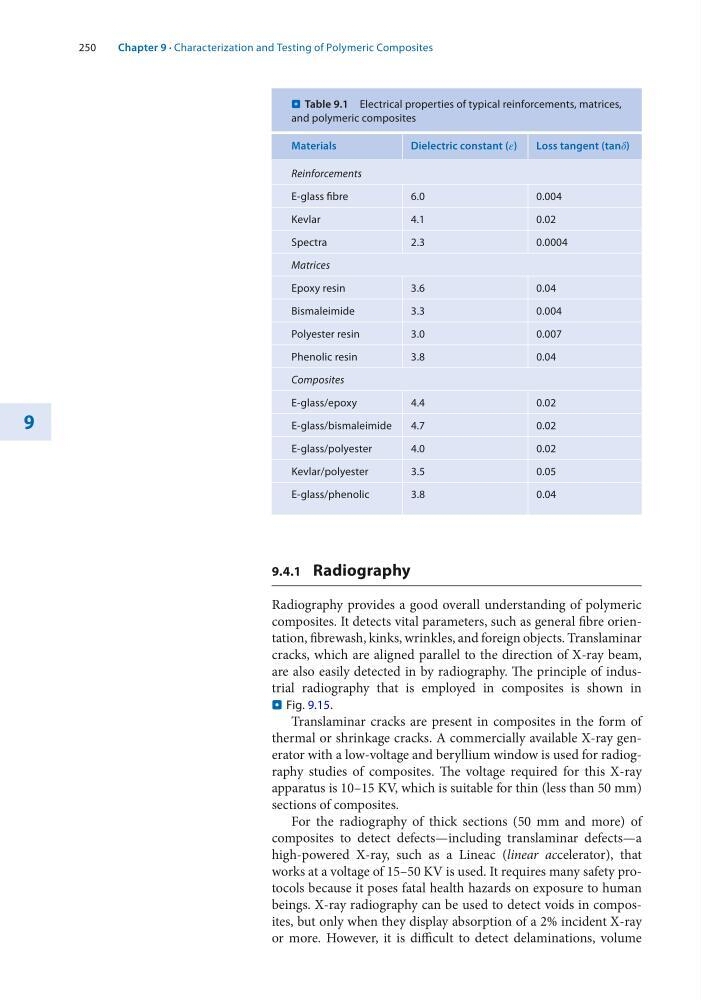
. Table 9.1 Electrical properties of typical reinforcements, matrices,
and polymeric composites
Materials
Dielectric constant (ε)
Loss tangent (tanδ)
Reinforcements
E-glass fibre
6.0
0.004
Kevlar
4.1
0.02
Spectra
2.3
0.0004
Matrices
Epoxy resin
3.6
0.04
Bismaleimide
3.3
0.004
Polyester resin
3.0
0.007
Phenolic resin
3.8
0.04
Composites
E-glass/epoxy
4.4
0.02
E-glass/bismaleimide
4.7
0.02
E-glass/polyester
4.0
0.02
Kevlar/polyester
3.5
0.05
E-glass/phenolic
3.8
0.04
Chapter 9 · Characterization and Testing of Polymeric Composites
9
9.4.1 Radiography
Radiography provides a good overall understanding of polymeric
composites. It detects vital parameters, such as general fibre orientation, fibrewash, kinks, wrinkles, and foreign objects. Translaminar
cracks, which are aligned parallel to the direction of X-ray beam,
are also easily detected in by radiography. The principle of industrial radiography that is employed in composites is shown in
. Fig. 9.15.
Translaminar cracks are present in composites in the form of
thermal or shrinkage cracks. A commercially available X-ray generator with a low-voltage and beryllium window is used for radiography studies of composites. The voltage required for this X-ray
apparatus is 10–15 KV, which is suitable for thin (less than 50 mm)
sections of composites.
For the radiography of thick sections (50 mm and more) of
composites to detect defects—including translaminar defects—a
high-powered X-ray, such as a Lineac (linear accelerator), that
works at a voltage of 15–50 KV is used. It requires many safety protocols because it poses fatal health hazards on exposure to human
beings. X-ray radiography can be used to detect voids in composites, but only when they display absorption of a 2% incident X-ray
or more. However, it is difficult to detect delaminations, volume
. Table 9.1 Electrical properties of typical reinforcements, matrices,
and polymeric composites
Materials
Dielectric constant (ε)
Loss tangent (tanδ)
Reinforcements
E-glass fibre
6.0
0.004
Kevlar
4.1
0.02
Spectra
2.3
0.0004
Matrices
Epoxy resin
3.6
0.04
Bismaleimide
3.3
0.004
Polyester resin
3.0
0.007
Phenolic resin
3.8
0.04
Composites
E-glass/epoxy
4.4
0.02
E-glass/bismaleimide
4.7
0.02
E-glass/polyester
4.0
0.02
Kevlar/polyester
3.5
0.05
E-glass/phenolic
3.8
0.04
Chapter 9 · Characterization and Testing of Polymeric Composites