

249
9
The value of the loss tangent is experimentally calculated as
the ratio of ε″ (imaginary part of permittivity) and ε′ (real part
of permittivity) of the sample, as given in Eq. 9.10.
tan
^ / ^
d e
e
=
²
¢
(9.10)
3. Transmission Loss—Transmission loss is a functional test of
dielectric material that is used for radar-transparent structures.
The loss of energy in transmission of electromagnetic wave
through a dielectric medium is called transmission loss. In
transmission loss, the EM wave travels through the thickness of
dielectric material. The transmission of EM wave is denoted as
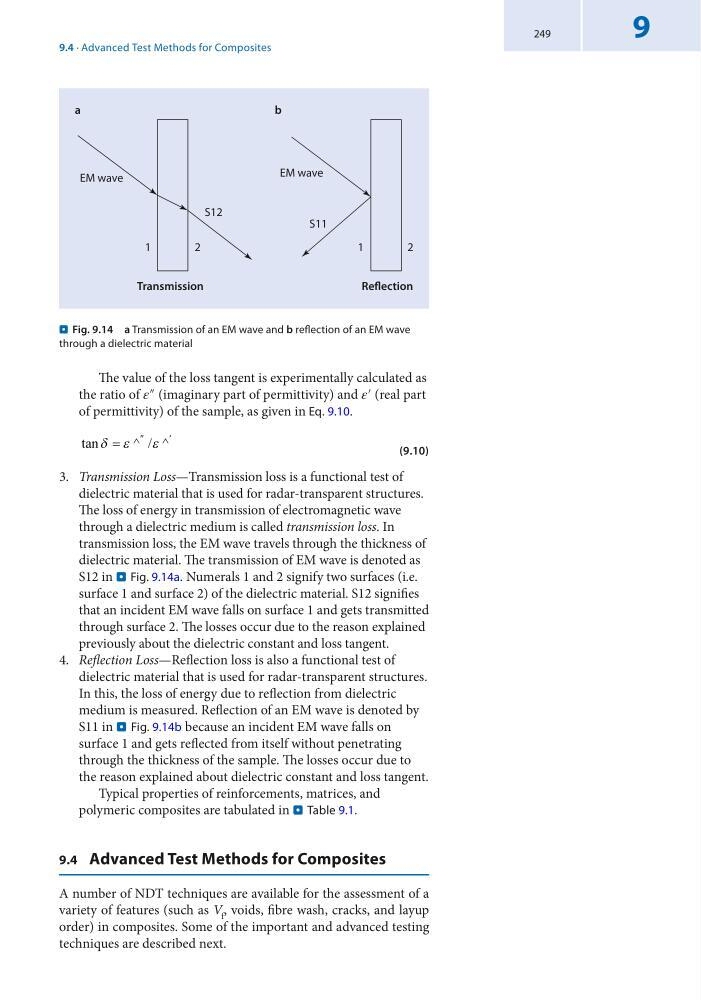
S12 in . Fig. 9.14a. Numerals 1 and 2 signify two surfaces (i.e.
surface 1 and surface 2) of the dielectric material. S12 signifies
that an incident EM wave falls on surface 1 and gets transmitted
through surface 2. The losses occur due to the reason explained
previously about the dielectric constant and loss tangent.
4. Reflection Loss—Reflection loss is also a functional test of
dielectric material that is used for radar-transparent structures.
In this, the loss of energy due to reflection from dielectric
medium is measured. Reflection of an EM wave is denoted by
S11 in . Fig. 9.14b because an incident EM wave falls on
surface 1 and gets reflected from itself without penetrating
through the thickness of the sample. The losses occur due to
the reason explained about dielectric constant and loss tangent.
Typical properties of reinforcements, matrices, and
polymeric composites are tabulated in . Table 9.1.
9.4 Advanced Test Methods for Composites
A number of NDT techniques are available for the assessment of a
variety of features (such as V f , voids, fibre wash, cracks, and layup
order) in composites. Some of the important and advanced testing
techniques are described next.
Transmission
1
2
S12
S11
EM wave
EM wave
1
2
Reflection
b
a
. Fig. 9.14 a Transmission of an EM wave and b reflection of an EM wave
through a dielectric material
9.4 · Advanced Test Methods for Composites
9
The value of the loss tangent is experimentally calculated as
the ratio of ε″ (imaginary part of permittivity) and ε′ (real part
of permittivity) of the sample, as given in Eq. 9.10.
tan
^ / ^
d e
e
=
²
¢
(9.10)
3. Transmission Loss—Transmission loss is a functional test of
dielectric material that is used for radar-transparent structures.
The loss of energy in transmission of electromagnetic wave
through a dielectric medium is called transmission loss. In
transmission loss, the EM wave travels through the thickness of
dielectric material. The transmission of EM wave is denoted as
S12 in . Fig. 9.14a. Numerals 1 and 2 signify two surfaces (i.e.
surface 1 and surface 2) of the dielectric material. S12 signifies
that an incident EM wave falls on surface 1 and gets transmitted
through surface 2. The losses occur due to the reason explained
previously about the dielectric constant and loss tangent.
4. Reflection Loss—Reflection loss is also a functional test of
dielectric material that is used for radar-transparent structures.
In this, the loss of energy due to reflection from dielectric
medium is measured. Reflection of an EM wave is denoted by
S11 in . Fig. 9.14b because an incident EM wave falls on
surface 1 and gets reflected from itself without penetrating
through the thickness of the sample. The losses occur due to
the reason explained about dielectric constant and loss tangent.
Typical properties of reinforcements, matrices, and
polymeric composites are tabulated in . Table 9.1.
9.4 Advanced Test Methods for Composites
A number of NDT techniques are available for the assessment of a
variety of features (such as V f , voids, fibre wash, cracks, and layup
order) in composites. Some of the important and advanced testing
techniques are described next.
Transmission
1
2
S12
S11
EM wave
EM wave
1
2
Reflection
b
a
. Fig. 9.14 a Transmission of an EM wave and b reflection of an EM wave
through a dielectric material
9.4 · Advanced Test Methods for Composites