

247
9
damage occurs. As a result, the strain in the specimen increases
in stress-controlled tests, but the stress in the specimen
decreases in strain-controlled tests. In composites, fatigue
failure occurs at the core first, and failure then propagates from
the core to the surface. The reason of failure at the core is
attributed to heat build-up at the core and the ability to to
conduct it outside due to the insulating characteristic of
polymeric composites. On the other hand, when the surface of
the composite is in direct contact of air, heat is easily dissipated.
9.3.3 Electromagnetic (EM) Performance
The electromagnetic (EM) performance of a polymeric composite
is evaluated based on its dielectric constant, loss tangent, transmission loss, and reflection loss. These are explained here.
1. Dielectric Constant—The dielectric constant (ε) is the capacity
of charge storage by the insulating material on the application
of an electric field. Low dielectric constant benefits good
transmission of an EM wave because the loss of EM energy in
polarization is at the minimum. The relative dielectric constant
of the composite is calculated from Eq. 9.9.
e
e
e
c
m
f
f
f
m
f
¢
¢
¢
=
+
+
V
V
V V
log
l og
(9.9)
where:
5 e c
¢ = Relative dielectric constant of composite
5 e m
¢ = Relative dielectric constant of matrix
5 e f
¢ = Relative dielectric constant of fibre
5 V m = Volume fraction of matrix
5 V f = Volume fraction of fibre
s max
s min
Cycles
+
I
s a
s r
s m
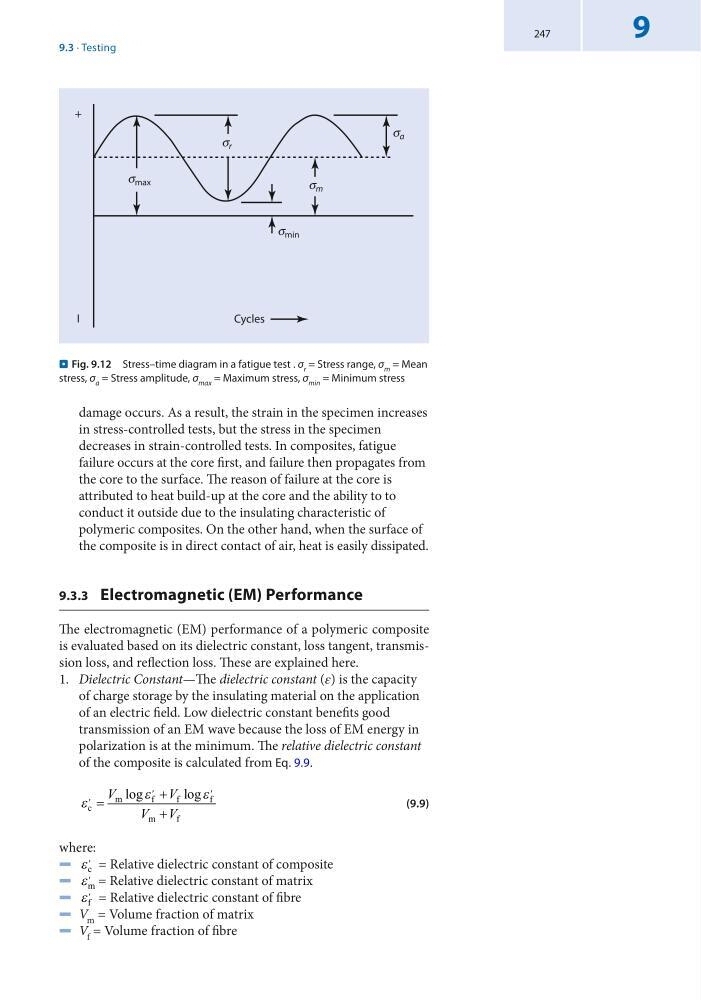
. Fig. 9.12 Stress–time diagram in a fatigue test . σ r = Stress range, σ m = Mean
stress, σ a = Stress amplitude, σ max = Maximum stress, σ min = Minimum stress
9.3 · Testing
9
damage occurs. As a result, the strain in the specimen increases
in stress-controlled tests, but the stress in the specimen
decreases in strain-controlled tests. In composites, fatigue
failure occurs at the core first, and failure then propagates from
the core to the surface. The reason of failure at the core is
attributed to heat build-up at the core and the ability to to
conduct it outside due to the insulating characteristic of
polymeric composites. On the other hand, when the surface of
the composite is in direct contact of air, heat is easily dissipated.
9.3.3 Electromagnetic (EM) Performance
The electromagnetic (EM) performance of a polymeric composite
is evaluated based on its dielectric constant, loss tangent, transmission loss, and reflection loss. These are explained here.
1. Dielectric Constant—The dielectric constant (ε) is the capacity
of charge storage by the insulating material on the application
of an electric field. Low dielectric constant benefits good
transmission of an EM wave because the loss of EM energy in
polarization is at the minimum. The relative dielectric constant
of the composite is calculated from Eq. 9.9.
e
e
e
c
m
f
f
f
m
f
¢
¢
¢
=
+
+
V
V
V V
log
l og
(9.9)
where:
5 e c
¢ = Relative dielectric constant of composite
5 e m
¢ = Relative dielectric constant of matrix
5 e f
¢ = Relative dielectric constant of fibre
5 V m = Volume fraction of matrix
5 V f = Volume fraction of fibre
s max
s min
Cycles
+
I
s a
s r
s m
. Fig. 9.12 Stress–time diagram in a fatigue test . σ r = Stress range, σ m = Mean
stress, σ a = Stress amplitude, σ max = Maximum stress, σ min = Minimum stress
9.3 · Testing