

246
9
sample does not fail for up to one million cycles. The fatigue
test is carried out commonly in following three modes:
(i) Tension–tension mode
(ii) Tension–compression mode
(iii) Compression–compression mode
The interphase is also important in fatigue resistance; therefore, low-viscosity and high-strength resins score above highly
viscous thermoplastic resins. For example, epoxy-based
composites are quite good in fatigue resistance due to their
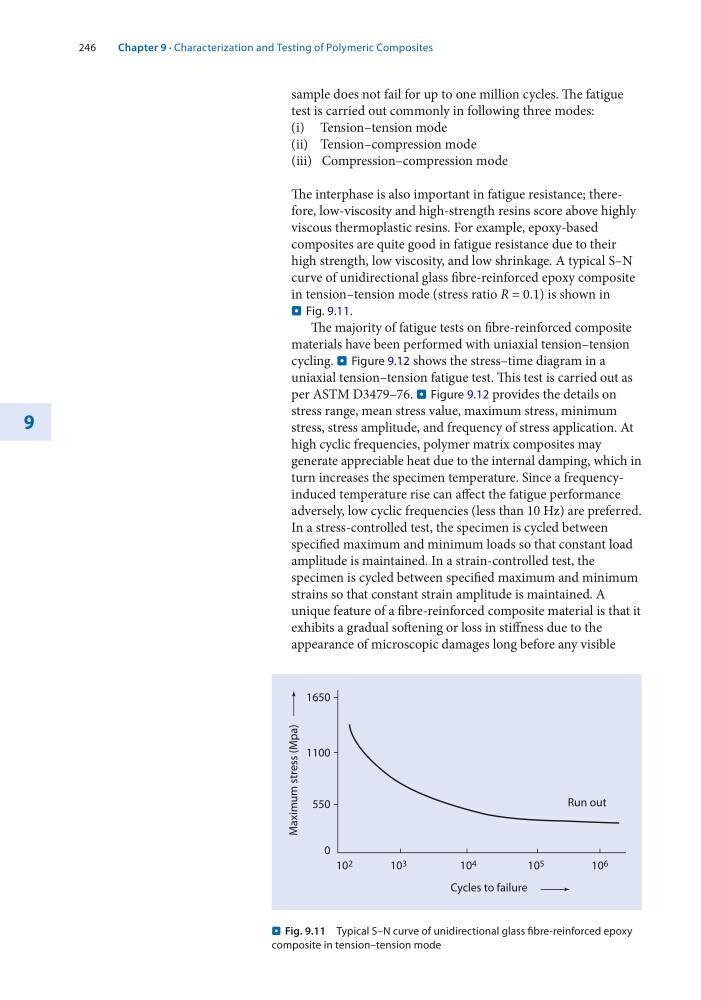
high strength, low viscosity, and low shrinkage. A typical S–N
curve of unidirectional glass fibre-reinforced epoxy composite
in tension–tension mode (stress ratio R = 0.1) is shown in
. Fig. 9.11.
The majority of fatigue tests on fibre-reinforced composite
materials have been performed with uniaxial tension–tension
cycling. . Figure 9.12 shows the stress–time diagram in a
uniaxial tension–tension fatigue test. This test is carried out as
per ASTM D3479–76. . Figure 9.12 provides the details on
stress range, mean stress value, maximum stress, minimum
stress, stress amplitude, and frequency of stress application. At
high cyclic frequencies, polymer matrix composites may
generate appreciable heat due to the internal damping, which in
turn increases the specimen temperature. Since a frequencyinduced temperature rise can affect the fatigue performance
adversely, low cyclic frequencies (less than 10 Hz) are preferred.
In a stress-controlled test, the specimen is cycled between
specified maximum and minimum loads so that constant load
amplitude is maintained. In a strain-controlled test, the
specimen is cycled between specified maximum and minimum
strains so that constant strain amplitude is maintained. A
unique feature of a fibre-reinforced composite material is that it
exhibits a gradual softening or loss in stiffness due to the
appearance of microscopic damages long before any visible
10 2
0
550
1100
1650
10 3
10 4
Run out
Cycles to failure
Maximum stress (Mpa)
10 5
10 6
. Fig. 9.11 Typical S–N curve of unidirectional glass fibre-reinforced epoxy
composite in tension–tension mode
Chapter 9 · Characterization and Testing of Polymeric Composites
9
sample does not fail for up to one million cycles. The fatigue
test is carried out commonly in following three modes:
(i) Tension–tension mode
(ii) Tension–compression mode
(iii) Compression–compression mode
The interphase is also important in fatigue resistance; therefore, low-viscosity and high-strength resins score above highly
viscous thermoplastic resins. For example, epoxy-based
composites are quite good in fatigue resistance due to their
high strength, low viscosity, and low shrinkage. A typical S–N
curve of unidirectional glass fibre-reinforced epoxy composite
in tension–tension mode (stress ratio R = 0.1) is shown in
. Fig. 9.11.
The majority of fatigue tests on fibre-reinforced composite
materials have been performed with uniaxial tension–tension
cycling. . Figure 9.12 shows the stress–time diagram in a
uniaxial tension–tension fatigue test. This test is carried out as
per ASTM D3479–76. . Figure 9.12 provides the details on
stress range, mean stress value, maximum stress, minimum
stress, stress amplitude, and frequency of stress application. At
high cyclic frequencies, polymer matrix composites may
generate appreciable heat due to the internal damping, which in
turn increases the specimen temperature. Since a frequencyinduced temperature rise can affect the fatigue performance
adversely, low cyclic frequencies (less than 10 Hz) are preferred.
In a stress-controlled test, the specimen is cycled between
specified maximum and minimum loads so that constant load
amplitude is maintained. In a strain-controlled test, the
specimen is cycled between specified maximum and minimum
strains so that constant strain amplitude is maintained. A
unique feature of a fibre-reinforced composite material is that it
exhibits a gradual softening or loss in stiffness due to the
appearance of microscopic damages long before any visible
10 2
0
550
1100
1650
10 3
10 4
Run out
Cycles to failure
Maximum stress (Mpa)
10 5
10 6
. Fig. 9.11 Typical S–N curve of unidirectional glass fibre-reinforced epoxy
composite in tension–tension mode
Chapter 9 · Characterization and Testing of Polymeric Composites