

245
9
frequency of loading, temperature, humidity, etc. all come into
the picture. Heat build-up is also associated with cyclic loading
(i.e. fatigue), and it also causes failure of the composite. Fatigue
failure is generally understood as a cumulative effect of the
gradual growth of internal flaws with a repeated or cyclic
application of load. These failures are initiated in the matrix.
Therefore, the matrix has a significant role in fatigue strength.
The development of cracks due to fatigue causes a loss of
modulus of the composite. Therefore, more load is borne by
the fibres. Materials that are ductile in nature under normal
operating conditions are known to fail in a brittle manner
when they are subjected to repeated or cyclic stresses or strains.
The cycle leading to failure depends on a number of variables,
such as stress level, stress state, mode of cycling, frequency of
load cycle, process history, material composition, and environmental conditions. The heat produced in the composite
samples from fatigue is not conducted away due to the poor
conductivity of composites. The heat build-up in composites
softens the matrix, leading to debonding and causes a reduction in the fatigue strength. Due to all of these factors, a factor
of safety of 2 is given to structures with a low cycle fatigue and
of 4 for a high cycle fatigue.
The fatigue behaviour of a material is usually characterized
by an S–N curve, which shows the relationship between the
stress amplitude or maximum stress and the number of cycles
leading to failure on a semi-logarithmic scale. The S–N curve
of metals show an endurance limit. However, there is no such
endurance limit in the case of composites. An S–N curve is
obtained by testing a number of specimens at various stress
levels under sinusoidal loading conditions. The number of
cycles required for failure at a stress level is called the fatigue
life of a material. There is a theoretical value for the stress
amplitude below which the material will not fail for any
number of cycles, which is called run out, fatigue limit,
endurance limit, or fatigue strength. The fatigue strength of
composite shown on S–N curve is the strength at which a
Model I
M odel II
Model III
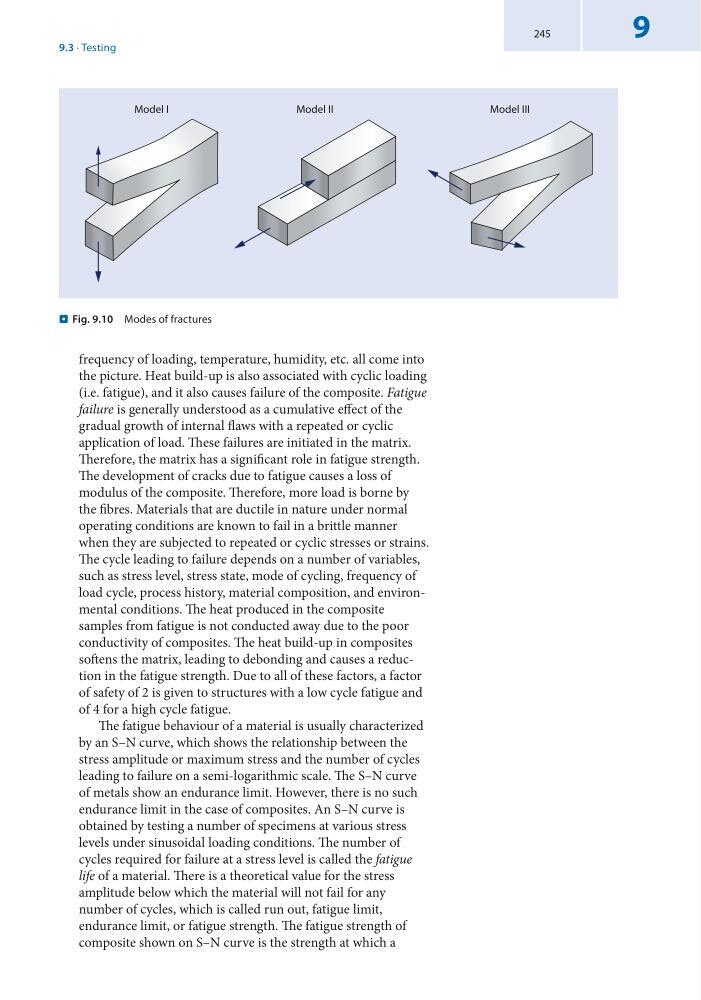
. Fig. 9.10 Modes of fractures
9.3 · Testing
9
frequency of loading, temperature, humidity, etc. all come into
the picture. Heat build-up is also associated with cyclic loading
(i.e. fatigue), and it also causes failure of the composite. Fatigue
failure is generally understood as a cumulative effect of the
gradual growth of internal flaws with a repeated or cyclic
application of load. These failures are initiated in the matrix.
Therefore, the matrix has a significant role in fatigue strength.
The development of cracks due to fatigue causes a loss of
modulus of the composite. Therefore, more load is borne by
the fibres. Materials that are ductile in nature under normal
operating conditions are known to fail in a brittle manner
when they are subjected to repeated or cyclic stresses or strains.
The cycle leading to failure depends on a number of variables,
such as stress level, stress state, mode of cycling, frequency of
load cycle, process history, material composition, and environmental conditions. The heat produced in the composite
samples from fatigue is not conducted away due to the poor
conductivity of composites. The heat build-up in composites
softens the matrix, leading to debonding and causes a reduction in the fatigue strength. Due to all of these factors, a factor
of safety of 2 is given to structures with a low cycle fatigue and
of 4 for a high cycle fatigue.
The fatigue behaviour of a material is usually characterized
by an S–N curve, which shows the relationship between the
stress amplitude or maximum stress and the number of cycles
leading to failure on a semi-logarithmic scale. The S–N curve
of metals show an endurance limit. However, there is no such
endurance limit in the case of composites. An S–N curve is
obtained by testing a number of specimens at various stress
levels under sinusoidal loading conditions. The number of
cycles required for failure at a stress level is called the fatigue
life of a material. There is a theoretical value for the stress
amplitude below which the material will not fail for any
number of cycles, which is called run out, fatigue limit,
endurance limit, or fatigue strength. The fatigue strength of
composite shown on S–N curve is the strength at which a
Model I
M odel II
Model III
. Fig. 9.10 Modes of fractures
9.3 · Testing