

238
9
9.3 Testing
Testing of any material reveals its intrinsic property at a macro level.
Polymeric composites are gaining significance; therefore, it is
important to test their properties for the design and development of
suitable products.
9.3.1 Physical Testing
1. Coin Tapping Test—Coin tapping is a qualitative test used to
check the compactness of the composite. It is used as the first
measure to check the quality of the composite. This test detects
only large-sized delamination or under curing of the composite
part. A fully cured and good-quality composite will give a
sharp sound by tapping the edge of a coin on it. Carbon
fibre- reinforced composites give a metallic sound upon coin
tapping. If composite has major delaminations and defects, a
thud will be heard upon coin tapping.
2. Measurement of Density—The specific gravity is measured by
dipping samples in water using the ASTM D792A method. In this
method, samples are prepared in the form of small pieces. The
weight of each sample is taken in air and in water using cotton
thread. Precaution is taken for attachment of any air bubbles
when the dipping the sample in distilled water. For weighing, a
manual chemical balance is used. The weight of the sample is
taken by dipping the sample into distilled water by suspending it
with the help of a thin cotton thread. The distilled water is filled
up to 2/3rds of the volume of a 100 ml beaker. A loop is made on
a cotton thread so that by using the same thread and loop all
samples can be dipped into the beaker and their weight can be
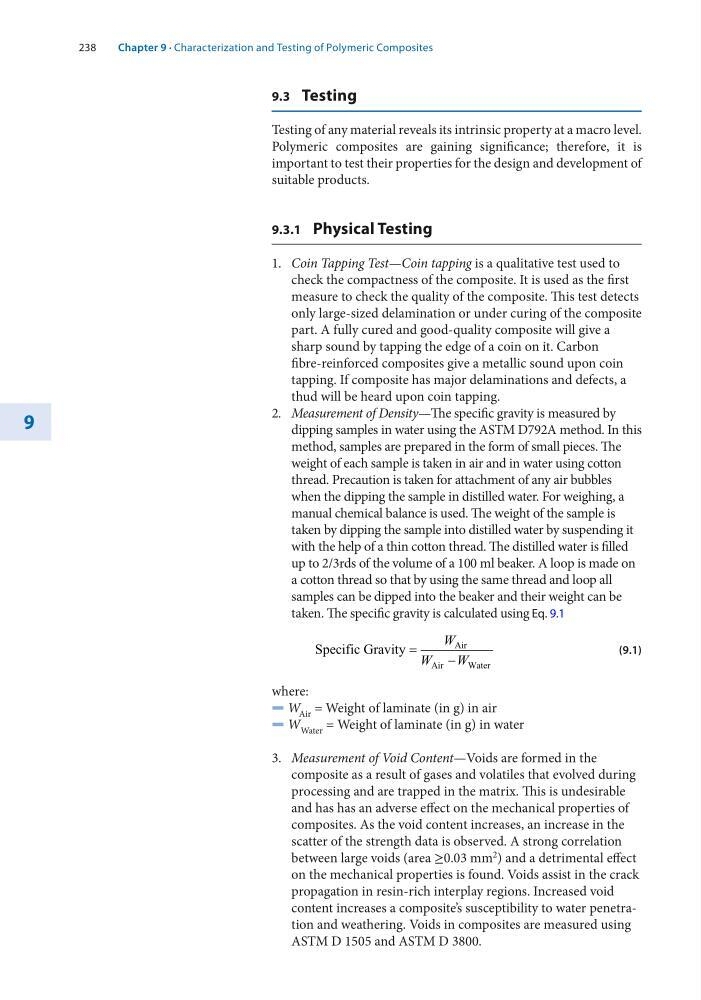
taken. The specific gravity is calculated using Eq. 9.1
Specific Gravity
Air
Air
Water
=
-
W
W
W
(9.1)
where:
5 W Air = Weight of laminate (in g) in air
5 W Water = Weight of laminate (in g) in water
3. Measurement of Void Content—Voids are formed in the
composite as a result of gases and volatiles that evolved during
processing and are trapped in the matrix. This is undesirable
and has has an adverse effect on the mechanical properties of
composites. As the void content increases, an increase in the
scatter of the strength data is observed. A strong correlation
between large voids (area ≥0.03 mm 2 ) and a detrimental effect
on the mechanical properties is found. Voids assist in the crack
propagation in resin- rich interplay regions. Increased void
content increases a composite’s susceptibility to water penetration and weathering. Voids in composites are measured using
ASTM D 1505 and ASTM D 3800.
Chapter 9 · Characterization and Testing of Polymeric Composites
9
9.3 Testing
Testing of any material reveals its intrinsic property at a macro level.
Polymeric composites are gaining significance; therefore, it is
important to test their properties for the design and development of
suitable products.
9.3.1 Physical Testing
1. Coin Tapping Test—Coin tapping is a qualitative test used to
check the compactness of the composite. It is used as the first
measure to check the quality of the composite. This test detects
only large-sized delamination or under curing of the composite
part. A fully cured and good-quality composite will give a
sharp sound by tapping the edge of a coin on it. Carbon
fibre- reinforced composites give a metallic sound upon coin
tapping. If composite has major delaminations and defects, a
thud will be heard upon coin tapping.
2. Measurement of Density—The specific gravity is measured by
dipping samples in water using the ASTM D792A method. In this
method, samples are prepared in the form of small pieces. The
weight of each sample is taken in air and in water using cotton
thread. Precaution is taken for attachment of any air bubbles
when the dipping the sample in distilled water. For weighing, a
manual chemical balance is used. The weight of the sample is
taken by dipping the sample into distilled water by suspending it
with the help of a thin cotton thread. The distilled water is filled
up to 2/3rds of the volume of a 100 ml beaker. A loop is made on
a cotton thread so that by using the same thread and loop all
samples can be dipped into the beaker and their weight can be
taken. The specific gravity is calculated using Eq. 9.1
Specific Gravity
Air
Air
Water
=
-
W
W
W
(9.1)
where:
5 W Air = Weight of laminate (in g) in air
5 W Water = Weight of laminate (in g) in water
3. Measurement of Void Content—Voids are formed in the
composite as a result of gases and volatiles that evolved during
processing and are trapped in the matrix. This is undesirable
and has has an adverse effect on the mechanical properties of
composites. As the void content increases, an increase in the
scatter of the strength data is observed. A strong correlation
between large voids (area ≥0.03 mm 2 ) and a detrimental effect
on the mechanical properties is found. Voids assist in the crack
propagation in resin- rich interplay regions. Increased void
content increases a composite’s susceptibility to water penetration and weathering. Voids in composites are measured using
ASTM D 1505 and ASTM D 3800.
Chapter 9 · Characterization and Testing of Polymeric Composites