

239
9
The void content of a composite significantly affects its
physical, mechanical, thermal, and electrical properties. The
measurement of void content is carried out using ASTM
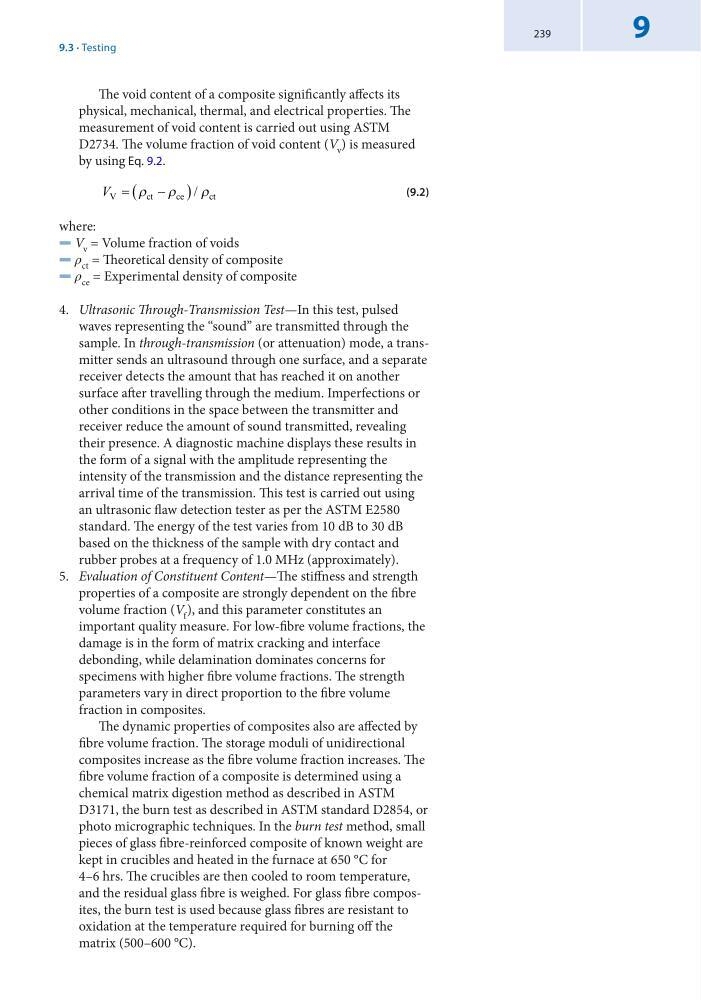
D2734. The volume fraction of void content (V v ) is measured
by using Eq. 9.2.
V V
c t
c e
c t
=
-
(
)
r
r
r
/
(9.2)
where:
5 V v = Volume fraction of voids
5 ρ ct = Theoretical density of composite
5 ρ ce = Experimental density of composite
4. Ultrasonic Through-Transmission Test—In this test, pulsed
waves representing the “sound” are transmitted through the
sample. In through-transmission (or attenuation) mode, a transmitter sends an ultrasound through one surface, and a separate
receiver detects the amount that has reached it on another
surface after travelling through the medium. Imperfections or
other conditions in the space between the transmitter and
receiver reduce the amount of sound transmitted, revealing
their presence. A diagnostic machine displays these results in
the form of a signal with the amplitude representing the
intensity of the transmission and the distance representing the
arrival time of the transmission. This test is carried out using
an ultrasonic flaw detection tester as per the ASTM E2580
standard. The energy of the test varies from 10 dB to 30 dB
based on the thickness of the sample with dry contact and
rubber probes at a frequency of 1.0 MHz (approximately).
5. Evaluation of Constituent Content—The stiffness and strength
properties of a composite are strongly dependent on the fibre
volume fraction (V f ), and this parameter constitutes an
important quality measure. For low-fibre volume fractions, the
damage is in the form of matrix cracking and interface
debonding, while delamination dominates concerns for
specimens with higher fibre volume fractions. The strength
parameters vary in direct proportion to the fibre volume
fraction in composites.
The dynamic properties of composites also are affected by
fibre volume fraction. The storage moduli of unidirectional
composites increase as the fibre volume fraction increases. The
fibre volume fraction of a composite is determined using a
chemical matrix digestion method as described in ASTM
D3171, the burn test as described in ASTM standard D2854, or
photo micrographic techniques. In the burn test method, small
pieces of glass fibre- reinforced composite of known weight are
kept in crucibles and heated in the furnace at 650 °C for
4–6 hrs. The crucibles are then cooled to room temperature,
and the residual glass fibre is weighed. For glass fibre composites, the burn test is used because glass fibres are resistant to
oxidation at the temperature required for burning off the
matrix (500–600 °C).
9.3 · Testing
9
The void content of a composite significantly affects its
physical, mechanical, thermal, and electrical properties. The
measurement of void content is carried out using ASTM
D2734. The volume fraction of void content (V v ) is measured
by using Eq. 9.2.
V V
c t
c e
c t
=
-
(
)
r
r
r
/
(9.2)
where:
5 V v = Volume fraction of voids
5 ρ ct = Theoretical density of composite
5 ρ ce = Experimental density of composite
4. Ultrasonic Through-Transmission Test—In this test, pulsed
waves representing the “sound” are transmitted through the
sample. In through-transmission (or attenuation) mode, a transmitter sends an ultrasound through one surface, and a separate
receiver detects the amount that has reached it on another
surface after travelling through the medium. Imperfections or
other conditions in the space between the transmitter and
receiver reduce the amount of sound transmitted, revealing
their presence. A diagnostic machine displays these results in
the form of a signal with the amplitude representing the
intensity of the transmission and the distance representing the
arrival time of the transmission. This test is carried out using
an ultrasonic flaw detection tester as per the ASTM E2580
standard. The energy of the test varies from 10 dB to 30 dB
based on the thickness of the sample with dry contact and
rubber probes at a frequency of 1.0 MHz (approximately).
5. Evaluation of Constituent Content—The stiffness and strength
properties of a composite are strongly dependent on the fibre
volume fraction (V f ), and this parameter constitutes an
important quality measure. For low-fibre volume fractions, the
damage is in the form of matrix cracking and interface
debonding, while delamination dominates concerns for
specimens with higher fibre volume fractions. The strength
parameters vary in direct proportion to the fibre volume
fraction in composites.
The dynamic properties of composites also are affected by
fibre volume fraction. The storage moduli of unidirectional
composites increase as the fibre volume fraction increases. The
fibre volume fraction of a composite is determined using a
chemical matrix digestion method as described in ASTM
D3171, the burn test as described in ASTM standard D2854, or
photo micrographic techniques. In the burn test method, small
pieces of glass fibre- reinforced composite of known weight are
kept in crucibles and heated in the furnace at 650 °C for
4–6 hrs. The crucibles are then cooled to room temperature,
and the residual glass fibre is weighed. For glass fibre composites, the burn test is used because glass fibres are resistant to
oxidation at the temperature required for burning off the
matrix (500–600 °C).
9.3 · Testing