

236
9
tivity of composites is caused by a low atomic density, weak
interactions or bonds, etc.
ASTM D5930–09 is the standard test method for finding
the thermal conductivity of plastics. This test method determines the thermal conductivity of plastics or composites over a
temperature range from −40 to 400 °C. The thermal conductivity of thermoplastics, thermosets, rubbers, and composites is in
the range from 0.08 to 2.0 W/m.K.
9.2.2 Morphology
Morphology is the study of the shape, size, texture, and phase distribution of the constituents in the composite material.
1. Visual Evaluation—The morphology of composites is revealed
by visual inspection. A patchy appearance on the composite
implies that the volume fractions of resin and reinforcement
are not even. Moreover, some stain marks indicate hot spots
where the resin became over cured, leading to degradation.
Such areas are mechanically weaker than the rest of the
composite.
2. Scanning Electron Microscopy (SEM)—SEM is used to analyse
the topography of any material (e.g. composite sample). Its
depth of penetration is small (approximately 30 nm). SEM can
achieve a resolution better than 1 nm. The surface of the
composite needs to metallized by coating it by gold. The
scanning electron microscope uses a focused beam of highenergy electrons to generate a variety of signals at the surface
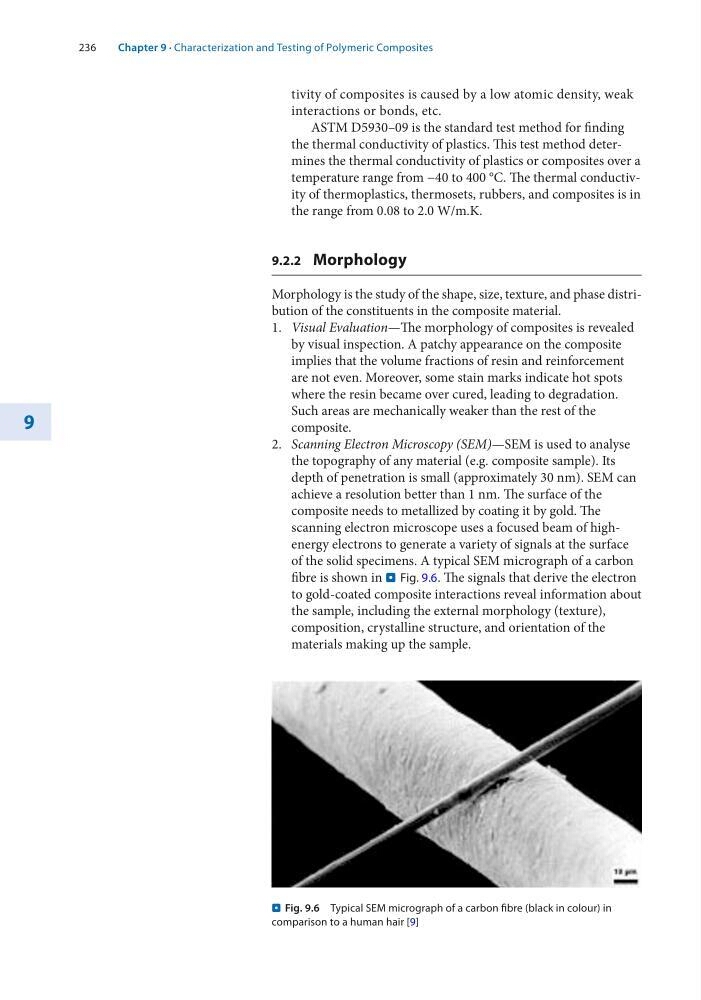
of the solid specimens. A typical SEM micrograph of a carbon
fibre is shown in . Fig. 9.6. The signals that derive the electron
to gold-coated composite interactions reveal information about
the sample, including the external morphology (texture),
composition, crystalline structure, and orientation of the
materials making up the sample.
. Fig. 9.6 Typical SEM micrograph of a carbon fibre (black in colour) in
comparison to a human hair [9]
Chapter 9 · Characterization and Testing of Polymeric Composites
9
tivity of composites is caused by a low atomic density, weak
interactions or bonds, etc.
ASTM D5930–09 is the standard test method for finding
the thermal conductivity of plastics. This test method determines the thermal conductivity of plastics or composites over a
temperature range from −40 to 400 °C. The thermal conductivity of thermoplastics, thermosets, rubbers, and composites is in
the range from 0.08 to 2.0 W/m.K.
9.2.2 Morphology
Morphology is the study of the shape, size, texture, and phase distribution of the constituents in the composite material.
1. Visual Evaluation—The morphology of composites is revealed
by visual inspection. A patchy appearance on the composite
implies that the volume fractions of resin and reinforcement
are not even. Moreover, some stain marks indicate hot spots
where the resin became over cured, leading to degradation.
Such areas are mechanically weaker than the rest of the
composite.
2. Scanning Electron Microscopy (SEM)—SEM is used to analyse
the topography of any material (e.g. composite sample). Its
depth of penetration is small (approximately 30 nm). SEM can
achieve a resolution better than 1 nm. The surface of the
composite needs to metallized by coating it by gold. The
scanning electron microscope uses a focused beam of highenergy electrons to generate a variety of signals at the surface
of the solid specimens. A typical SEM micrograph of a carbon
fibre is shown in . Fig. 9.6. The signals that derive the electron
to gold-coated composite interactions reveal information about
the sample, including the external morphology (texture),
composition, crystalline structure, and orientation of the
materials making up the sample.
. Fig. 9.6 Typical SEM micrograph of a carbon fibre (black in colour) in
comparison to a human hair [9]
Chapter 9 · Characterization and Testing of Polymeric Composites