

235
9
transforms the uncured or partially cured resins into a fully
cured solid resin. The cure pressure provides the necessary force
that is required for the flow and percolation of the viscous resin
around fibres. The cure pressure also provides a desired shape
and compaction to the composite. The amount of temperature
and pressure as well as their duration significantly affects the
performance of the composites. The length of time, with
respect to temperature and pressure, required to cure composites is called the cure cycle. The cure cycle is dependent on the
resin chemistry, morphology, thermal activity, and additives
(such as inhibitors or accelerators) [8].
The curing cycle has various parameters. For room temperature curing resin systems, an important parameter is gel
time. It is tested for initiation of curing. It is a test which
determines the time duration for on set of cross-linking, i.e.
gelation of resin system. Time duration of gelation varies with
temperature. Gelation time reduces with increase in temperature. Gelation leads to cross-linking of room and a solid mass
is formed.
For a high-temperature curing resin system, the process of
gelation leading to cross-linking begins at the same temperature from which the chemical reaction for cross-linking is
initiated. Once the cross-linking is completed, the resin will
twin into a solved mass. The cross-linking reaction is an
irreversible reaction.
Full cross-linking causes complete curing of the resin. It
can be said that a full degree of cure signifies a complete
cross-linking of the matrix resin.
6. Thermal Conductivity—The thermal conductivity of polymeric composites is quite poor—except for carbon fibrereinforced composites. Even in carbon fibre-reinforced
composites, the heat conductivity is limited due to presence
of a nonconducting resin matrix. The low thermal conducTemperature (°C)
4000
3000
2000
1000
0
0
50
100 150 200 250 300 350
227. 75 °C
232. 61°C
+ +
118.49 °C
227. 13 °C
234.09 °C
219.82 °C
800
600
400
200
Loss modulus (Mpa) [– – –]
Storage modulus (Mpa) [– .
–]
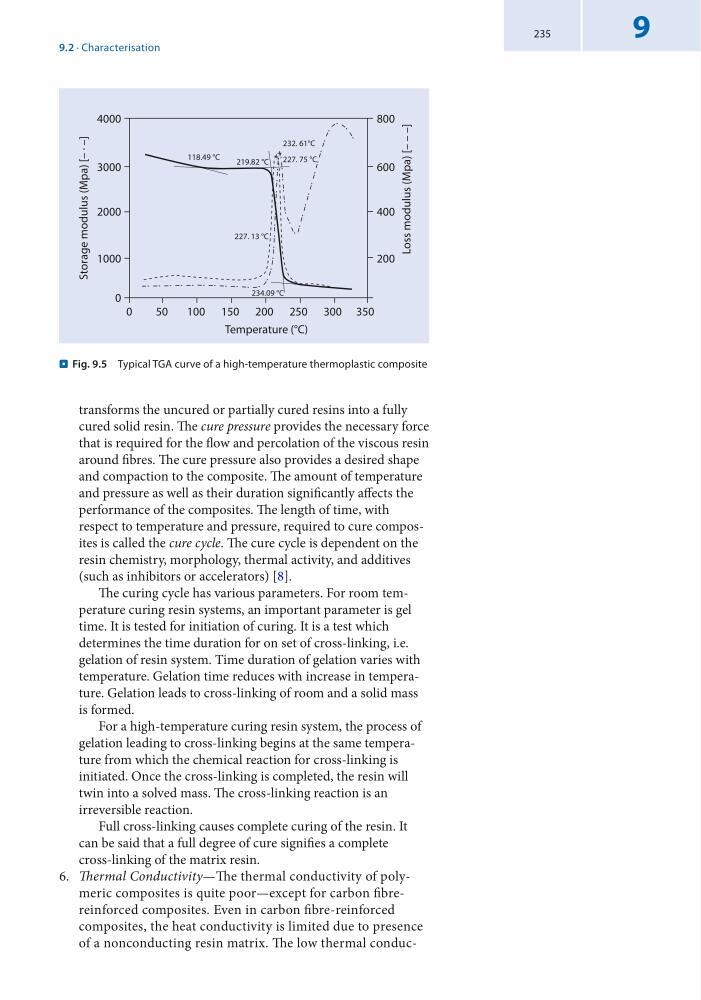
. Fig. 9.5 Typical TGA curve of a high-temperature thermoplastic composite
9.2 · Characterisation
9
transforms the uncured or partially cured resins into a fully
cured solid resin. The cure pressure provides the necessary force
that is required for the flow and percolation of the viscous resin
around fibres. The cure pressure also provides a desired shape
and compaction to the composite. The amount of temperature
and pressure as well as their duration significantly affects the
performance of the composites. The length of time, with
respect to temperature and pressure, required to cure composites is called the cure cycle. The cure cycle is dependent on the
resin chemistry, morphology, thermal activity, and additives
(such as inhibitors or accelerators) [8].
The curing cycle has various parameters. For room temperature curing resin systems, an important parameter is gel
time. It is tested for initiation of curing. It is a test which
determines the time duration for on set of cross-linking, i.e.
gelation of resin system. Time duration of gelation varies with
temperature. Gelation time reduces with increase in temperature. Gelation leads to cross-linking of room and a solid mass
is formed.
For a high-temperature curing resin system, the process of
gelation leading to cross-linking begins at the same temperature from which the chemical reaction for cross-linking is
initiated. Once the cross-linking is completed, the resin will
twin into a solved mass. The cross-linking reaction is an
irreversible reaction.
Full cross-linking causes complete curing of the resin. It
can be said that a full degree of cure signifies a complete
cross-linking of the matrix resin.
6. Thermal Conductivity—The thermal conductivity of polymeric composites is quite poor—except for carbon fibrereinforced composites. Even in carbon fibre-reinforced
composites, the heat conductivity is limited due to presence
of a nonconducting resin matrix. The low thermal conducTemperature (°C)
4000
3000
2000
1000
0
0
50
100 150 200 250 300 350
227. 75 °C
232. 61°C
+ +
118.49 °C
227. 13 °C
234.09 °C
219.82 °C
800
600
400
200
Loss modulus (Mpa) [– – –]
Storage modulus (Mpa) [– .
–]
. Fig. 9.5 Typical TGA curve of a high-temperature thermoplastic composite
9.2 · Characterisation