

196
7
Preforms and prepregs are used for the processing of polymeric
composites for excercising better control over the properties and
dimensional control on the moulded product. They provide a flexible window for the processing of polymeric composites. The greatest advantage of using prepregs is their ease of use. If the polymeric
composites are made by using liquid resin in a matched die moulding process, there would be a need to use fabric, matrix, and other
additives for fabrication of the composite product. Most thermosetting matrix systems are considered hazardous when coupled with
messy handling of liquid resins. Prepregs come in the form of dry or
sticky roll and has the desired amount of both resin and hardener
already impregnated in the fabric.
Most thermosetting prepregs come with a separation film on
both sides of the fabric to protect it from dust and contamination,
prevent the sticking of adjacent layers of prepreg in the roll, and
make transportation easier. The prepreg is then cut to the desired
shape, the separation film is peeled off, and the prepreg is then laid
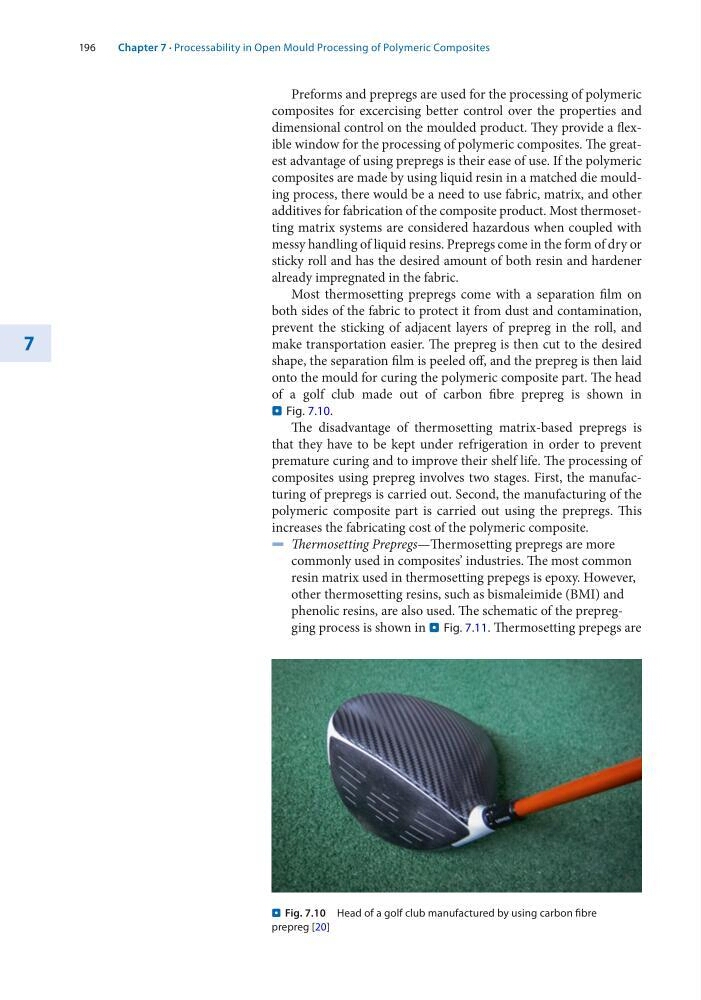
onto the mould for curing the polymeric composite part. The head
of a golf club made out of carbon fibre prepreg is shown in
. Fig. 7.10.
The disadvantage of thermosetting matrix-based prepregs is
that they have to be kept under refrigeration in order to prevent
premature curing and to improve their shelf life. The processing of
composites using prepreg involves two stages. First, the manufacturing of prepregs is carried out. Second, the manufacturing of the
polymeric composite part is carried out using the prepregs. This
increases the fabricating cost of the polymeric composite.
5 Thermosetting Prepregs—Thermosetting prepregs are more
commonly used in composites’ industries. The most common
resin matrix used in thermosetting prepegs is epoxy. However,
other thermosetting resins, such as bismaleimide (BMI) and
phenolic resins, are also used. The schematic of the prepregging process is shown in . Fig. 7.11. Thermosetting prepegs are
. Fig. 7.10 Head of a golf club manufactured by using carbon fibre
prepreg [20]
Chapter 7 · Processability in Open Mould Processing of Polymeric Composites
7
Preforms and prepregs are used for the processing of polymeric
composites for excercising better control over the properties and
dimensional control on the moulded product. They provide a flexible window for the processing of polymeric composites. The greatest advantage of using prepregs is their ease of use. If the polymeric
composites are made by using liquid resin in a matched die moulding process, there would be a need to use fabric, matrix, and other
additives for fabrication of the composite product. Most thermosetting matrix systems are considered hazardous when coupled with
messy handling of liquid resins. Prepregs come in the form of dry or
sticky roll and has the desired amount of both resin and hardener
already impregnated in the fabric.
Most thermosetting prepregs come with a separation film on
both sides of the fabric to protect it from dust and contamination,
prevent the sticking of adjacent layers of prepreg in the roll, and
make transportation easier. The prepreg is then cut to the desired
shape, the separation film is peeled off, and the prepreg is then laid
onto the mould for curing the polymeric composite part. The head
of a golf club made out of carbon fibre prepreg is shown in
. Fig. 7.10.
The disadvantage of thermosetting matrix-based prepregs is
that they have to be kept under refrigeration in order to prevent
premature curing and to improve their shelf life. The processing of
composites using prepreg involves two stages. First, the manufacturing of prepregs is carried out. Second, the manufacturing of the
polymeric composite part is carried out using the prepregs. This
increases the fabricating cost of the polymeric composite.
5 Thermosetting Prepregs—Thermosetting prepregs are more
commonly used in composites’ industries. The most common
resin matrix used in thermosetting prepegs is epoxy. However,
other thermosetting resins, such as bismaleimide (BMI) and
phenolic resins, are also used. The schematic of the prepregging process is shown in . Fig. 7.11. Thermosetting prepegs are
. Fig. 7.10 Head of a golf club manufactured by using carbon fibre
prepreg [20]
Chapter 7 · Processability in Open Mould Processing of Polymeric Composites