

195
7
constitutes one ply in the construction of a multi-ply layup.
Impregnated roving is wound onto cores or bobbins and is used for
filament winding. Once the resin mixture has been impregnated
onto the fibres, the prepreg must be stored in a refrigerator or
freezer. The cold storage prevents the chemical reaction from occurring prematurely and causing cross-linking of the matrix. Prepreg
materials are used widely in advanced composite industries, particularly in the aerospace industry.
The term preform is short for prefabricated form. Preforms are
made by braiding, weaving, and/or cutting and stitching the reinforcing fabric into the desired shape. Preforms are the pre-shaped
reinforcement that ensures the firm, positional placement of the
reinforcement and avoids the placement of the reinforcement layer
by layer. The placement of reinforcement layer by layer is timeconsuming and delays the total processing cycle. Preforms in a
desired shape and size may be prepared separately. After impregnation and curing, the preform will result into a final product.
Preforms enhance the processability of polymeric composites.
Preforms are often used in a resin transfer moulding (RTM) process. Preform- based moulding is required where high-dimensional
accuracies and consistency in the properties of polymeric composite are needed. Glass braiding-reinforced thermoplastic pipes are
shown in . Fig. 7.9.
Prepregs in composites are becoming increasingly common due
to their ease of use, consistent properties, and high-quality surface
finish. Different types of resins, including the majority of thermoset
and thermoplastic matrices, are used in making prepregs. The processibility of polymeric composites is influenced by the properties
of the prepreg. Prepregs limit the deviation in processing parameters and processability to a great extent. Many of the processability
issues related to reinforcement and matrix in terms of their volume
fractions are well controlled with prepregs.
. Fig. 7.9 Glass braiding-reinforced thermoplastic pipes [19]
7.1 · Open Mould Processing Technologies
7
constitutes one ply in the construction of a multi-ply layup.
Impregnated roving is wound onto cores or bobbins and is used for
filament winding. Once the resin mixture has been impregnated
onto the fibres, the prepreg must be stored in a refrigerator or
freezer. The cold storage prevents the chemical reaction from occurring prematurely and causing cross-linking of the matrix. Prepreg
materials are used widely in advanced composite industries, particularly in the aerospace industry.
The term preform is short for prefabricated form. Preforms are
made by braiding, weaving, and/or cutting and stitching the reinforcing fabric into the desired shape. Preforms are the pre-shaped
reinforcement that ensures the firm, positional placement of the
reinforcement and avoids the placement of the reinforcement layer
by layer. The placement of reinforcement layer by layer is timeconsuming and delays the total processing cycle. Preforms in a
desired shape and size may be prepared separately. After impregnation and curing, the preform will result into a final product.
Preforms enhance the processability of polymeric composites.
Preforms are often used in a resin transfer moulding (RTM) process. Preform- based moulding is required where high-dimensional
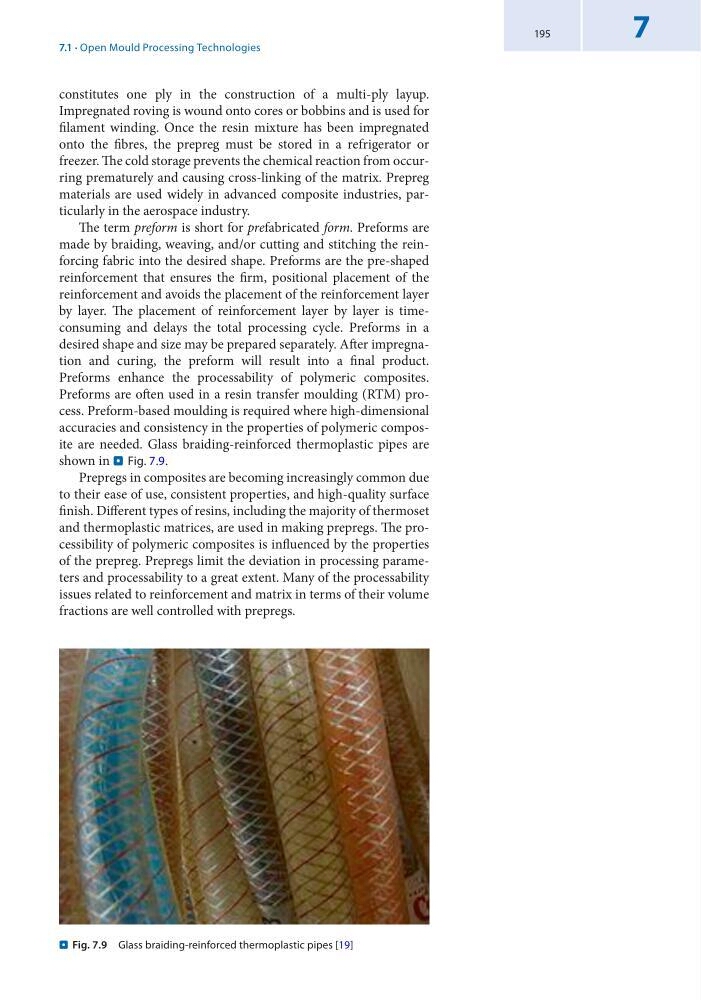
accuracies and consistency in the properties of polymeric composite are needed. Glass braiding-reinforced thermoplastic pipes are
shown in . Fig. 7.9.
Prepregs in composites are becoming increasingly common due
to their ease of use, consistent properties, and high-quality surface
finish. Different types of resins, including the majority of thermoset
and thermoplastic matrices, are used in making prepregs. The processibility of polymeric composites is influenced by the properties
of the prepreg. Prepregs limit the deviation in processing parameters and processability to a great extent. Many of the processability
issues related to reinforcement and matrix in terms of their volume
fractions are well controlled with prepregs.
. Fig. 7.9 Glass braiding-reinforced thermoplastic pipes [19]
7.1 · Open Mould Processing Technologies