

197
7
sandwiched between two separating films (commonly lowdensity polyethylene film) so that the adjacent layers don’t stick
together during storage.
5 Thermoplastic Prepregs—In thermoplastic prepregs, thermoplastic resins are used. Unlike thermosetting prepregs, thermoplastic prepregs do not have various stages and thickness. They
are dry prepregs, and on the application of heat and pressure,
they consolidate in the form of composites. Thermoplastic
prepregs incorporating fibreglass, carbon fibre, aramid, etc. as
reinforcement and PP, PET, PE, PP, PEEK, etc. as resin matrices
are available.
The primary difference between thermosetting and
thermoplastic prepregs is that thermoplastic prepregs are stable
at room temperature and generally have a longer shelf life
compared to thermosetting prepregs.
In thermosetting prepregs, the thermosetting resin is in a
liquid state and is applied on the fabric or tape so that it fully
impregnates the fibre reinforcement. Excess resin is precisely
removed from the reinforcement. Meanwhile, the resin
undergoes partial curing (i.e. changing the state of the resin
from liquid to semisolid). This is known as the B-stage. In the
B-stage, the resin is partially cured and usually feels tacky.
When the resin is brought up to its curing temperature, it often
returns briefly to a liquid state prior to cross-linking (hardening) completely. This helps in the percolation of the resin
among the filaments of the reinforcement due to the low
viscosity of the resin. Once cured, the thermoset resin that was
in the B-stage gets fully cross- linked. This cross-linked stage is
called the C-stage.
4
To solvent recovery
3
6
7
8
5
2
1
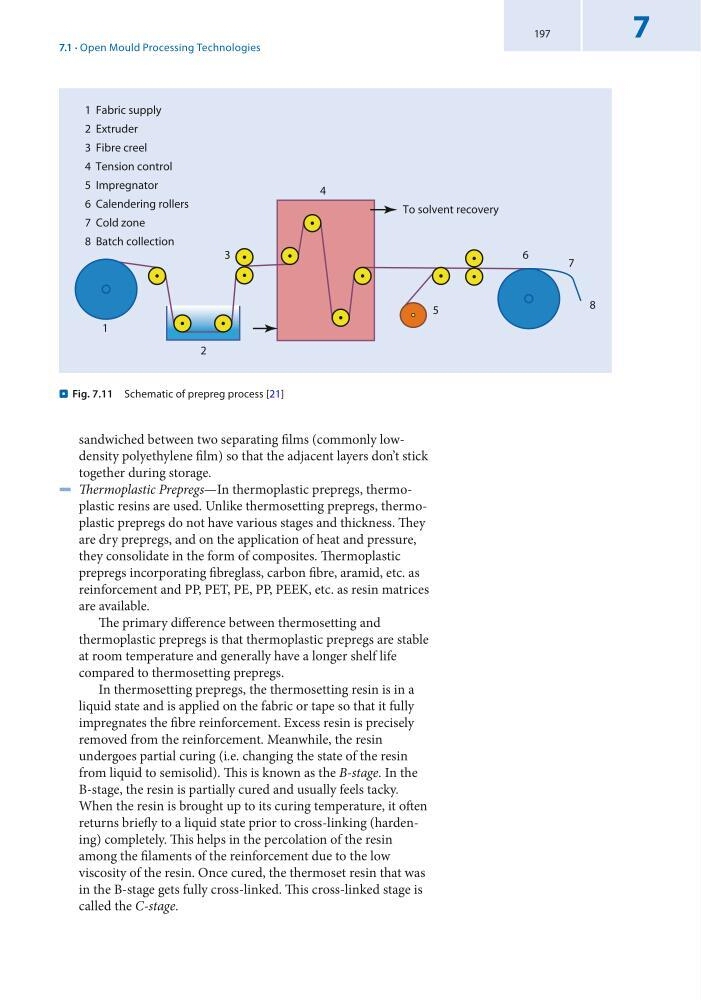
1 Fabric supply
2 Extruder
3 Fibre creel
4 Tension control
5 Impregnator
6 Calendering rollers
7 Cold zone
8 Batch collection
. Fig. 7.11 Schematic of prepreg process [21]
7.1 · Open Mould Processing Technologies
7
sandwiched between two separating films (commonly lowdensity polyethylene film) so that the adjacent layers don’t stick
together during storage.
5 Thermoplastic Prepregs—In thermoplastic prepregs, thermoplastic resins are used. Unlike thermosetting prepregs, thermoplastic prepregs do not have various stages and thickness. They
are dry prepregs, and on the application of heat and pressure,
they consolidate in the form of composites. Thermoplastic
prepregs incorporating fibreglass, carbon fibre, aramid, etc. as
reinforcement and PP, PET, PE, PP, PEEK, etc. as resin matrices
are available.
The primary difference between thermosetting and
thermoplastic prepregs is that thermoplastic prepregs are stable
at room temperature and generally have a longer shelf life
compared to thermosetting prepregs.
In thermosetting prepregs, the thermosetting resin is in a
liquid state and is applied on the fabric or tape so that it fully
impregnates the fibre reinforcement. Excess resin is precisely
removed from the reinforcement. Meanwhile, the resin
undergoes partial curing (i.e. changing the state of the resin
from liquid to semisolid). This is known as the B-stage. In the
B-stage, the resin is partially cured and usually feels tacky.
When the resin is brought up to its curing temperature, it often
returns briefly to a liquid state prior to cross-linking (hardening) completely. This helps in the percolation of the resin
among the filaments of the reinforcement due to the low
viscosity of the resin. Once cured, the thermoset resin that was
in the B-stage gets fully cross- linked. This cross-linked stage is
called the C-stage.
4
To solvent recovery
3
6
7
8
5
2
1
1 Fabric supply
2 Extruder
3 Fibre creel
4 Tension control
5 Impregnator
6 Calendering rollers
7 Cold zone
8 Batch collection
. Fig. 7.11 Schematic of prepreg process [21]
7.1 · Open Mould Processing Technologies