

191
7
(approximately 5 mm) offered by rovings and tows after being
spread on the mandrel. However, the number of passes
required by tape having a width of approximately 100 mm is
much less than that of roving and tow winding. Thus, the
processing is reduced. The tape laying of thermoplastics also
has been tried; however, the overall interest in this process
dwindled due to complexities of processing and the highenergy requirement that did not measure up to the viable
economies of production. Most tape laying of thermoplastics
involves hot shoes or laser welding. Some work on PEEK has
been carried out using an amorphous film carrier, which
becomes molten material when heated. This severely limits the
temperature capability of the system, but it does not provide
good laminates without subsequent autoclave compaction.
5 Processability Parameters—The following are the processability
parameters for automated tape winding technology.
5 Winding path—In this technology, the tape can be wound
on a geodesic path only. A non-geodesic path will not allow
the wound tape to remain at a required position; rather, they
will slip away.
5 Tensile strength of tape—In tape winding technology, tape is
wound under tension. Therefore, it is essential that the tape
must have high enough tensile strength to sustain the force
of winding.
5 Tackiness—Tackiness is an important processability parameter in tape winding technology. Low tackiness of prepregged tape does not allow it to remain on its wound
position; therefore, the quality of composite deteriorates.
Only good tackiness allows the processability of prepregged
tape in a tape winding process. The tackiness is ensured by
the ‘B’ staging of the matrix resin in the tape prepreg and its
proper storage thereafter.
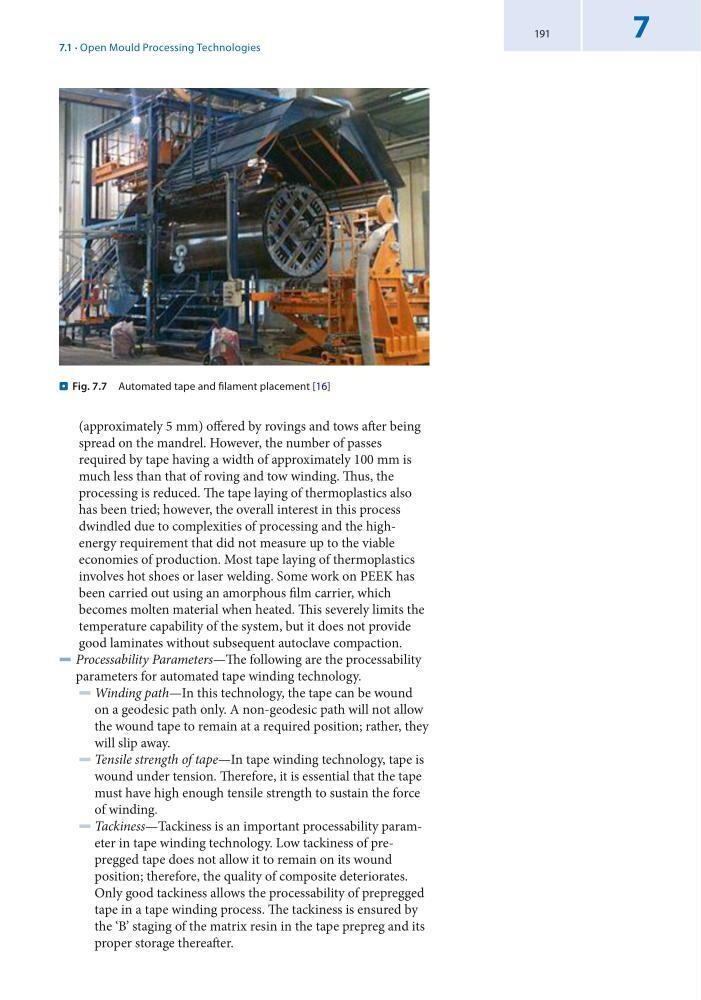
. Fig. 7.7 Automated tape and filament placement [16]
7.1 · Open Mould Processing Technologies
7
(approximately 5 mm) offered by rovings and tows after being
spread on the mandrel. However, the number of passes
required by tape having a width of approximately 100 mm is
much less than that of roving and tow winding. Thus, the
processing is reduced. The tape laying of thermoplastics also
has been tried; however, the overall interest in this process
dwindled due to complexities of processing and the highenergy requirement that did not measure up to the viable
economies of production. Most tape laying of thermoplastics
involves hot shoes or laser welding. Some work on PEEK has
been carried out using an amorphous film carrier, which
becomes molten material when heated. This severely limits the
temperature capability of the system, but it does not provide
good laminates without subsequent autoclave compaction.
5 Processability Parameters—The following are the processability
parameters for automated tape winding technology.
5 Winding path—In this technology, the tape can be wound
on a geodesic path only. A non-geodesic path will not allow
the wound tape to remain at a required position; rather, they
will slip away.
5 Tensile strength of tape—In tape winding technology, tape is
wound under tension. Therefore, it is essential that the tape
must have high enough tensile strength to sustain the force
of winding.
5 Tackiness—Tackiness is an important processability parameter in tape winding technology. Low tackiness of prepregged tape does not allow it to remain on its wound
position; therefore, the quality of composite deteriorates.
Only good tackiness allows the processability of prepregged
tape in a tape winding process. The tackiness is ensured by
the ‘B’ staging of the matrix resin in the tape prepreg and its
proper storage thereafter.
. Fig. 7.7 Automated tape and filament placement [16]
7.1 · Open Mould Processing Technologies