

192
7
7.1.6 Vacuum Infusion (VI) Technology
5 Processing Technology—The vacuum infusion process is akin to
vacuum bagging. In this process, reinforcement is placed
between the mould and the vacuum bag, and then the vacuum
is applied. While under the vacuum, the resin is applied on the
reinforcement so that the reinforcement is impregnated. Due to
the vacuum process, the resin is sucked very efficiently inside
the vacuum bag and penetrates all over the reinforcement. The
pressure in vacuum infusion technology is kept at 0.5–10 bars
inside the vacuum bag.
Open moulds are used in this process. The reinforcement
and core material are laid to dry in the mould. This is done
manually with precise positioning of the reinforcement. When
the resin is sucked into the mould, the laminate is already
compacted; therefore, there is no room for excess resin.
Excellent volume fraction of the reinforcement is possible
with vacuum infusion. Therefore, mechanical properties of
the laminate are excellent. Vacuum infusion is suitable to
mould very large structures, but the production rate in this
process is low.
In order to achieve glossy outer surfaces, a mould may be gel
coated. After curing of the gel coat, the dry reinforcement is
placed in the mould. The reinforcement includes a reinforcing
fabric or mat and core material if required. A perforated release
film is placed over the dry reinforcement. A mesh or a ‘crinkle’ ply
is positioned to facilitate the distribution of the resin across the
reinforcement. The vacuum bag is then positioned and sealed at
the edges of the mould. The vacuum bag is connected to the resin
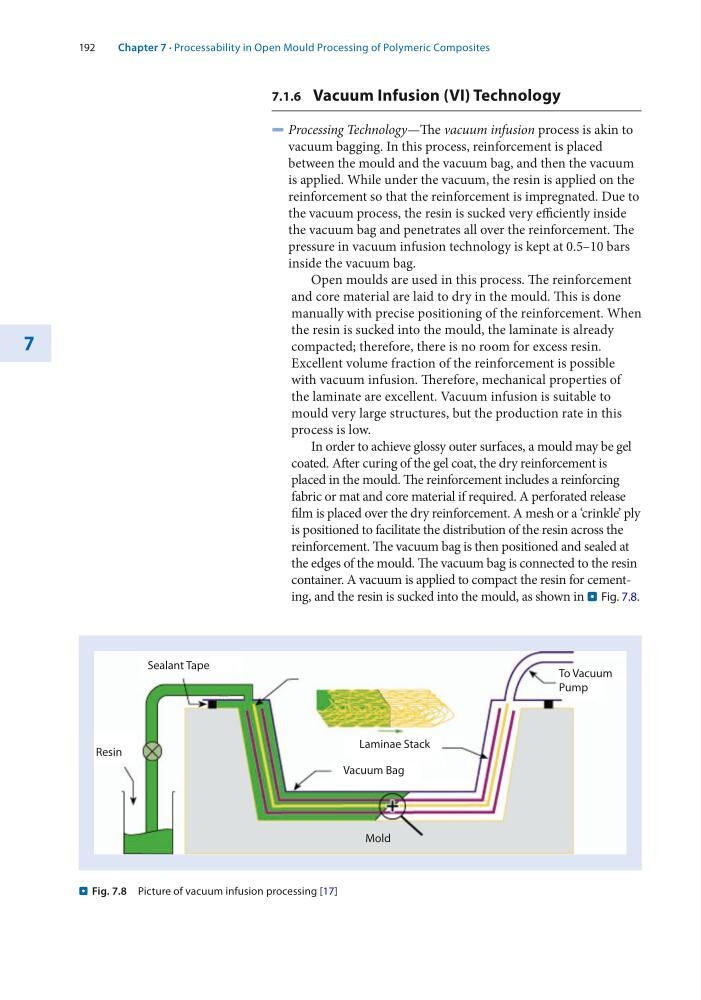
container. A vacuum is applied to compact the resin for cementing, and the resin is sucked into the mould, as shown in . Fig. 7.8.
Sealant Tape
Resin
Laminae Stack
Vacuum Bag
To Vacuum
Pump
Mold
. Fig. 7.8 Picture of vacuum infusion processing [17]
Chapter 7 · Processability in Open Mould Processing of Polymeric Composites
7
7.1.6 Vacuum Infusion (VI) Technology
5 Processing Technology—The vacuum infusion process is akin to
vacuum bagging. In this process, reinforcement is placed
between the mould and the vacuum bag, and then the vacuum
is applied. While under the vacuum, the resin is applied on the
reinforcement so that the reinforcement is impregnated. Due to
the vacuum process, the resin is sucked very efficiently inside
the vacuum bag and penetrates all over the reinforcement. The
pressure in vacuum infusion technology is kept at 0.5–10 bars
inside the vacuum bag.
Open moulds are used in this process. The reinforcement
and core material are laid to dry in the mould. This is done
manually with precise positioning of the reinforcement. When
the resin is sucked into the mould, the laminate is already
compacted; therefore, there is no room for excess resin.
Excellent volume fraction of the reinforcement is possible
with vacuum infusion. Therefore, mechanical properties of
the laminate are excellent. Vacuum infusion is suitable to
mould very large structures, but the production rate in this
process is low.
In order to achieve glossy outer surfaces, a mould may be gel
coated. After curing of the gel coat, the dry reinforcement is
placed in the mould. The reinforcement includes a reinforcing
fabric or mat and core material if required. A perforated release
film is placed over the dry reinforcement. A mesh or a ‘crinkle’ ply
is positioned to facilitate the distribution of the resin across the
reinforcement. The vacuum bag is then positioned and sealed at
the edges of the mould. The vacuum bag is connected to the resin
container. A vacuum is applied to compact the resin for cementing, and the resin is sucked into the mould, as shown in . Fig. 7.8.
Sealant Tape
Resin
Laminae Stack
Vacuum Bag
To Vacuum
Pump
Mold
. Fig. 7.8 Picture of vacuum infusion processing [17]
Chapter 7 · Processability in Open Mould Processing of Polymeric Composites