

167
6
5. Polybutylene Terephthalate (PBT)—PBT is one of the rarest
crystalline polyester-based thermoplastic. It is available in the
form of granules, fibres, sheets, and films. It is manufactured
using a polycondensation reaction of purified terephthalic acid
(PTA) or dimethyl terephthalate (DMT) with 1,4-butanediol
(BDO). Water from the reaction comes out as condensate. The
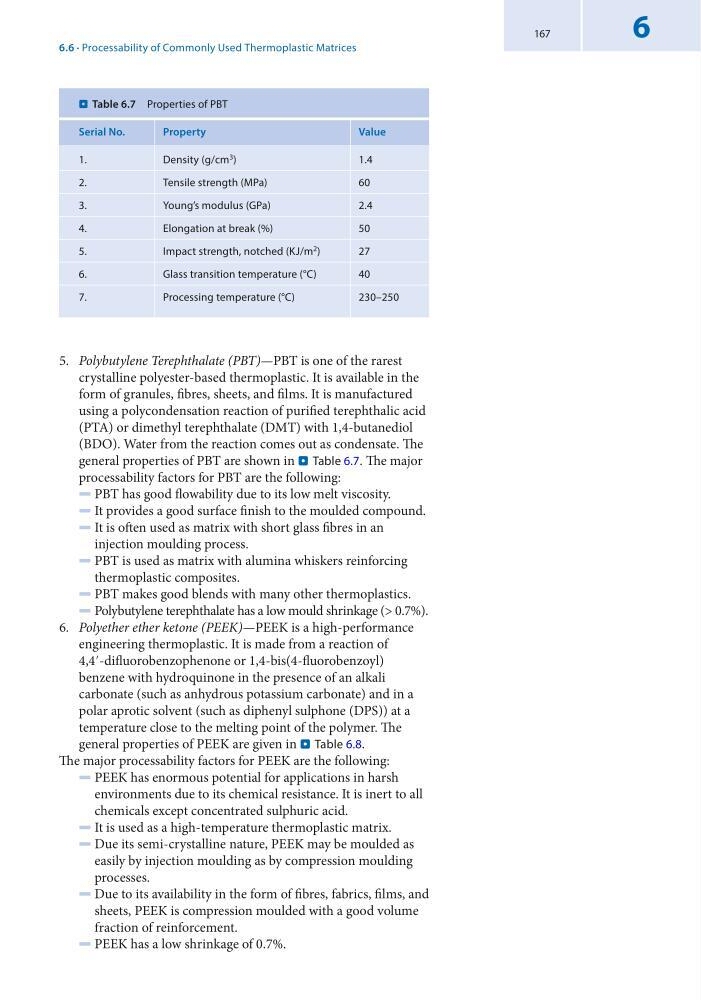
general properties of PBT are shown in . Table 6.7. The major
processability factors for PBT are the following:
5 PBT has good flowability due to its low melt viscosity.
5 It provides a good surface finish to the moulded compound.
5 It is often used as matrix with short glass fibres in an
injection moulding process.
5 PBT is used as matrix with alumina whiskers reinforcing
thermoplastic composites.
5 PBT makes good blends with many other thermoplastics.
5 Polybutylene terephthalate has a low mould shrinkage (> 0.7%).
6. Polyether ether ketone (PEEK)—PEEK is a high- performance
engineering thermoplastic. It is made from a reaction of
4,4′-difluorobenzophenone or 1,4-bis(4-fluorobenzoyl)
benzene with hydroquinone in the presence of an alkali
carbonate (such as anhydrous potassium carbonate) and in a
polar aprotic solvent (such as diphenyl sulphone (DPS)) at a
temperature close to the melting point of the polymer. The
general properties of PEEK are given in . Table 6.8.
The major processability factors for PEEK are the following:
5 PEEK has enormous potential for applications in harsh
environments due to its chemical resistance. It is inert to all
chemicals except concentrated sulphuric acid.
5 It is used as a high-temperature thermoplastic matrix.
5 Due its semi-crystalline nature, PEEK may be moulded as
easily by injection moulding as by compression moulding
processes.
5 Due to its availability in the form of fibres, fabrics, films, and
sheets, PEEK is compression moulded with a good volume
fraction of reinforcement.
5 PEEK has a low shrinkage of 0.7%.
. Table 6.7 Properties of PBT
Serial No.
Property
Value
1.
Density (g/cm 3 )
1.4
2.
Tensile strength (MPa)
60
3.
Young’s modulus (GPa)
2.4
4.
Elongation at break (%)
50
5.
Impact strength, notched (KJ/m 2 )
27
6.
Glass transition temperature (°C)
40
7.
Processing temperature (°C)
230–250
6.6 · Processability of Commonly Used Thermoplastic Matrices
6
5. Polybutylene Terephthalate (PBT)—PBT is one of the rarest
crystalline polyester-based thermoplastic. It is available in the
form of granules, fibres, sheets, and films. It is manufactured
using a polycondensation reaction of purified terephthalic acid
(PTA) or dimethyl terephthalate (DMT) with 1,4-butanediol
(BDO). Water from the reaction comes out as condensate. The
general properties of PBT are shown in . Table 6.7. The major
processability factors for PBT are the following:
5 PBT has good flowability due to its low melt viscosity.
5 It provides a good surface finish to the moulded compound.
5 It is often used as matrix with short glass fibres in an
injection moulding process.
5 PBT is used as matrix with alumina whiskers reinforcing
thermoplastic composites.
5 PBT makes good blends with many other thermoplastics.
5 Polybutylene terephthalate has a low mould shrinkage (> 0.7%).
6. Polyether ether ketone (PEEK)—PEEK is a high- performance
engineering thermoplastic. It is made from a reaction of
4,4′-difluorobenzophenone or 1,4-bis(4-fluorobenzoyl)
benzene with hydroquinone in the presence of an alkali
carbonate (such as anhydrous potassium carbonate) and in a
polar aprotic solvent (such as diphenyl sulphone (DPS)) at a
temperature close to the melting point of the polymer. The
general properties of PEEK are given in . Table 6.8.
The major processability factors for PEEK are the following:
5 PEEK has enormous potential for applications in harsh
environments due to its chemical resistance. It is inert to all
chemicals except concentrated sulphuric acid.
5 It is used as a high-temperature thermoplastic matrix.
5 Due its semi-crystalline nature, PEEK may be moulded as
easily by injection moulding as by compression moulding
processes.
5 Due to its availability in the form of fibres, fabrics, films, and
sheets, PEEK is compression moulded with a good volume
fraction of reinforcement.
5 PEEK has a low shrinkage of 0.7%.
. Table 6.7 Properties of PBT
Serial No.
Property
Value
1.
Density (g/cm 3 )
1.4
2.
Tensile strength (MPa)
60
3.
Young’s modulus (GPa)
2.4
4.
Elongation at break (%)
50
5.
Impact strength, notched (KJ/m 2 )
27
6.
Glass transition temperature (°C)
40
7.
Processing temperature (°C)
230–250
6.6 · Processability of Commonly Used Thermoplastic Matrices