

166
6
5 PC is hygroscopic in nature due to the presence of an ester
group. PC granules and sheets need drying to remove
moisture before moulding.
5 Polycarbonates are both injection and compression mouldable for the fabrication of thermoplastic composites.
5 PC has a low shrinkage (>0.5%).
4. Acrylonitrile Butadiene Styrene (ABS)—ABS is a terpolymer
and is amorphous in nature. It is one of the most important
engineering thermoplastics, and it is often used as matrix with
short glass fibres as the reinforcement. It is available in the
form of granules and sheets. The general properties of ABS are
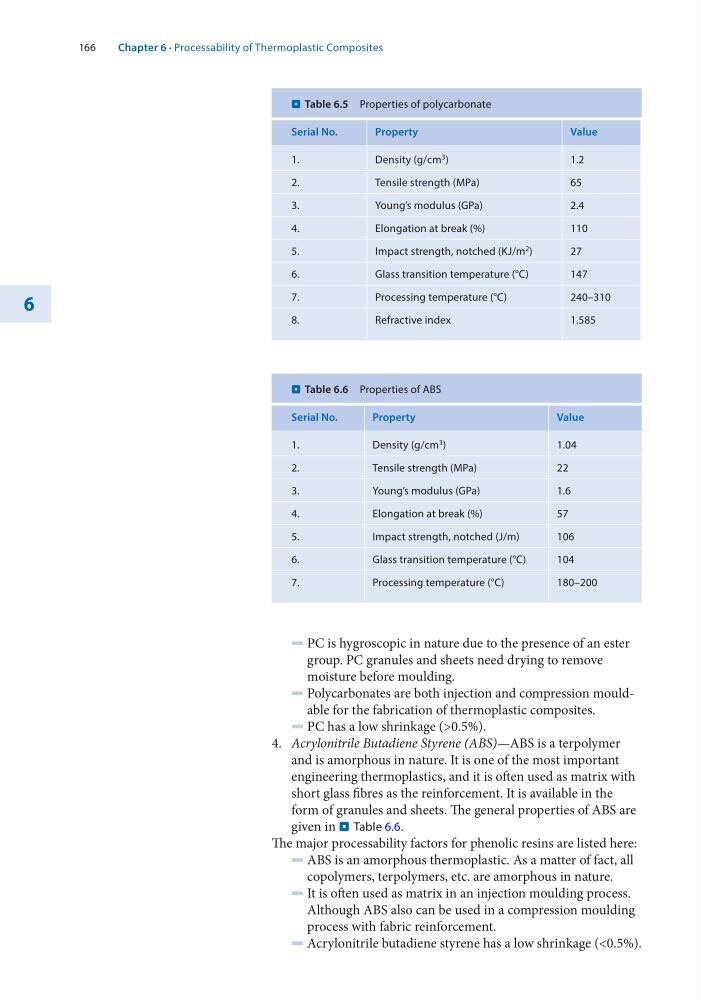
given in . Table 6.6.
The major processability factors for phenolic resins are listed here:
5 ABS is an amorphous thermoplastic. As a matter of fact, all
copolymers, terpolymers, etc. are amorphous in nature.
5 It is often used as matrix in an injection moulding process.
Although ABS also can be used in a compression moulding
process with fabric reinforcement.
5 Acrylonitrile butadiene styrene has a low shrinkage (<0.5%).
. Table 6.5 Properties of polycarbonate
Serial No.
Property
Value
1.
Density (g/cm 3 )
1.2
2.
Tensile strength (MPa)
65
3.
Young’s modulus (GPa)
2.4
4.
Elongation at break (%)
110
5.
Impact strength, notched (KJ/m 2 )
27
6.
Glass transition temperature (°C)
147
7.
Processing temperature (°C)
240–310
8.
Refractive index
1.585
. Table 6.6 Properties of ABS
Serial No.
Property
Value
1.
Density (g/cm 3 )
1.04
2.
Tensile strength (MPa)
22
3.
Young’s modulus (GPa)
1.6
4.
Elongation at break (%)
57
5.
Impact strength, notched (J/m)
106
6.
Glass transition temperature (°C)
104
7.
Processing temperature (°C)
180–200
Chapter 6 · Processability of Thermoplastic Composites
6
5 PC is hygroscopic in nature due to the presence of an ester
group. PC granules and sheets need drying to remove
moisture before moulding.
5 Polycarbonates are both injection and compression mouldable for the fabrication of thermoplastic composites.
5 PC has a low shrinkage (>0.5%).
4. Acrylonitrile Butadiene Styrene (ABS)—ABS is a terpolymer
and is amorphous in nature. It is one of the most important
engineering thermoplastics, and it is often used as matrix with
short glass fibres as the reinforcement. It is available in the
form of granules and sheets. The general properties of ABS are
given in . Table 6.6.
The major processability factors for phenolic resins are listed here:
5 ABS is an amorphous thermoplastic. As a matter of fact, all
copolymers, terpolymers, etc. are amorphous in nature.
5 It is often used as matrix in an injection moulding process.
Although ABS also can be used in a compression moulding
process with fabric reinforcement.
5 Acrylonitrile butadiene styrene has a low shrinkage (<0.5%).
. Table 6.5 Properties of polycarbonate
Serial No.
Property
Value
1.
Density (g/cm 3 )
1.2
2.
Tensile strength (MPa)
65
3.
Young’s modulus (GPa)
2.4
4.
Elongation at break (%)
110
5.
Impact strength, notched (KJ/m 2 )
27
6.
Glass transition temperature (°C)
147
7.
Processing temperature (°C)
240–310
8.
Refractive index
1.585
. Table 6.6 Properties of ABS
Serial No.
Property
Value
1.
Density (g/cm 3 )
1.04
2.
Tensile strength (MPa)
22
3.
Young’s modulus (GPa)
1.6
4.
Elongation at break (%)
57
5.
Impact strength, notched (J/m)
106
6.
Glass transition temperature (°C)
104
7.
Processing temperature (°C)
180–200
Chapter 6 · Processability of Thermoplastic Composites