

165
6
(semi- crystalline in nature), and atactic (amorphous in nature).
Apart from these three forms, the copolymer of PP used with
ethylene is also popular and is also amorphous in nature.
Isotactic PP is used in composite industries. PP is available in
the forms of granules, films, sheets, and fibres. The general
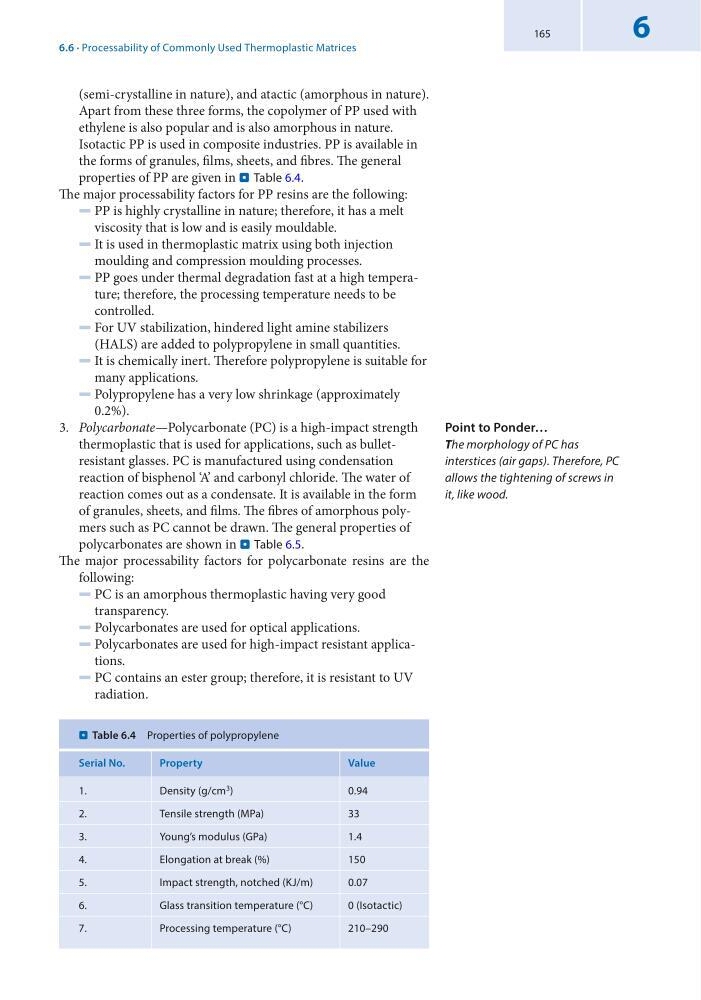
properties of PP are given in . Table 6.4.
The major processability factors for PP resins are the following:
5 PP is highly crystalline in nature; therefore, it has a melt
viscosity that is low and is easily mouldable.
5 It is used in thermoplastic matrix using both injection
moulding and compression moulding processes.
5 PP goes under thermal degradation fast at a high temperature; therefore, the processing temperature needs to be
controlled.
5 For UV stabilization, hindered light amine stabilizers
(HALS) are added to polypropylene in small quantities.
5 It is chemically inert. Therefore polypropylene is suitable for
many applications.
5 Polypropylene has a very low shrinkage (approximately
0.2%).
3. Polycarbonate—Polycarbonate (PC) is a high- impact strength
thermoplastic that is used for applications, such as bulletresistant glasses. PC is manufactured using condensation
reaction of bisphenol ‘ A’ and carbonyl chloride. The water of
reaction comes out as a condensate. It is available in the form
of granules, sheets, and films. The fibres of amorphous polymers such as PC cannot be drawn. The general properties of
polycarbonates are shown in . Table 6.5.
The major processability factors for polycarbonate resins are the
following:
5 PC is an amorphous thermoplastic having very good
transparency.
5 Polycarbonates are used for optical applications.
5 Polycarbonates are used for high-impact resistant applications.
5 PC contains an ester group; therefore, it is resistant to UV
radiation.
Point to Ponder…
The morphology of PC has
interstices (air gaps). Therefore, PC
allows the tightening of screws in
it, like wood.
. Table 6.4 Properties of polypropylene
Serial No.
Property
Value
1.
Density (g/cm 3 )
0.94
2.
Tensile strength (MPa)
33
3.
Young’s modulus (GPa)
1.4
4.
Elongation at break (%)
150
5.
Impact strength, notched (KJ/m)
0.07
6.
Glass transition temperature (°C)
0 (Isotactic)
7.
Processing temperature (°C)
210–290
6.6 · Processability of Commonly Used Thermoplastic Matrices
6
(semi- crystalline in nature), and atactic (amorphous in nature).
Apart from these three forms, the copolymer of PP used with
ethylene is also popular and is also amorphous in nature.
Isotactic PP is used in composite industries. PP is available in
the forms of granules, films, sheets, and fibres. The general
properties of PP are given in . Table 6.4.
The major processability factors for PP resins are the following:
5 PP is highly crystalline in nature; therefore, it has a melt
viscosity that is low and is easily mouldable.
5 It is used in thermoplastic matrix using both injection
moulding and compression moulding processes.
5 PP goes under thermal degradation fast at a high temperature; therefore, the processing temperature needs to be
controlled.
5 For UV stabilization, hindered light amine stabilizers
(HALS) are added to polypropylene in small quantities.
5 It is chemically inert. Therefore polypropylene is suitable for
many applications.
5 Polypropylene has a very low shrinkage (approximately
0.2%).
3. Polycarbonate—Polycarbonate (PC) is a high- impact strength
thermoplastic that is used for applications, such as bulletresistant glasses. PC is manufactured using condensation
reaction of bisphenol ‘ A’ and carbonyl chloride. The water of
reaction comes out as a condensate. It is available in the form
of granules, sheets, and films. The fibres of amorphous polymers such as PC cannot be drawn. The general properties of
polycarbonates are shown in . Table 6.5.
The major processability factors for polycarbonate resins are the
following:
5 PC is an amorphous thermoplastic having very good
transparency.
5 Polycarbonates are used for optical applications.
5 Polycarbonates are used for high-impact resistant applications.
5 PC contains an ester group; therefore, it is resistant to UV
radiation.
Point to Ponder…
The morphology of PC has
interstices (air gaps). Therefore, PC
allows the tightening of screws in
it, like wood.
. Table 6.4 Properties of polypropylene
Serial No.
Property
Value
1.
Density (g/cm 3 )
0.94
2.
Tensile strength (MPa)
33
3.
Young’s modulus (GPa)
1.4
4.
Elongation at break (%)
150
5.
Impact strength, notched (KJ/m)
0.07
6.
Glass transition temperature (°C)
0 (Isotactic)
7.
Processing temperature (°C)
210–290
6.6 · Processability of Commonly Used Thermoplastic Matrices