

168
6
7. Polyetherimide (PEI)—PEI is high-performance engineering
thermoplastic. It is amorphous in nature. Polyetherimide is
manufactured through complex and multistep reactions of
bisphenol ‘ A’ , phthalic anhydride, and aromatic amine. The
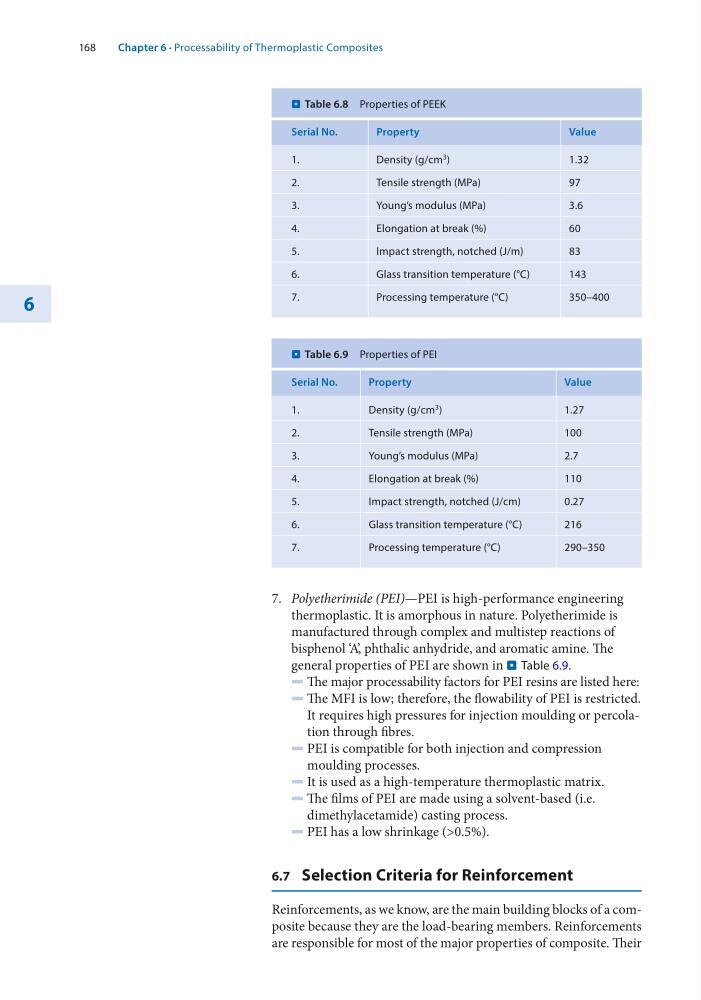
general properties of PEI are shown in . Table 6.9.
5 The major processability factors for PEI resins are listed here:
5 The MFI is low; therefore, the flowability of PEI is restricted.
It requires high pressures for injection moulding or percolation through fibres.
5 PEI is compatible for both injection and compression
moulding processes.
5 It is used as a high-temperature thermoplastic matrix.
5 The films of PEI are made using a solvent-based (i.e.
dimethylacetamide) casting process.
5 PEI has a low shrinkage (>0.5%).
6.7 Selection Criteria for Reinforcement
Reinforcements, as we know, are the main building blocks of a composite because they are the load-bearing members. Reinforcements
are responsible for most of the major properties of composite. Their
. Table 6.8 Properties of PEEK
Serial No.
Property
Value
1.
Density (g/cm 3 )
1.32
2.
Tensile strength (MPa)
97
3.
Young’s modulus (MPa)
3.6
4.
Elongation at break (%)
60
5.
Impact strength, notched (J/m)
83
6.
Glass transition temperature (°C)
143
7.
Processing temperature (°C)
350–400
. Table 6.9 Properties of PEI
Serial No.
Property
Value
1.
Density (g/cm 3 )
1.27
2.
Tensile strength (MPa)
100
3.
Young’s modulus (MPa)
2.7
4.
Elongation at break (%)
110
5.
Impact strength, notched (J/cm)
0.27
6.
Glass transition temperature (°C)
216
7.
Processing temperature (°C)
290–350
Chapter 6 · Processability of Thermoplastic Composites
6
7. Polyetherimide (PEI)—PEI is high-performance engineering
thermoplastic. It is amorphous in nature. Polyetherimide is
manufactured through complex and multistep reactions of
bisphenol ‘ A’ , phthalic anhydride, and aromatic amine. The
general properties of PEI are shown in . Table 6.9.
5 The major processability factors for PEI resins are listed here:
5 The MFI is low; therefore, the flowability of PEI is restricted.
It requires high pressures for injection moulding or percolation through fibres.
5 PEI is compatible for both injection and compression
moulding processes.
5 It is used as a high-temperature thermoplastic matrix.
5 The films of PEI are made using a solvent-based (i.e.
dimethylacetamide) casting process.
5 PEI has a low shrinkage (>0.5%).
6.7 Selection Criteria for Reinforcement
Reinforcements, as we know, are the main building blocks of a composite because they are the load-bearing members. Reinforcements
are responsible for most of the major properties of composite. Their
. Table 6.8 Properties of PEEK
Serial No.
Property
Value
1.
Density (g/cm 3 )
1.32
2.
Tensile strength (MPa)
97
3.
Young’s modulus (MPa)
3.6
4.
Elongation at break (%)
60
5.
Impact strength, notched (J/m)
83
6.
Glass transition temperature (°C)
143
7.
Processing temperature (°C)
350–400
. Table 6.9 Properties of PEI
Serial No.
Property
Value
1.
Density (g/cm 3 )
1.27
2.
Tensile strength (MPa)
100
3.
Young’s modulus (MPa)
2.7
4.
Elongation at break (%)
110
5.
Impact strength, notched (J/cm)
0.27
6.
Glass transition temperature (°C)
216
7.
Processing temperature (°C)
290–350
Chapter 6 · Processability of Thermoplastic Composites