

160
6
v Answer
D
S
S
au =
=
=
∞
19.6 28
0.7
/
Efficiency of this joint is 70%.
6.5 Selection Criteria for Thermoplastic Matrices
The selection criteria for thermosetting matrices are dependent on
the processability factors of resin as well as the processing technology. A summary of those processability factors already has been
outlined in 7 Chap. 1 (7 Sect. 1.3). The processability factors for
thermosetting resins are detailed here.
1. Properties Driven by Selection Criteria
5 Melt Flow Index (MFI)—MFI is a parameter that indirectly
determines the viscosity of a polymer melt. MFI is flow of
molten polymer mass measured in grams in 10 minutes
under a standard load and temperature. High MFIs favour
the percolation of the matrix around fibres and fill the mould
cavities faster at lower pressure in both the injection moulding and compression moulding processes [17, 18]. The MFI
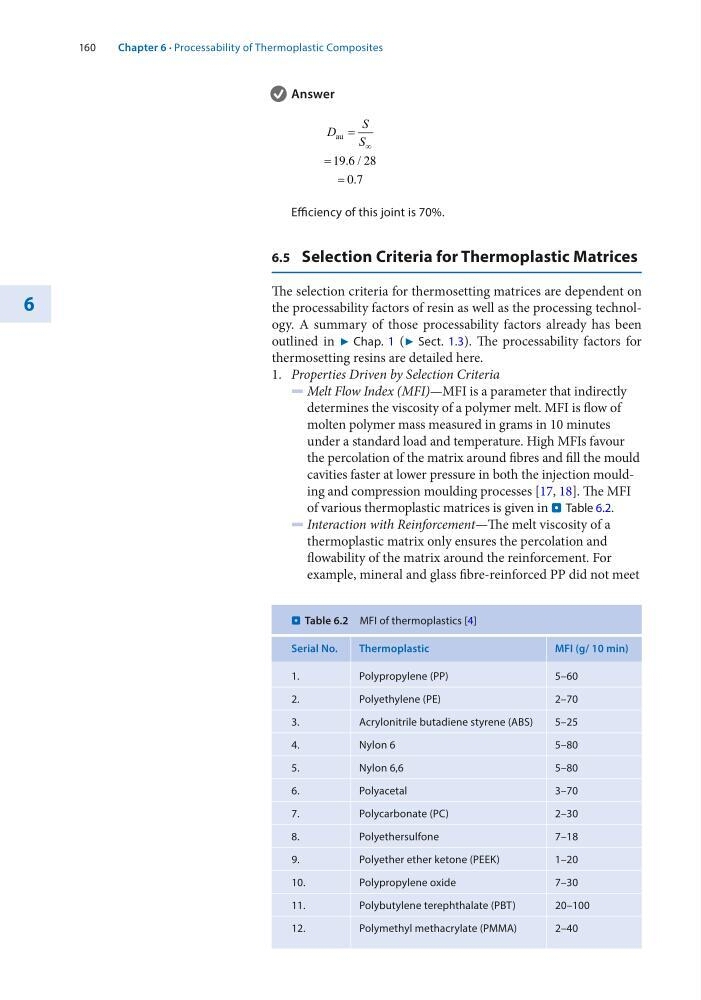
of various thermoplastic matrices is given in . Table 6.2.
5 Interaction with Reinforcement—The melt viscosity of a
thermoplastic matrix only ensures the percolation and
flowability of the matrix around the reinforcement. For
example, mineral and glass fibre-reinforced PP did not meet
. Table 6.2 MFI of thermoplastics [4]
Serial No.
Thermoplastic
MFI (g/ 10 min)
1.
Polypropylene (PP)
5–60
2.
Polyethylene (PE)
2–70
3.
Acrylonitrile butadiene styrene (ABS)
5–25
4.
Nylon 6
5–80
5.
Nylon 6,6
5–80
6.
Polyacetal
3–70
7.
Polycarbonate (PC)
2–30
8.
Polyethersulfone
7–18
9.
Polyether ether ketone (PEEK)
1–20
10.
Polypropylene oxide
7–30
11.
Polybutylene terephthalate (PBT)
20–100
12.
Polymethyl methacrylate (PMMA)
2–40
Chapter 6 · Processability of Thermoplastic Composites
6
v Answer
D
S
S
au =
=
=
∞
19.6 28
0.7
/
Efficiency of this joint is 70%.
6.5 Selection Criteria for Thermoplastic Matrices
The selection criteria for thermosetting matrices are dependent on
the processability factors of resin as well as the processing technology. A summary of those processability factors already has been
outlined in 7 Chap. 1 (7 Sect. 1.3). The processability factors for
thermosetting resins are detailed here.
1. Properties Driven by Selection Criteria
5 Melt Flow Index (MFI)—MFI is a parameter that indirectly
determines the viscosity of a polymer melt. MFI is flow of
molten polymer mass measured in grams in 10 minutes
under a standard load and temperature. High MFIs favour
the percolation of the matrix around fibres and fill the mould
cavities faster at lower pressure in both the injection moulding and compression moulding processes [17, 18]. The MFI
of various thermoplastic matrices is given in . Table 6.2.
5 Interaction with Reinforcement—The melt viscosity of a
thermoplastic matrix only ensures the percolation and
flowability of the matrix around the reinforcement. For
example, mineral and glass fibre-reinforced PP did not meet
. Table 6.2 MFI of thermoplastics [4]
Serial No.
Thermoplastic
MFI (g/ 10 min)
1.
Polypropylene (PP)
5–60
2.
Polyethylene (PE)
2–70
3.
Acrylonitrile butadiene styrene (ABS)
5–25
4.
Nylon 6
5–80
5.
Nylon 6,6
5–80
6.
Polyacetal
3–70
7.
Polycarbonate (PC)
2–30
8.
Polyethersulfone
7–18
9.
Polyether ether ketone (PEEK)
1–20
10.
Polypropylene oxide
7–30
11.
Polybutylene terephthalate (PBT)
20–100
12.
Polymethyl methacrylate (PMMA)
2–40
Chapter 6 · Processability of Thermoplastic Composites