

159
6
6.4.2 Autohesion
Once two interfaces come into intimate contact, a bonding process
between the interfaces starts. In the case of a matrix and a particle
interface, the bond is formed by adhesion, and in the case of two thermoplastic interfaces, the bond is formed by cohesion. The combined
effect of bonding of all of the interfaces is called autohesion. A model
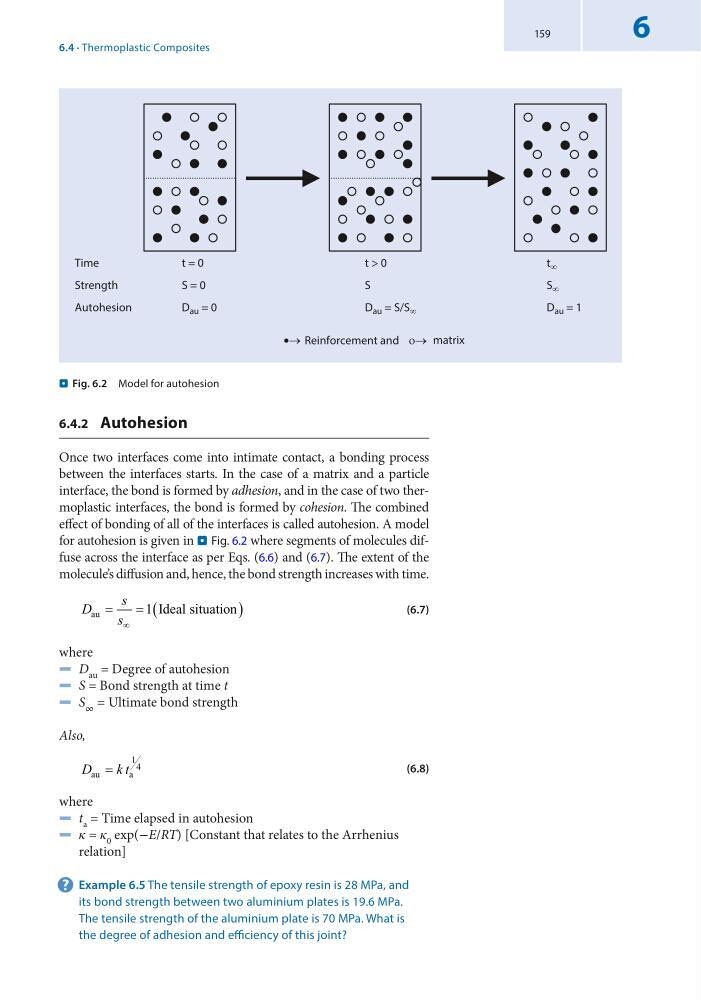
for autohesion is given in . Fig. 6.2 where segments of molecules diffuse across the interface as per Eqs. (6.6) and (6.7). The extent of the
molecule’s diffusion and, hence, the bond strength increases with time.
D
s
s
au
Ideal situation
=
= (
)
∞
1
(6.7)
where
5 D au = Degree of autohesion
5 S = Bond strength at time t
5 S ∞ = Ultimate bond strength
Also,
D
kt
au
a
=
1 4
(6.8)
where
5 t a = Time elapsed in autohesion
5 к = к 0 exp(−E/RT) [Constant that relates to the Arrhenius
relation]
? Example 6.5 The tensile strength of epoxy resin is 28 MPa, and
its bond strength between two aluminium plates is 19.6 MPa.
The tensile strength of the aluminium plate is 70 MPa. What is
the degree of adhesion and efficiency of this joint?
Time
t = 0
t > 0
t ¥
Strength
S = 0
S
S ¥
Autohesion
D au = 0
D au = S/S ¥
D au = 1
Reinforcement and
matrix
. Fig. 6.2 Model for autohesion
6.4 · Thermoplastic Composites
6
6.4.2 Autohesion
Once two interfaces come into intimate contact, a bonding process
between the interfaces starts. In the case of a matrix and a particle
interface, the bond is formed by adhesion, and in the case of two thermoplastic interfaces, the bond is formed by cohesion. The combined
effect of bonding of all of the interfaces is called autohesion. A model
for autohesion is given in . Fig. 6.2 where segments of molecules diffuse across the interface as per Eqs. (6.6) and (6.7). The extent of the
molecule’s diffusion and, hence, the bond strength increases with time.
D
s
s
au
Ideal situation
=
= (
)
∞
1
(6.7)
where
5 D au = Degree of autohesion
5 S = Bond strength at time t
5 S ∞ = Ultimate bond strength
Also,
D
kt
au
a
=
1 4
(6.8)
where
5 t a = Time elapsed in autohesion
5 к = к 0 exp(−E/RT) [Constant that relates to the Arrhenius
relation]
? Example 6.5 The tensile strength of epoxy resin is 28 MPa, and
its bond strength between two aluminium plates is 19.6 MPa.
The tensile strength of the aluminium plate is 70 MPa. What is
the degree of adhesion and efficiency of this joint?
Time
t = 0
t > 0
t ¥
Strength
S = 0
S
S ¥
Autohesion
D au = 0
D au = S/S ¥
D au = 1
Reinforcement and
matrix
. Fig. 6.2 Model for autohesion
6.4 · Thermoplastic Composites