

161
6
the specifications for washing machine tubs due to a lack of
flowability. This was changed by adjusting of the grade of PP
for better flowability, good interphase properties, and
superior hydrolysis resistance. This innovation revitalized
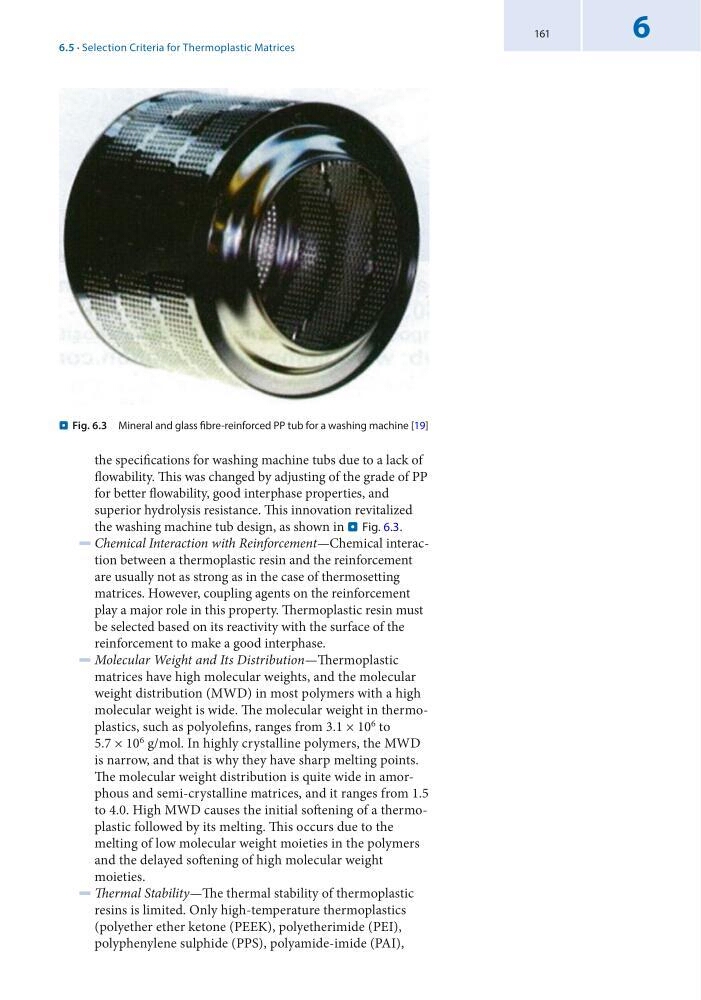
the washing machine tub design, as shown in . Fig. 6.3.
5 Chemical Interaction with Reinforcement—Chemical interaction between a thermoplastic resin and the reinforcement
are usually not as strong as in the case of thermosetting
matrices. However, coupling agents on the reinforcement
play a major role in this property. Thermoplastic resin must
be selected based on its reactivity with the surface of the
reinforcement to make a good interphase.
5 Molecular Weight and Its Distribution—Thermoplastic
matrices have high molecular weights, and the molecular
weight distribution (MWD) in most polymers with a high
molecular weight is wide. The molecular weight in thermoplastics, such as polyolefins, ranges from 3.1 × 10 6 to
5.7 × 10 6 g/mol. In highly crystalline polymers, the MWD
is narrow, and that is why they have sharp melting points.
The molecular weight distribution is quite wide in amorphous and semi-crystalline matrices, and it ranges from 1.5
to 4.0. High MWD causes the initial softening of a thermoplastic followed by its melting. This occurs due to the
melting of low molecular weight moieties in the polymers
and the delayed softening of high molecular weight
moieties.
5 Thermal Stability—The thermal stability of thermoplastic
resins is limited. Only high-temperature thermoplastics
(polyether ether ketone (PEEK), polyetherimide (PEI),
polyphenylene sulphide (PPS), polyamide-imide (PAI),
. Fig. 6.3 Mineral and glass fibre-reinforced PP tub for a washing machine [19]
6.5 · Selection Criteria for Thermoplastic Matrices
6
the specifications for washing machine tubs due to a lack of
flowability. This was changed by adjusting of the grade of PP
for better flowability, good interphase properties, and
superior hydrolysis resistance. This innovation revitalized
the washing machine tub design, as shown in . Fig. 6.3.
5 Chemical Interaction with Reinforcement—Chemical interaction between a thermoplastic resin and the reinforcement
are usually not as strong as in the case of thermosetting
matrices. However, coupling agents on the reinforcement
play a major role in this property. Thermoplastic resin must
be selected based on its reactivity with the surface of the
reinforcement to make a good interphase.
5 Molecular Weight and Its Distribution—Thermoplastic
matrices have high molecular weights, and the molecular
weight distribution (MWD) in most polymers with a high
molecular weight is wide. The molecular weight in thermoplastics, such as polyolefins, ranges from 3.1 × 10 6 to
5.7 × 10 6 g/mol. In highly crystalline polymers, the MWD
is narrow, and that is why they have sharp melting points.
The molecular weight distribution is quite wide in amorphous and semi-crystalline matrices, and it ranges from 1.5
to 4.0. High MWD causes the initial softening of a thermoplastic followed by its melting. This occurs due to the
melting of low molecular weight moieties in the polymers
and the delayed softening of high molecular weight
moieties.
5 Thermal Stability—The thermal stability of thermoplastic
resins is limited. Only high-temperature thermoplastics
(polyether ether ketone (PEEK), polyetherimide (PEI),
polyphenylene sulphide (PPS), polyamide-imide (PAI),
. Fig. 6.3 Mineral and glass fibre-reinforced PP tub for a washing machine [19]
6.5 · Selection Criteria for Thermoplastic Matrices