

141
5
equated to the bond strength, since the bond strength also contains
the energy of dissipative processes (such as viscoelastic deformation, microcracking, plastic deformation, etc.) However, under certain conditions (low temperature and high peel rate), the work of
adhesion (W adhesion ) approximates the bond strength (W bond ).
Surface adhesion is essentially a surface energy phenomenon
and can be enhanced by altering the surface energies of the fibre
and/or the matrix.
5.4.2 Chemical Bonding
Chemical bonding between the matrix and the reinforcement is the
most effective method of increasing the interfacial bond strength.
Some fibres have chemically active groups that react with the
matrix, and in some cases, coupling agents are used to enhance the
bonding. In the case of inorganic reinforcements (such as glass
fibres, silica fibres, etc.), silane or titanate coupling agents are used,
as discussed in previous sections. For thermosetting matrices,
silane coupling agents are preferred, and for thermoplastic matrices, titanate coupling agents are preferred. Plasma is also used to
provide improvement in interfacial adhesion for chemically inert
materials (such as polypropylene, polyethylene, and Teflon). Plasma
extracts atoms from the fibre surface and promotes the attachment
of reactive groups, which can bond with appropriate chemical
group of the matrix. The use of a corona discharge has also shown
some improvement in bonding between matrices and chemically
inert fibres [22].
5.4.3 Mechanical Adhesion
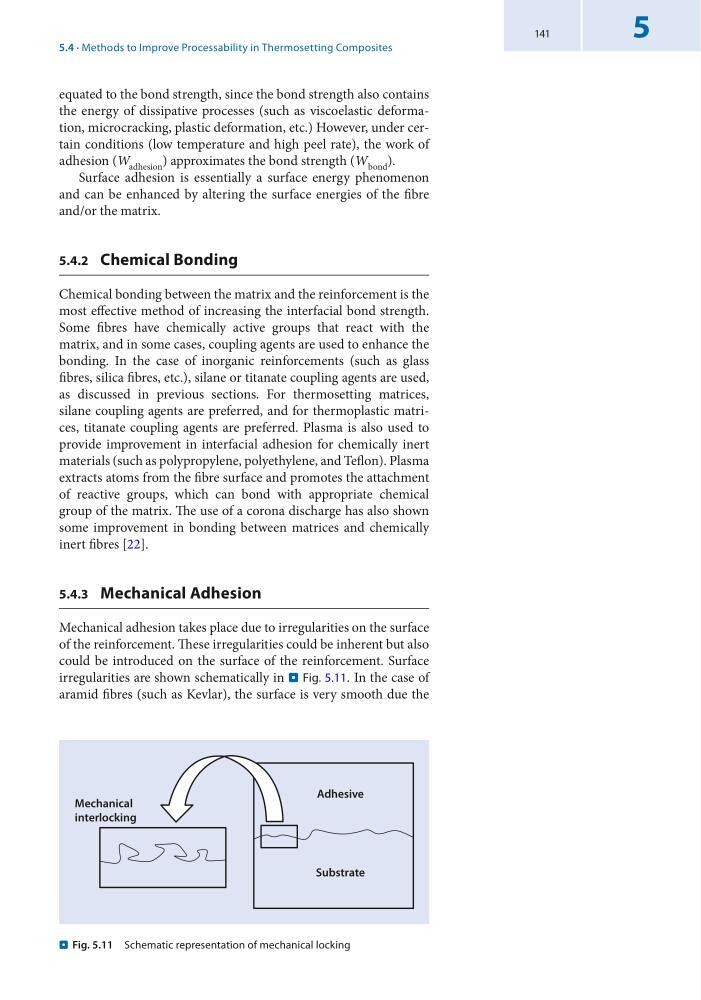
Mechanical adhesion takes place due to irregularities on the surface
of the reinforcement. These irregularities could be inherent but also
could be introduced on the surface of the reinforcement. Surface
irregularities are shown schematically in . Fig. 5.11. In the case of
aramid fibres (such as Kevlar), the surface is very smooth due the
Adhesive
Substrate
Mechanical
interlocking
. Fig. 5.11 Schematic representation of mechanical locking
5.4 · Methods to Improve Processability in Thermosetting Composites
5
equated to the bond strength, since the bond strength also contains
the energy of dissipative processes (such as viscoelastic deformation, microcracking, plastic deformation, etc.) However, under certain conditions (low temperature and high peel rate), the work of
adhesion (W adhesion ) approximates the bond strength (W bond ).
Surface adhesion is essentially a surface energy phenomenon
and can be enhanced by altering the surface energies of the fibre
and/or the matrix.
5.4.2 Chemical Bonding
Chemical bonding between the matrix and the reinforcement is the
most effective method of increasing the interfacial bond strength.
Some fibres have chemically active groups that react with the
matrix, and in some cases, coupling agents are used to enhance the
bonding. In the case of inorganic reinforcements (such as glass
fibres, silica fibres, etc.), silane or titanate coupling agents are used,
as discussed in previous sections. For thermosetting matrices,
silane coupling agents are preferred, and for thermoplastic matrices, titanate coupling agents are preferred. Plasma is also used to
provide improvement in interfacial adhesion for chemically inert
materials (such as polypropylene, polyethylene, and Teflon). Plasma
extracts atoms from the fibre surface and promotes the attachment
of reactive groups, which can bond with appropriate chemical
group of the matrix. The use of a corona discharge has also shown
some improvement in bonding between matrices and chemically
inert fibres [22].
5.4.3 Mechanical Adhesion
Mechanical adhesion takes place due to irregularities on the surface
of the reinforcement. These irregularities could be inherent but also
could be introduced on the surface of the reinforcement. Surface
irregularities are shown schematically in . Fig. 5.11. In the case of
aramid fibres (such as Kevlar), the surface is very smooth due the
Adhesive
Substrate
Mechanical
interlocking
. Fig. 5.11 Schematic representation of mechanical locking
5.4 · Methods to Improve Processability in Thermosetting Composites