

142
5
highly regular and oriented molecular structure of aramid fibres.
Though the chemical bond with the matrix could be formed due to
the chemical nature of aramid, wettability remains the problem to
achieving a good chemical bond. Therefore, the surfaces of aramid
fibres are mechanically roughened using quartz stone. This rubbing
against the quartz stone causes the microfibrillization of aramid
fibres on their surface, and this leads to good wettability, mechanical
bonding, and chemical bonding due to a higher surface area. Boron
carbide fibres and silicon carbide fibres are made by depositing a
carbide layer over tungsten or a carbon filament at a high temperature and in an inert atmosphere. These fibres are high-performance
fibres having a high modulus and with a high- temperature resistance. The rough surface created by depositing the carbide provides
the location for mechanical interlocking of the matrix.
5.4.4 Interdiffusion
The mutual solubility of two materials is the first approximation to
the amount of interdiffusion. The molecular intertwining can increase
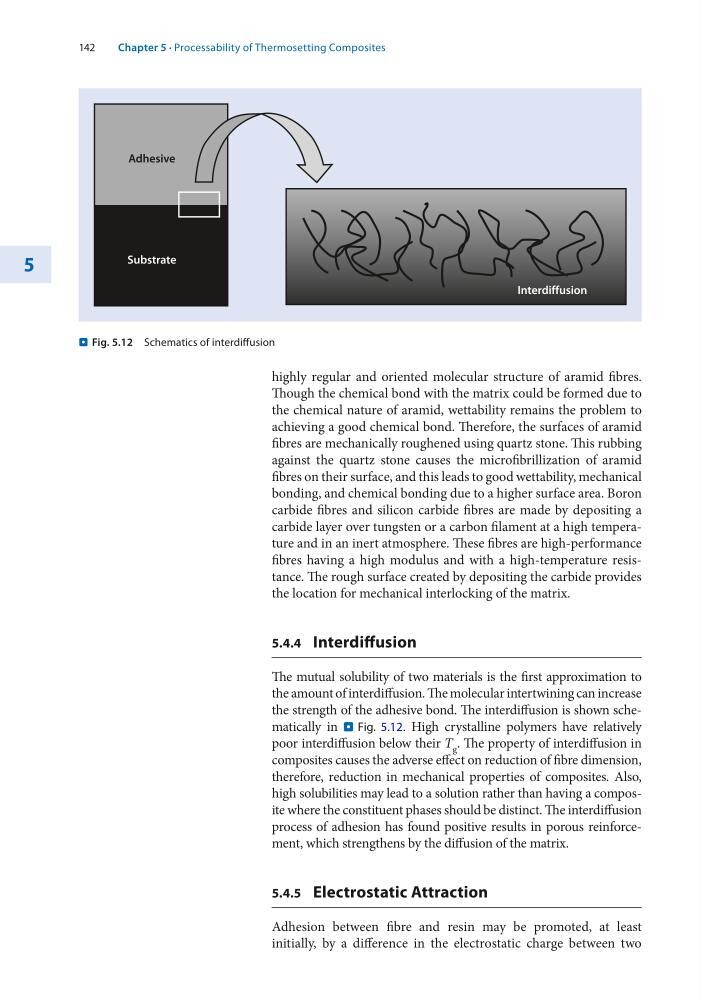
the strength of the adhesive bond. The interdiffusion is shown schematically in . Fig. 5.12. High crystalline polymers have relatively
poor interdiffusion below their T g . The property of interdiffusion in
composites causes the adverse effect on reduction of fibre dimension,
therefore, reduction in mechanical properties of composites. Also,
high solubilities may lead to a solution rather than having a composite where the constituent phases should be distinct. The interdiffusion
process of adhesion has found positive results in porous reinforcement, which strengthens by the diffusion of the matrix.
5.4.5 Electrostatic Attraction
Adhesion between fibre and resin may be promoted, at least
initially, by a difference in the electrostatic charge between two
. Fig. 5.12 Schematics of interdiffusion
Chapter 5 · Processability of Thermosetting Composites
5
highly regular and oriented molecular structure of aramid fibres.
Though the chemical bond with the matrix could be formed due to
the chemical nature of aramid, wettability remains the problem to
achieving a good chemical bond. Therefore, the surfaces of aramid
fibres are mechanically roughened using quartz stone. This rubbing
against the quartz stone causes the microfibrillization of aramid
fibres on their surface, and this leads to good wettability, mechanical
bonding, and chemical bonding due to a higher surface area. Boron
carbide fibres and silicon carbide fibres are made by depositing a
carbide layer over tungsten or a carbon filament at a high temperature and in an inert atmosphere. These fibres are high-performance
fibres having a high modulus and with a high- temperature resistance. The rough surface created by depositing the carbide provides
the location for mechanical interlocking of the matrix.
5.4.4 Interdiffusion
The mutual solubility of two materials is the first approximation to
the amount of interdiffusion. The molecular intertwining can increase
the strength of the adhesive bond. The interdiffusion is shown schematically in . Fig. 5.12. High crystalline polymers have relatively
poor interdiffusion below their T g . The property of interdiffusion in
composites causes the adverse effect on reduction of fibre dimension,
therefore, reduction in mechanical properties of composites. Also,
high solubilities may lead to a solution rather than having a composite where the constituent phases should be distinct. The interdiffusion
process of adhesion has found positive results in porous reinforcement, which strengthens by the diffusion of the matrix.
5.4.5 Electrostatic Attraction
Adhesion between fibre and resin may be promoted, at least
initially, by a difference in the electrostatic charge between two
. Fig. 5.12 Schematics of interdiffusion
Chapter 5 · Processability of Thermosetting Composites