

140
5
to lower production costs. Whereas if the same product is
required in larger batches, resorting to compression
moulding technology with a matched die mould is the best
option. Then the cost of the tooling could be amortised
faster with large production volumes. For higher production volumes, the processability of raw materials in loose
forms (e.g. reinforcing fabric and matrix) with moulding
processes such as matched die moulding on compression
moulding is not suitable. Rather, the use of sheet moulding
compounds (SMCs) or bulk moulding compounds (BMCs)
offers better processability over the loose form of raw
materials to match the production volume and quality.
5 Cost of Production—The cost of production may be
controlled by choosing the right kind of reinforcement for a
required service and the service life of the composite. Also,
the form and weave of the reinforcement could impact the
cost of the product. If CSM can provide the necessary
performance of the composite, using woven fabric would
unnecessarily raise the cost.
5.4 Methods to Improve Processability
in Thermosetting Composites
The properties of composites depend upon the simultaneous and
cooperative interaction between the matrix and the reinforcement.
The following are the basic requirements to cause synergistic properties of composites.
5.4.1 Adsorption and Wetting
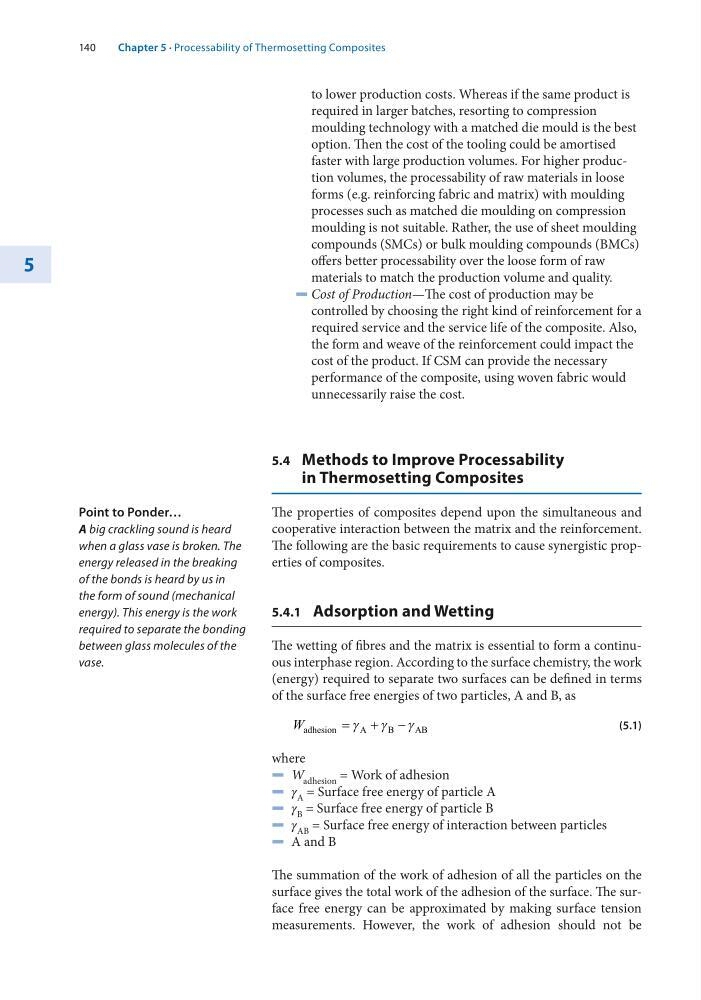
The wetting of fibres and the matrix is essential to form a continuous interphase region. According to the surface chemistry, the work
(energy) required to separate two surfaces can be defined in terms
of the surface free energies of two particles, A and B, as
W adhesion
A
B
AB
=
+ -
g
g g
(5.1)
where
5 W adhesion = Work of adhesion
5 γ A = Surface free energy of particle A
5 γ B = Surface free energy of particle B
5 γ AB = Surface free energy of interaction between particles
5 A and B
The summation of the work of adhesion of all the particles on the
surface gives the total work of the adhesion of the surface. The surface free energy can be approximated by making surface tension
measurements. However, the work of adhesion should not be
Point to Ponder…
A big crackling sound is heard
when a glass vase is broken. The
energy released in the breaking
of the bonds is heard by us in
the form of sound (mechanical
energy). This energy is the work
required to separate the bonding
between glass molecules of the
vase.
Chapter 5 · Processability of Thermosetting Composites
5
to lower production costs. Whereas if the same product is
required in larger batches, resorting to compression
moulding technology with a matched die mould is the best
option. Then the cost of the tooling could be amortised
faster with large production volumes. For higher production volumes, the processability of raw materials in loose
forms (e.g. reinforcing fabric and matrix) with moulding
processes such as matched die moulding on compression
moulding is not suitable. Rather, the use of sheet moulding
compounds (SMCs) or bulk moulding compounds (BMCs)
offers better processability over the loose form of raw
materials to match the production volume and quality.
5 Cost of Production—The cost of production may be
controlled by choosing the right kind of reinforcement for a
required service and the service life of the composite. Also,
the form and weave of the reinforcement could impact the
cost of the product. If CSM can provide the necessary
performance of the composite, using woven fabric would
unnecessarily raise the cost.
5.4 Methods to Improve Processability
in Thermosetting Composites
The properties of composites depend upon the simultaneous and
cooperative interaction between the matrix and the reinforcement.
The following are the basic requirements to cause synergistic properties of composites.
5.4.1 Adsorption and Wetting
The wetting of fibres and the matrix is essential to form a continuous interphase region. According to the surface chemistry, the work
(energy) required to separate two surfaces can be defined in terms
of the surface free energies of two particles, A and B, as
W adhesion
A
B
AB
=
+ -
g
g g
(5.1)
where
5 W adhesion = Work of adhesion
5 γ A = Surface free energy of particle A
5 γ B = Surface free energy of particle B
5 γ AB = Surface free energy of interaction between particles
5 A and B
The summation of the work of adhesion of all the particles on the
surface gives the total work of the adhesion of the surface. The surface free energy can be approximated by making surface tension
measurements. However, the work of adhesion should not be
Point to Ponder…
A big crackling sound is heard
when a glass vase is broken. The
energy released in the breaking
of the bonds is heard by us in
the form of sound (mechanical
energy). This energy is the work
required to separate the bonding
between glass molecules of the
vase.
Chapter 5 · Processability of Thermosetting Composites