

105
4
4.5.4 Troubleshooting
As it has been discussed in previous sections, rheology in polymeric
composites has its significance in the fabrication/production of the
product while obtaining the desired properties. The rheology in
polymeric composites has many manifestations; therefore, its reasons and solution are discussed here.
1. Viscosity of Resin—High viscosities of resin do not allow it to
flow and prevent the percolation of resin around the reinforcement. Therefore, poor wetting occurs, and this leads to
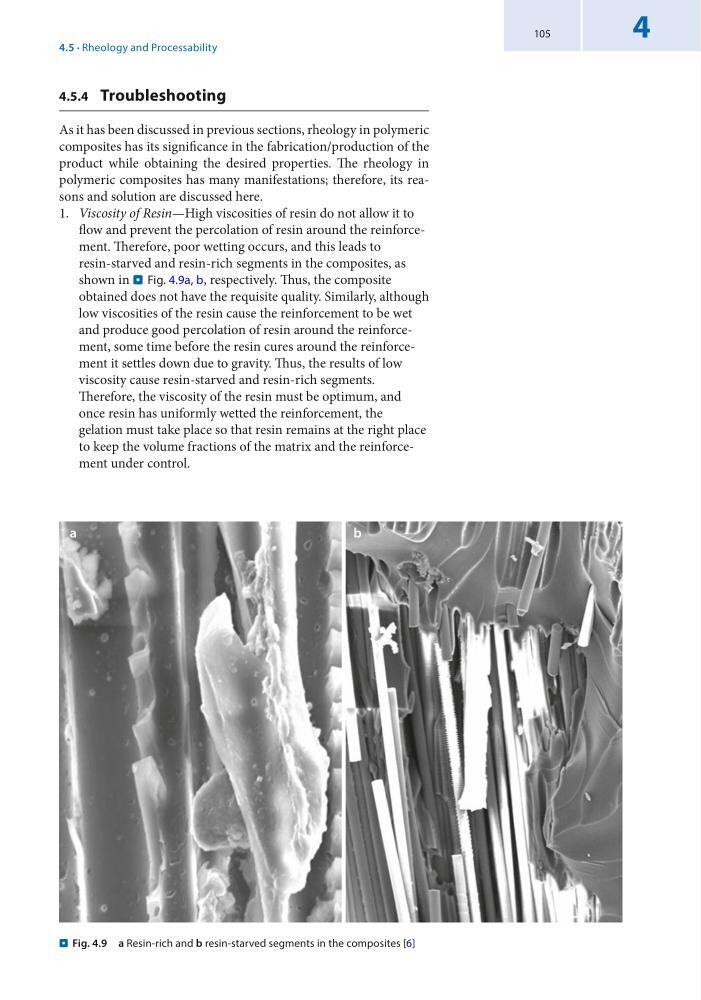
resin-starved and resin-rich segments in the composites, as
shown in . Fig. 4.9a, b, respectively. Thus, the composite
obtained does not have the requisite quality. Similarly, although
low viscosities of the resin cause the reinforcement to be wet
and produce good percolation of resin around the reinforcement, some time before the resin cures around the reinforcement it settles down due to gravity. Thus, the results of low
viscosity cause resin-starved and resin-rich segments.
Therefore, the viscosity of the resin must be optimum, and
once resin has uniformly wetted the reinforcement, the
gelation must take place so that resin remains at the right place
to keep the volume fractions of the matrix and the reinforcement under control.
a
b
. Fig. 4.9 a Resin-rich and b resin-starved segments in the composites [6]
4.5 · Rheology and Processability
4
4.5.4 Troubleshooting
As it has been discussed in previous sections, rheology in polymeric
composites has its significance in the fabrication/production of the
product while obtaining the desired properties. The rheology in
polymeric composites has many manifestations; therefore, its reasons and solution are discussed here.
1. Viscosity of Resin—High viscosities of resin do not allow it to
flow and prevent the percolation of resin around the reinforcement. Therefore, poor wetting occurs, and this leads to
resin-starved and resin-rich segments in the composites, as
shown in . Fig. 4.9a, b, respectively. Thus, the composite
obtained does not have the requisite quality. Similarly, although
low viscosities of the resin cause the reinforcement to be wet
and produce good percolation of resin around the reinforcement, some time before the resin cures around the reinforcement it settles down due to gravity. Thus, the results of low
viscosity cause resin-starved and resin-rich segments.
Therefore, the viscosity of the resin must be optimum, and
once resin has uniformly wetted the reinforcement, the
gelation must take place so that resin remains at the right place
to keep the volume fractions of the matrix and the reinforcement under control.
a
b
. Fig. 4.9 a Resin-rich and b resin-starved segments in the composites [6]
4.5 · Rheology and Processability