

104
4
4.5.3 Fibre Dispersion and Orientation
Fibre dispersion is a phenomenon in short fibre-reinforced composites. Fibre dispersion is important for the complete wetting of the
fibres in the composites and also for their orientation in the direction of the flow of the matrix. Both of these factors are important for
creating the good properties of the product. Fibre dispersion is
facilitated by the following factors:
5 Absence of cohesive bonding among the fibres.
5 No deterioration of surface treatment on the fibre surface.
Surface treatment helps in easier handling and the processability of the fibres.
5 Absence of moisture in the fibres. The moisture, being hydrophilic in nature, causes an incompatibility of the fibres with the
hydrophobic resin.
The dispersion of fibres depends upon their density and on the flow
rate of the resin. High-density fibres tend to settle down due to
gravity. This phenomenon is seen in large products. The role of the
temperature is also observed in the orientation of fibres because low
temperatures favour high viscosity, and the fibre position in the
product is frozen fast. The flow rate and hydrophobic surface of the
fibre control part of the flow of the resin.
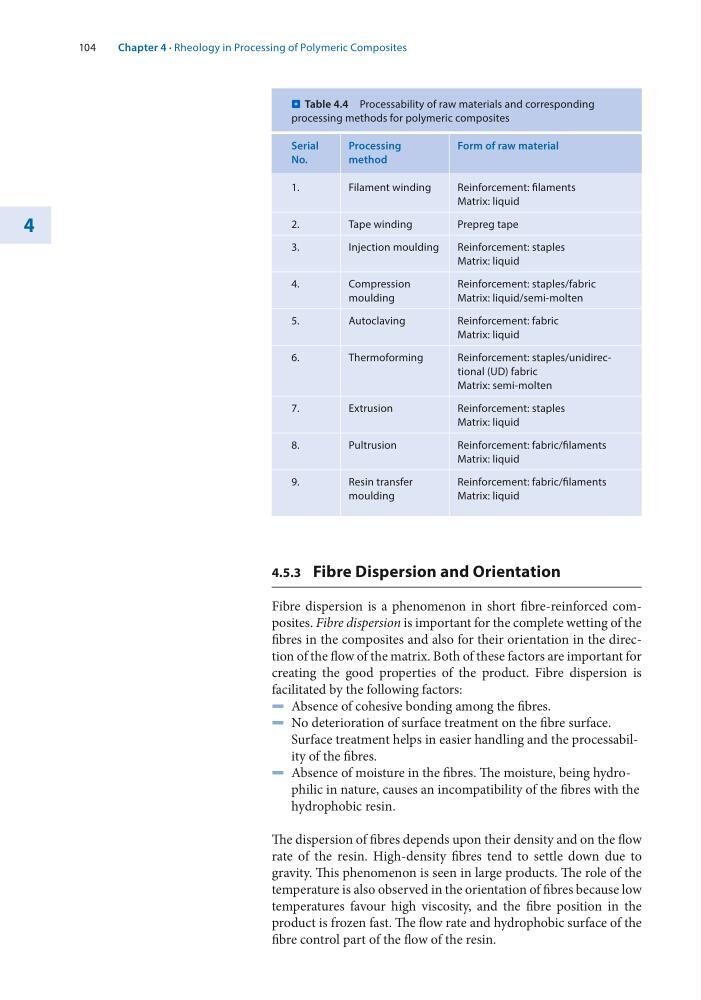
. Table 4.4 Processability of raw materials and corresponding
processing methods for polymeric composites
Serial
No.
Processing
method
Form of raw material
1.
Filament winding
Reinforcement: filaments
Matrix: liquid
2.
Tape winding
Prepreg tape
3.
Injection moulding
Reinforcement: staples
Matrix: liquid
4.
Compression
moulding
Reinforcement: staples/fabric
Matrix: liquid/semi-molten
5.
Autoclaving
Reinforcement: fabric
Matrix: liquid
6.
Thermoforming
Reinforcement: staples/unidirectional (UD) fabric
Matrix: semi-molten
7.
Extrusion
Reinforcement: staples
Matrix: liquid
8.
Pultrusion
Reinforcement: fabric/filaments
Matrix: liquid
9.
Resin transfer
moulding
Reinforcement: fabric/filaments
Matrix: liquid
Chapter 4 · Rheology in Processing of Polymeric Composites
4
4.5.3 Fibre Dispersion and Orientation
Fibre dispersion is a phenomenon in short fibre-reinforced composites. Fibre dispersion is important for the complete wetting of the
fibres in the composites and also for their orientation in the direction of the flow of the matrix. Both of these factors are important for
creating the good properties of the product. Fibre dispersion is
facilitated by the following factors:
5 Absence of cohesive bonding among the fibres.
5 No deterioration of surface treatment on the fibre surface.
Surface treatment helps in easier handling and the processability of the fibres.
5 Absence of moisture in the fibres. The moisture, being hydrophilic in nature, causes an incompatibility of the fibres with the
hydrophobic resin.
The dispersion of fibres depends upon their density and on the flow
rate of the resin. High-density fibres tend to settle down due to
gravity. This phenomenon is seen in large products. The role of the
temperature is also observed in the orientation of fibres because low
temperatures favour high viscosity, and the fibre position in the
product is frozen fast. The flow rate and hydrophobic surface of the
fibre control part of the flow of the resin.
. Table 4.4 Processability of raw materials and corresponding
processing methods for polymeric composites
Serial
No.
Processing
method
Form of raw material
1.
Filament winding
Reinforcement: filaments
Matrix: liquid
2.
Tape winding
Prepreg tape
3.
Injection moulding
Reinforcement: staples
Matrix: liquid
4.
Compression
moulding
Reinforcement: staples/fabric
Matrix: liquid/semi-molten
5.
Autoclaving
Reinforcement: fabric
Matrix: liquid
6.
Thermoforming
Reinforcement: staples/unidirectional (UD) fabric
Matrix: semi-molten
7.
Extrusion
Reinforcement: staples
Matrix: liquid
8.
Pultrusion
Reinforcement: fabric/filaments
Matrix: liquid
9.
Resin transfer
moulding
Reinforcement: fabric/filaments
Matrix: liquid
Chapter 4 · Rheology in Processing of Polymeric Composites