

106
4
2. Temperature of Matrix—The temperature of the matrix
regulates the viscosity, gelation, and final curing. In fact,
temperature controls the major portion of the curing/moulding cycle of the polymeric composites. Even the mould
temperature plays a vital role in the fabrication of composites.
If the temperature is not uniform throughout the mould or the
composite part, the product obtained would have varied
cross-linked densities. This would lead to a poor quality
product. In order to obtain a uniform cross-linked density, it is
important to soak the mould or product at the following
temperatures:
5 Temperature at which minimum viscosity occurs
5 Temperature at which gelation occurs
5 Temperature in between the gelation temperature and the
highest curing temperature
5 Highest curing temperature
Demoulding at a high temperature may cause warpages.
Warpage may be defined as the dimensional distortion in the
composite product when it is demoulded. Warpages may be following five types: bow, crook, kink, cup, and twist. It is more
common for thin sections of composites and for carbon fibrereinforced composites. Carbon fibre is the only reinforcing
commercial material that has a negative coefficient of thermal
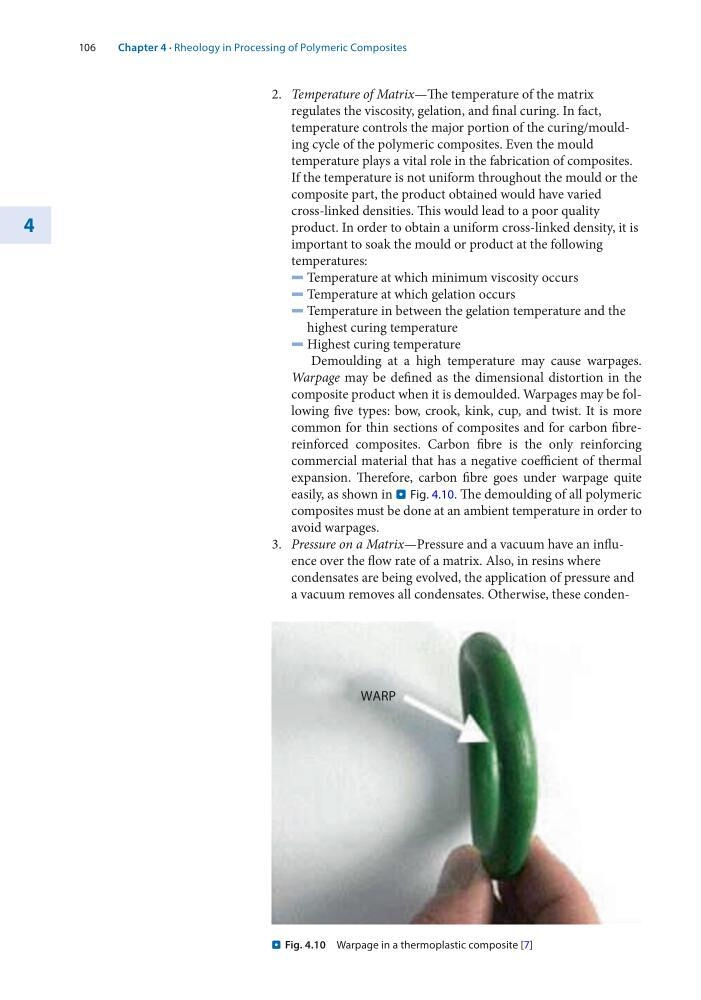
expansion. Therefore, carbon fibre goes under warpage quite
easily, as shown in . Fig. 4.10. The demoulding of all polymeric
composites must be done at an ambient temperature in order to
avoid warpages.
3. Pressure on a Matrix—Pressure and a vacuum have an influence over the flow rate of a matrix. Also, in resins where
condensates are being evolved, the application of pressure and
a vacuum removes all condensates. Otherwise, these condenWARP
. Fig. 4.10 Warpage in a thermoplastic composite [7]
Chapter 4 · Rheology in Processing of Polymeric Composites
4
2. Temperature of Matrix—The temperature of the matrix
regulates the viscosity, gelation, and final curing. In fact,
temperature controls the major portion of the curing/moulding cycle of the polymeric composites. Even the mould
temperature plays a vital role in the fabrication of composites.
If the temperature is not uniform throughout the mould or the
composite part, the product obtained would have varied
cross-linked densities. This would lead to a poor quality
product. In order to obtain a uniform cross-linked density, it is
important to soak the mould or product at the following
temperatures:
5 Temperature at which minimum viscosity occurs
5 Temperature at which gelation occurs
5 Temperature in between the gelation temperature and the
highest curing temperature
5 Highest curing temperature
Demoulding at a high temperature may cause warpages.
Warpage may be defined as the dimensional distortion in the
composite product when it is demoulded. Warpages may be following five types: bow, crook, kink, cup, and twist. It is more
common for thin sections of composites and for carbon fibrereinforced composites. Carbon fibre is the only reinforcing
commercial material that has a negative coefficient of thermal
expansion. Therefore, carbon fibre goes under warpage quite
easily, as shown in . Fig. 4.10. The demoulding of all polymeric
composites must be done at an ambient temperature in order to
avoid warpages.
3. Pressure on a Matrix—Pressure and a vacuum have an influence over the flow rate of a matrix. Also, in resins where
condensates are being evolved, the application of pressure and
a vacuum removes all condensates. Otherwise, these condenWARP
. Fig. 4.10 Warpage in a thermoplastic composite [7]
Chapter 4 · Rheology in Processing of Polymeric Composites