

Topics in Current Chemistry (2020) 378:29
1 3
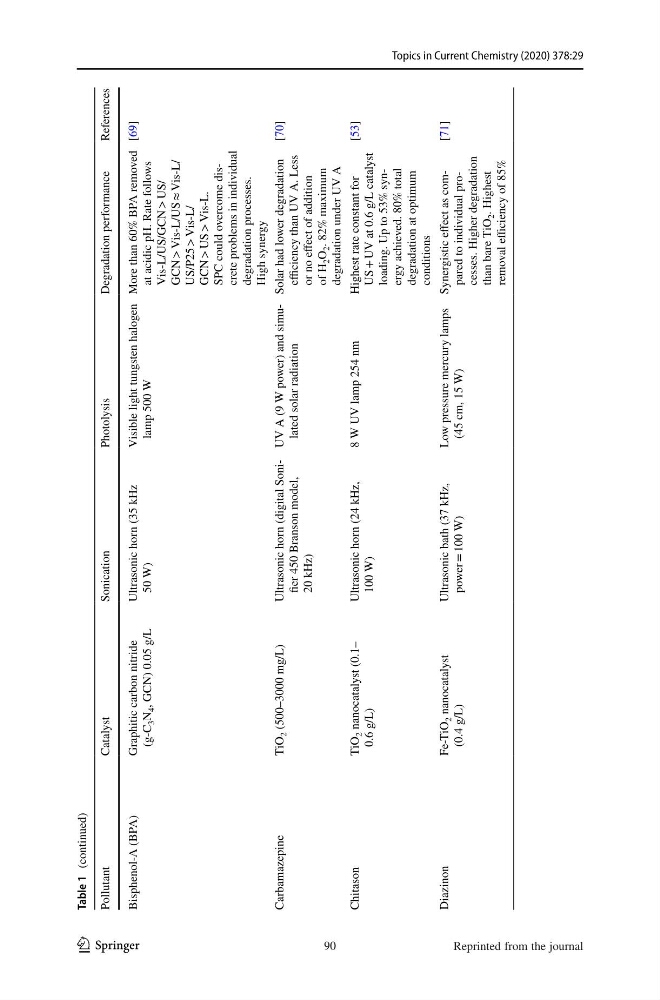
Table 1
(continued)
Pollutant
Catalyst
Sonication
Photolysis
Degradation performance
References
Bisphenol-A (BPA)
Graphitic carbon nitride
(g-C
3 N
4 , GCN) 0.05 g/L
Ultrasonic horn (35 kHz
50 W)
Visible light tungsten halogen
lamp 500 W
More than 60% BPA removed
at acidic pH. Rate follows
Vis-L/US/GCN > US/
GCN > Vis-L/US ≈ Vis-L/
US/P25 > Vis-L/
GCN > US > Vis-L.
SPC could overcome discrete problems in individual
degradation processes.
High synergy
[69]
Carbamazepine
TiO
2 (500–3000 mg/L)
Ultrasonic horn (digital Sonifier 450 Branson model,
20 kHz)
UV A (9 W power) and simulated solar radiation
Solar had lower degradation
efficiency than UV A. Less
or no effect of addition
of H
2 O
2 . 82% maximum
degradation under UV A
[70]
Chitason
TiO
2 nanocatalyst (0.1–
0.6 g/L)
Ultrasonic horn (24 kHz,
100 W)
8 W UV lamp 254 nm
Highest rate constant for
US + UV at 0.6 g/L catalyst
loading. Up to 53% synergy achieved. 80% total
degradation at optimum
conditions
[53]
Diazinon
Fe-TiO
2 nanocatalyst
(0.4 g/L)
Ultrasonic bath (37 kHz,
power
= 100 W)
Low pressure mercury lamps
(45 cm, 15 W)
Synergistic effect as compared to individual processes. Higher degradation
than bare TiO
2 . Highest
removal efficiency of 85%
[71]
90
Reprinted from the journal
1 3
Table 1
(continued)
Pollutant
Catalyst
Sonication
Photolysis
Degradation performance
References
Bisphenol-A (BPA)
Graphitic carbon nitride
(g-C
3 N
4 , GCN) 0.05 g/L
Ultrasonic horn (35 kHz
50 W)
Visible light tungsten halogen
lamp 500 W
More than 60% BPA removed
at acidic pH. Rate follows
Vis-L/US/GCN > US/
GCN > Vis-L/US ≈ Vis-L/
US/P25 > Vis-L/
GCN > US > Vis-L.
SPC could overcome discrete problems in individual
degradation processes.
High synergy
[69]
Carbamazepine
TiO
2 (500–3000 mg/L)
Ultrasonic horn (digital Sonifier 450 Branson model,
20 kHz)
UV A (9 W power) and simulated solar radiation
Solar had lower degradation
efficiency than UV A. Less
or no effect of addition
of H
2 O
2 . 82% maximum
degradation under UV A
[70]
Chitason
TiO
2 nanocatalyst (0.1–
0.6 g/L)
Ultrasonic horn (24 kHz,
100 W)
8 W UV lamp 254 nm
Highest rate constant for
US + UV at 0.6 g/L catalyst
loading. Up to 53% synergy achieved. 80% total
degradation at optimum
conditions
[53]
Diazinon
Fe-TiO
2 nanocatalyst
(0.4 g/L)
Ultrasonic bath (37 kHz,
power
= 100 W)
Low pressure mercury lamps
(45 cm, 15 W)
Synergistic effect as compared to individual processes. Higher degradation
than bare TiO
2 . Highest
removal efficiency of 85%
[71]
90
Reprinted from the journal