

1 3
Topics in Current Chemistry (2020) 378:29
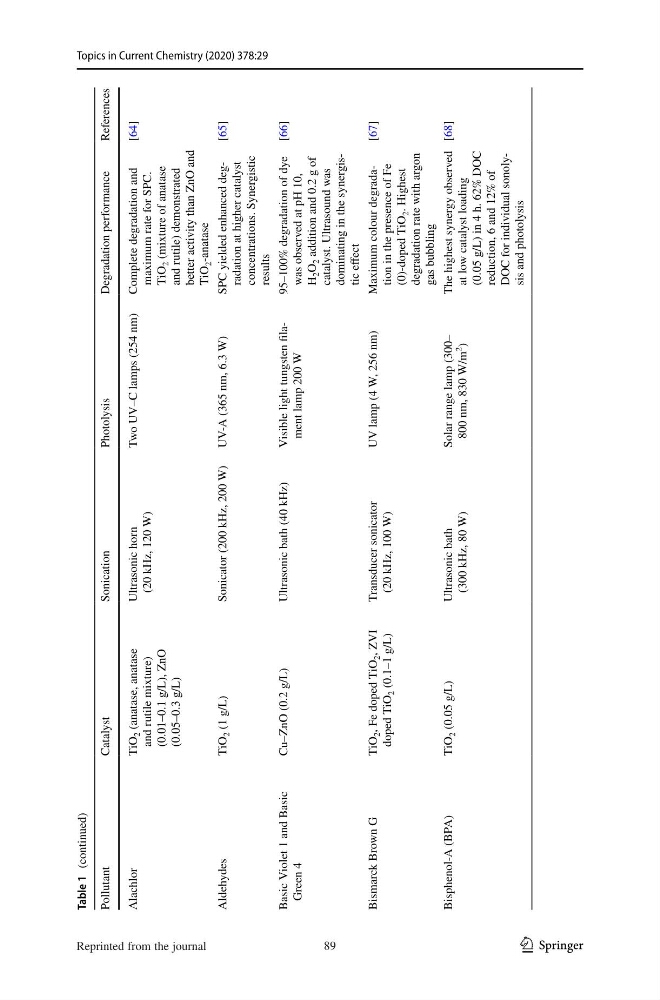
Table 1
(continued)
Pollutant
Catalyst
Sonication
Photolysis
Degradation performance
References
Alachlor
TiO
2 (anatase, anatase
and rutile mixture)
(0.01–0.1 g/L), ZnO
(0.05–0.3 g/L)
Ultrasonic horn
(20 kHz, 120 W)
Two UV–C lamps (254 nm)
Complete degradation and
maximum rate for SPC.
TiO
2 (mixture of anatase
and rutile) demonstrated
better activity than ZnO and
TiO
2 -anatase
[64]
Aldehydes
TiO
2 (1 g/L)
Sonicator (200 kHz, 200 W) UV-A (365 nm, 6.3 W)
SPC yielded enhanced degradation at higher catalyst
concentrations. Synergistic
results
[65]
Basic Violet 1 and Basic
Green 4
Cu–ZnO (0.2 g/L)
Ultrasonic bath (40 kHz)
Visible light tungsten filament lamp 200 W
95–100% degradation of dye
was observed at pH 10,
H
2 O
2 addition and 0.2 g of
catalyst. Ultrasound was
dominating in the synergistic effect
[66]
Bismarck Brown G
TiO
2 , Fe doped TiO
2 , ZVI
doped
TiO
2 (0.1–1 g/L)
Transducer sonicator
(20 kHz, 100 W)
UV lamp (4 W, 256 nm)
Maximum colour degradation in the presence of Fe
(0)-doped
TiO
2 . Highest
degradation rate with argon
gas bubbling
[67]
Bisphenol-A (BPA)
TiO
2 (0.05 g/L)
Ultrasonic bath
(300 kHz, 80 W)
Solar range lamp (300–
800 nm, 830 W/m
2
)
The highest synergy observed
at low catalyst loading
(0.05 g/L) in 4 h. 62% DOC
reduction, 6 and 12% of
DOC for individual sonolysis and photolysis
[68]
89
Reprinted from the journal
Topics in Current Chemistry (2020) 378:29
Table 1
(continued)
Pollutant
Catalyst
Sonication
Photolysis
Degradation performance
References
Alachlor
TiO
2 (anatase, anatase
and rutile mixture)
(0.01–0.1 g/L), ZnO
(0.05–0.3 g/L)
Ultrasonic horn
(20 kHz, 120 W)
Two UV–C lamps (254 nm)
Complete degradation and
maximum rate for SPC.
TiO
2 (mixture of anatase
and rutile) demonstrated
better activity than ZnO and
TiO
2 -anatase
[64]
Aldehydes
TiO
2 (1 g/L)
Sonicator (200 kHz, 200 W) UV-A (365 nm, 6.3 W)
SPC yielded enhanced degradation at higher catalyst
concentrations. Synergistic
results
[65]
Basic Violet 1 and Basic
Green 4
Cu–ZnO (0.2 g/L)
Ultrasonic bath (40 kHz)
Visible light tungsten filament lamp 200 W
95–100% degradation of dye
was observed at pH 10,
H
2 O
2 addition and 0.2 g of
catalyst. Ultrasound was
dominating in the synergistic effect
[66]
Bismarck Brown G
TiO
2 , Fe doped TiO
2 , ZVI
doped
TiO
2 (0.1–1 g/L)
Transducer sonicator
(20 kHz, 100 W)
UV lamp (4 W, 256 nm)
Maximum colour degradation in the presence of Fe
(0)-doped
TiO
2 . Highest
degradation rate with argon
gas bubbling
[67]
Bisphenol-A (BPA)
TiO
2 (0.05 g/L)
Ultrasonic bath
(300 kHz, 80 W)
Solar range lamp (300–
800 nm, 830 W/m
2
)
The highest synergy observed
at low catalyst loading
(0.05 g/L) in 4 h. 62% DOC
reduction, 6 and 12% of
DOC for individual sonolysis and photolysis
[68]
89
Reprinted from the journal