

Topics in Current Chemistry (2020) 378:29
1 3
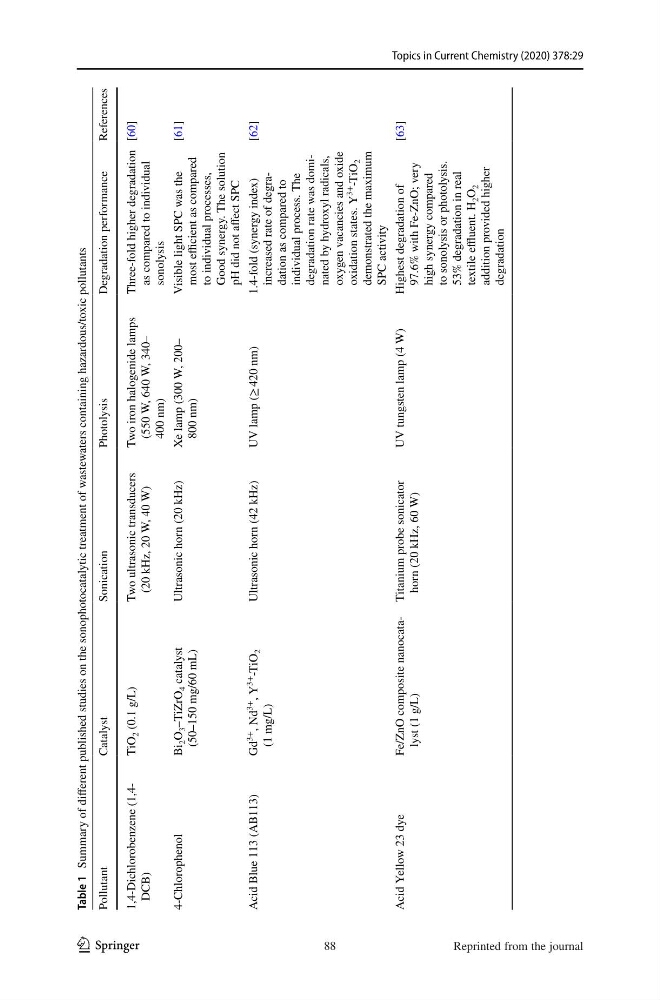
Table 1
Summary of different published studies on the sonophotocatalytic treatment of wastewaters containing hazardous/toxic pollutants
Pollutant
Catalyst
Sonication
Photolysis
Degradation performance
References
1,4-Dichlorobenzene (1,4DCB)
TiO
2 (0.1 g/L)
Two ultrasonic transducers
(20 kHz, 20 W, 40 W)
Two iron halogenide lamps
(550 W, 640 W, 340–
400 nm)
Three-fold higher degradation
as compared to individual
sonolysis
[60]
4-Chlorophenol
Bi
2 O
3 –TiZrO
4 catalyst
(50–150 mg/60 mL)
Ultrasonic horn (20 kHz)
Xe lamp (300 W, 200–
800 nm)
Visible light SPC was the
most efficient as compared
to individual processes,
Good synergy. The solution
pH did not affect SPC
[61]
Acid Blue 113 (AB113)
Gd
3+
, Nd
3+
, Y
3+
-TiO
2
(1 mg/L)
Ultrasonic horn (42 kHz)
UV lamp (≥ 420 nm)
1.4-fold (synergy index)
increased rate of degradation as compared to
individual process. The
degradation rate was dominated by hydroxyl radicals,
oxygen vacancies and oxide
oxidation states. Y
3+
-TiO
2
demonstrated the maximum
SPC activity
[62]
Acid Yellow 23 dye
Fe/ZnO composite nanocatalyst (1 g/L)
Titanium probe sonicator
horn (20 kHz, 60 W)
UV tungsten lamp (4 W)
Highest degradation of
97.6% with Fe-ZnO; very
high synergy compared
to sonolysis or photolysis.
53% degradation in real
textile effluent. H
2 O
2
addition provided higher
degradation
[63]
88
Reprinted from the journal
1 3
Table 1
Summary of different published studies on the sonophotocatalytic treatment of wastewaters containing hazardous/toxic pollutants
Pollutant
Catalyst
Sonication
Photolysis
Degradation performance
References
1,4-Dichlorobenzene (1,4DCB)
TiO
2 (0.1 g/L)
Two ultrasonic transducers
(20 kHz, 20 W, 40 W)
Two iron halogenide lamps
(550 W, 640 W, 340–
400 nm)
Three-fold higher degradation
as compared to individual
sonolysis
[60]
4-Chlorophenol
Bi
2 O
3 –TiZrO
4 catalyst
(50–150 mg/60 mL)
Ultrasonic horn (20 kHz)
Xe lamp (300 W, 200–
800 nm)
Visible light SPC was the
most efficient as compared
to individual processes,
Good synergy. The solution
pH did not affect SPC
[61]
Acid Blue 113 (AB113)
Gd
3+
, Nd
3+
, Y
3+
-TiO
2
(1 mg/L)
Ultrasonic horn (42 kHz)
UV lamp (≥ 420 nm)
1.4-fold (synergy index)
increased rate of degradation as compared to
individual process. The
degradation rate was dominated by hydroxyl radicals,
oxygen vacancies and oxide
oxidation states. Y
3+
-TiO
2
demonstrated the maximum
SPC activity
[62]
Acid Yellow 23 dye
Fe/ZnO composite nanocatalyst (1 g/L)
Titanium probe sonicator
horn (20 kHz, 60 W)
UV tungsten lamp (4 W)
Highest degradation of
97.6% with Fe-ZnO; very
high synergy compared
to sonolysis or photolysis.
53% degradation in real
textile effluent. H
2 O
2
addition provided higher
degradation
[63]
88
Reprinted from the journal