

1 3
Topics in Current Chemistry (2020) 378:29
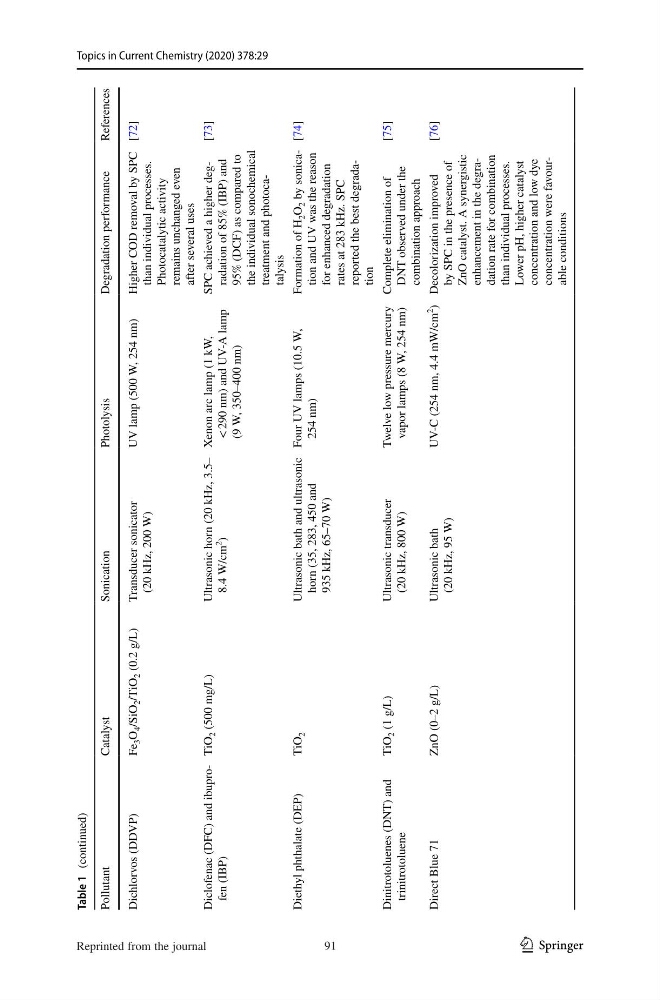
Table 1
(continued)
Pollutant
Catalyst
Sonication
Photolysis
Degradation performance
References
Dichlorvos (DDVP)
Fe
3 O
4 /SiO
2 /TiO
2 (0.2 g/L)
Transducer sonicator
(20 kHz, 200 W)
UV lamp (500 W, 254 nm)
Higher COD removal by SPC
than individual processes.
Photocatalytic activity
remains unchanged even
after several uses
[72]
Diclofenac (DFC) and ibuprofen (IBP)
TiO
2 (500 mg/L)
Ultrasonic horn (20 kHz, 3.5–
8.4 W/cm
2
)
Xenon arc lamp (1 kW,
< 290 nm) and UV-A lamp
(9 W, 350–400 nm)
SPC achieved a higher degradation of 85% (IBP) and
95% (DCF) as compared to
the individual sonochemical
treatment and photocatalysis
[73]
Diethyl phthalate (DEP)
TiO
2
Ultrasonic bath and ultrasonic
horn (35, 283, 450 and
935 kHz, 65–70 W)
Four UV lamps (10.5 W,
254 nm)
Formation of H
2 O
2 by sonication and UV was the reason
for enhanced degradation
rates at 283 kHz. SPC
reported the best degradation
[74]
Dinitrotoluenes (DNT) and
trinitrotoluene
TiO
2 (1 g/L)
Ultrasonic transducer
(20 kHz, 800 W)
Twelve low pressure mercury
vapor lamps (8 W, 254 nm)
Complete elimination of
DNT observed under the
combination approach
[75]
Direct Blue 71
ZnO (0–2 g/L)
Ultrasonic bath
(20 kHz, 95 W)
UV-C (254 nm, 4.4 mW/cm
2
) Decolorization improved
by SPC in the presence of
ZnO catalyst. A synergistic
enhancement in the degradation rate for combination
than individual processes.
Lower pH, higher catalyst
concentration and low dye
concentration were favourable conditions
[76]
91
Reprinted from the journal
Topics in Current Chemistry (2020) 378:29
Table 1
(continued)
Pollutant
Catalyst
Sonication
Photolysis
Degradation performance
References
Dichlorvos (DDVP)
Fe
3 O
4 /SiO
2 /TiO
2 (0.2 g/L)
Transducer sonicator
(20 kHz, 200 W)
UV lamp (500 W, 254 nm)
Higher COD removal by SPC
than individual processes.
Photocatalytic activity
remains unchanged even
after several uses
[72]
Diclofenac (DFC) and ibuprofen (IBP)
TiO
2 (500 mg/L)
Ultrasonic horn (20 kHz, 3.5–
8.4 W/cm
2
)
Xenon arc lamp (1 kW,
< 290 nm) and UV-A lamp
(9 W, 350–400 nm)
SPC achieved a higher degradation of 85% (IBP) and
95% (DCF) as compared to
the individual sonochemical
treatment and photocatalysis
[73]
Diethyl phthalate (DEP)
TiO
2
Ultrasonic bath and ultrasonic
horn (35, 283, 450 and
935 kHz, 65–70 W)
Four UV lamps (10.5 W,
254 nm)
Formation of H
2 O
2 by sonication and UV was the reason
for enhanced degradation
rates at 283 kHz. SPC
reported the best degradation
[74]
Dinitrotoluenes (DNT) and
trinitrotoluene
TiO
2 (1 g/L)
Ultrasonic transducer
(20 kHz, 800 W)
Twelve low pressure mercury
vapor lamps (8 W, 254 nm)
Complete elimination of
DNT observed under the
combination approach
[75]
Direct Blue 71
ZnO (0–2 g/L)
Ultrasonic bath
(20 kHz, 95 W)
UV-C (254 nm, 4.4 mW/cm
2
) Decolorization improved
by SPC in the presence of
ZnO catalyst. A synergistic
enhancement in the degradation rate for combination
than individual processes.
Lower pH, higher catalyst
concentration and low dye
concentration were favourable conditions
[76]
91
Reprinted from the journal