

Topics in Current Chemistry (2020) 378:29
1 3
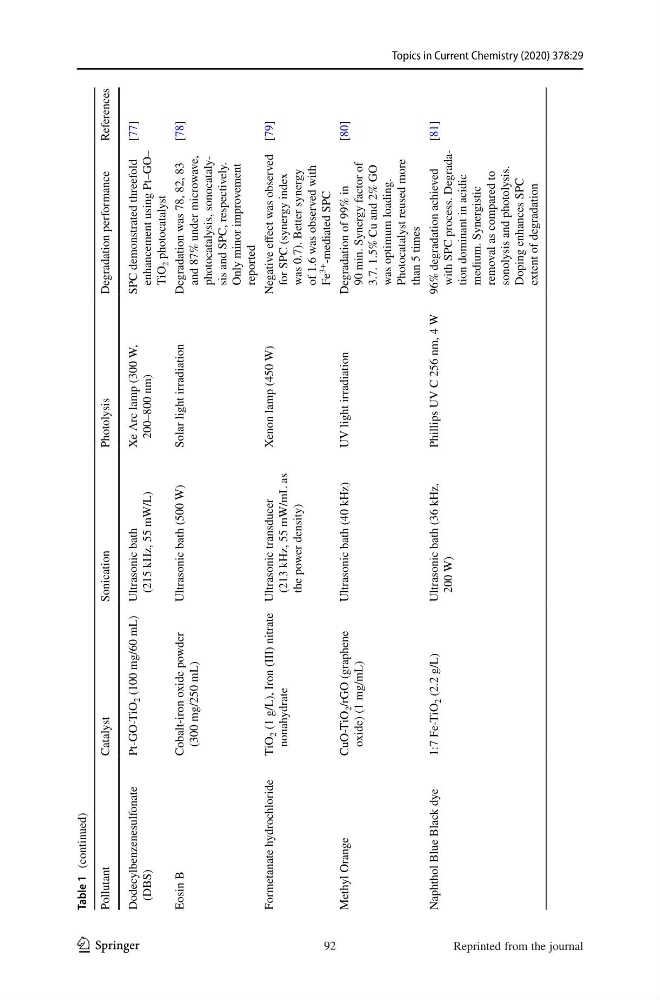
Table 1
(continued)
Pollutant
Catalyst
Sonication
Photolysis
Degradation performance
References
Dodecylbenzenesulfonate
(DBS)
Pt-GO-TiO
2 (100 mg/60 mL) Ultrasonic bath
(215 kHz, 55 mW/L)
Xe Arc lamp (300 W,
200–800 nm)
SPC demonstrated threefold
enhancement using Pt–GO–
TiO
2 photocatalyst
[77]
Eosin B
Cobalt-iron oxide powder
(300 mg/250 mL)
Ultrasonic bath (500 W)
Solar light irradiation
Degradation was 78, 82, 83
and 87% under microwave,
photocatalysis, sonocatalysis and SPC, respectively.
Only minor improvement
reported
[78]
Formetanate hydrochloride
TiO
2 (1 g/L), Iron (III) nitrate
nonahydrate
Ultrasonic transducer
(213 kHz, 55 mW/mL as
the power density)
Xenon lamp (450 W)
Negative effect was observed
for SPC (synergy index
was 0.7). Better synergy
of 1.6 was observed with
Fe
3+
-mediated SPC
[79]
Methyl Orange
CuO-TiO
2 /rGO (graphene
oxide) (1 mg/mL)
Ultrasonic bath (40 kHz)
UV light irradiation
Degradation of 99% in
90 min. Synergy factor of
3.7. 1.5% Cu and 2% GO
was optimum loading.
Photocatalyst reused more
than 5 times
[80]
Naphthol Blue Black dye
1:7 Fe-TiO
2 (2.2 g/L)
Ultrasonic bath (36 kHz,
200 W)
Phillips UV C 256 nm, 4 W
96% degradation achieved
with SPC process. Degradation dominant in acidic
medium. Synergistic
removal as compared to
sonolysis and photolysis.
Doping enhances SPC
extent of degradation
[81]
92
Reprinted from the journal
1 3
Table 1
(continued)
Pollutant
Catalyst
Sonication
Photolysis
Degradation performance
References
Dodecylbenzenesulfonate
(DBS)
Pt-GO-TiO
2 (100 mg/60 mL) Ultrasonic bath
(215 kHz, 55 mW/L)
Xe Arc lamp (300 W,
200–800 nm)
SPC demonstrated threefold
enhancement using Pt–GO–
TiO
2 photocatalyst
[77]
Eosin B
Cobalt-iron oxide powder
(300 mg/250 mL)
Ultrasonic bath (500 W)
Solar light irradiation
Degradation was 78, 82, 83
and 87% under microwave,
photocatalysis, sonocatalysis and SPC, respectively.
Only minor improvement
reported
[78]
Formetanate hydrochloride
TiO
2 (1 g/L), Iron (III) nitrate
nonahydrate
Ultrasonic transducer
(213 kHz, 55 mW/mL as
the power density)
Xenon lamp (450 W)
Negative effect was observed
for SPC (synergy index
was 0.7). Better synergy
of 1.6 was observed with
Fe
3+
-mediated SPC
[79]
Methyl Orange
CuO-TiO
2 /rGO (graphene
oxide) (1 mg/mL)
Ultrasonic bath (40 kHz)
UV light irradiation
Degradation of 99% in
90 min. Synergy factor of
3.7. 1.5% Cu and 2% GO
was optimum loading.
Photocatalyst reused more
than 5 times
[80]
Naphthol Blue Black dye
1:7 Fe-TiO
2 (2.2 g/L)
Ultrasonic bath (36 kHz,
200 W)
Phillips UV C 256 nm, 4 W
96% degradation achieved
with SPC process. Degradation dominant in acidic
medium. Synergistic
removal as compared to
sonolysis and photolysis.
Doping enhances SPC
extent of degradation
[81]
92
Reprinted from the journal