

Topics in Current Chemistry (2020) 378:29
1 3
et al. [30] studied the synthesis of Graphene–Ce–TiO 2 and Graphene–Fe–TiO 2
nanocomposites in the presence of ultrasound (horn-type system with a frequency
of 22 kHz and rated power dissipation of 200 W). The proper formation of the composites was confirmed based on the X-ray powder diffraction (XRD) analysis. X-ray
fluorescence analysis confirmed the presence of metals (Ce and Fe) in the obtained
catalyst. Subsequently, the obtained catalyst was also successfully demonstrated
to show excellent activity for degradation of crystal violet dye. Comparison of the
different catalysts revealed that the Fe-based composite showed a higher degradation rate constant than both the Ce-based composite and the bare graphene–TiO 2
[30]. The presence of Fe or Ce helped in enhancing the charge transfer, as shown in
Fig. 5 which reproduces the schematic representation of the proposed mechanism.
Also, the rate of the recombination of the electron–hole pair reduced to drive the
higher photocatalytic oxidation activity.
Another modification in the application of TiO 2 as the catalyst is the use of metal
doping with the objective of enhancing the interfacial charge transfer in photocatalytic degradation processes. Metal deposition is the most frequently studied modification for TiO 2 in terms of effects on the photochemical properties of its surface.
Metal deposition involves the loading of metal nanoparticles at the TiO 2 surface by
either photodeposition [31] or impregnation [32]. UV irradiation on metal-modified
TiO 2 surfaces induces a Fermi level equilibration between the metal and TiO 2 via
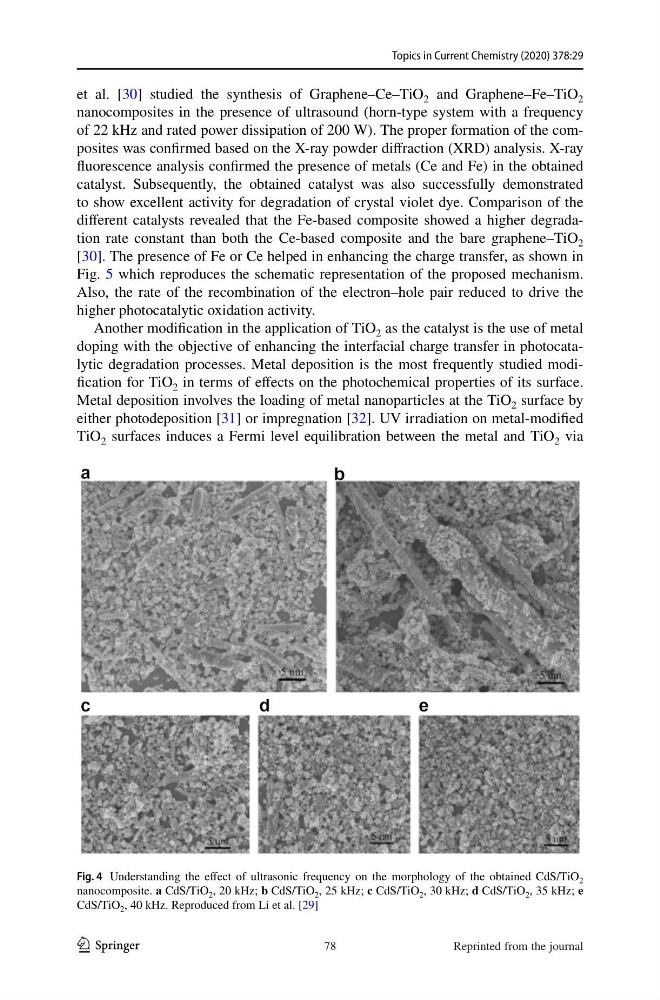
Fig. 4 Understanding the effect of ultrasonic frequency on the morphology of the obtained CdS/TiO 2
nanocomposite. a CdS/TiO 2 , 20 kHz; b CdS/TiO 2 , 25 kHz; c CdS/TiO 2 , 30 kHz; d CdS/TiO 2 , 35 kHz; e
CdS/TiO 2 , 40 kHz. Reproduced from Li et al. [29]
78
Reprinted from the journal
1 3
et al. [30] studied the synthesis of Graphene–Ce–TiO 2 and Graphene–Fe–TiO 2
nanocomposites in the presence of ultrasound (horn-type system with a frequency
of 22 kHz and rated power dissipation of 200 W). The proper formation of the composites was confirmed based on the X-ray powder diffraction (XRD) analysis. X-ray
fluorescence analysis confirmed the presence of metals (Ce and Fe) in the obtained
catalyst. Subsequently, the obtained catalyst was also successfully demonstrated
to show excellent activity for degradation of crystal violet dye. Comparison of the
different catalysts revealed that the Fe-based composite showed a higher degradation rate constant than both the Ce-based composite and the bare graphene–TiO 2
[30]. The presence of Fe or Ce helped in enhancing the charge transfer, as shown in
Fig. 5 which reproduces the schematic representation of the proposed mechanism.
Also, the rate of the recombination of the electron–hole pair reduced to drive the
higher photocatalytic oxidation activity.
Another modification in the application of TiO 2 as the catalyst is the use of metal
doping with the objective of enhancing the interfacial charge transfer in photocatalytic degradation processes. Metal deposition is the most frequently studied modification for TiO 2 in terms of effects on the photochemical properties of its surface.
Metal deposition involves the loading of metal nanoparticles at the TiO 2 surface by
either photodeposition [31] or impregnation [32]. UV irradiation on metal-modified
TiO 2 surfaces induces a Fermi level equilibration between the metal and TiO 2 via
Fig. 4 Understanding the effect of ultrasonic frequency on the morphology of the obtained CdS/TiO 2
nanocomposite. a CdS/TiO 2 , 20 kHz; b CdS/TiO 2 , 25 kHz; c CdS/TiO 2 , 30 kHz; d CdS/TiO 2 , 35 kHz; e
CdS/TiO 2 , 40 kHz. Reproduced from Li et al. [29]
78
Reprinted from the journal