

1 3
Topics in Current Chemistry (2020) 378:29
CdSe-TiO 2 photocatalyst has also been reported [21]. CdSe acts as a photosensitizer
and adds the visible light spectrum for TiO 2 application and also prevents recombination, resulting in higher activity. In that study, an ultrasonic bath enhanced the uniformity of the photocatalyst and reduced the synthesis time [21]. In a different study,
CdS/TiO 2 nanoparticles were synthesized, with sonoluminescence used to produce
nanoparticles of different sizes, morphologies and shapes [29]. The application of
ultrasound was based on the horn-type system, and different transducers operating at
various frequencies were used to study the effect of frequency. It was clearly established that the effect of ultrasonic intensity was dominant in defining the morphology and shape of the nanoparticles. Figure 4 shows that both nanorod and nanoparticle structures are produced and that the morphological characteristics depends
on the ultrasonic frequency. This figure also reveals that with an increase in ultrasound frequency the diameter of the spherical nanoparticles increases slightly and
the probability of the occurrence of the rod-like structure is decreased. The observed
trend indicates that lower frequency drives the higher crystallinity of CdS, possibly attributable to the dominance of physical effects [29]. In another study, Shende
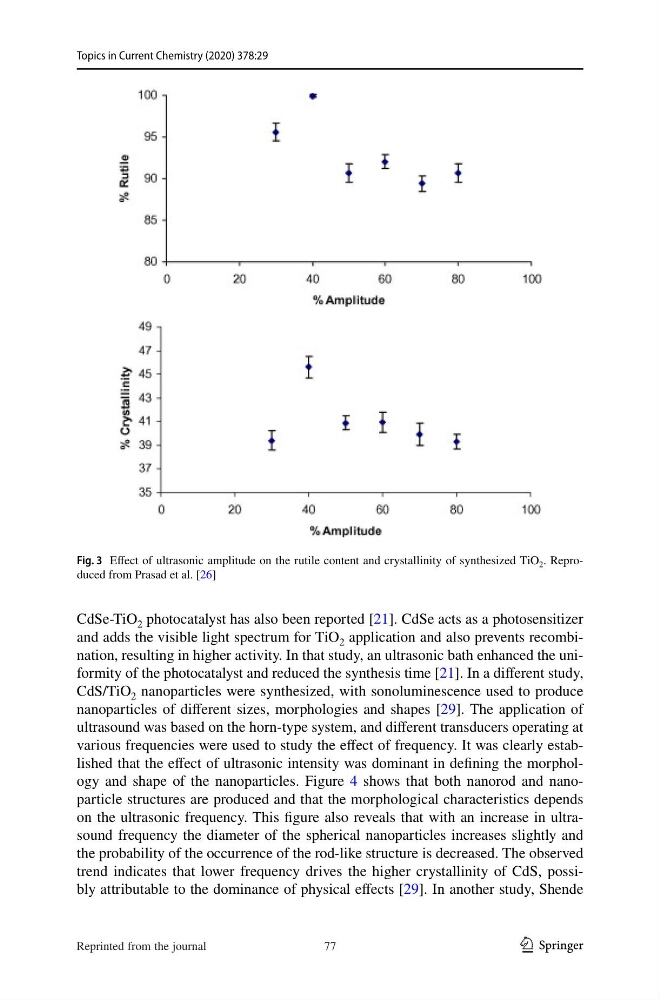
Fig. 3 Effect of ultrasonic amplitude on the rutile content and crystallinity of synthesized TiO 2 . Reproduced from Prasad et al. [26]
77
Reprinted from the journal
Topics in Current Chemistry (2020) 378:29
CdSe-TiO 2 photocatalyst has also been reported [21]. CdSe acts as a photosensitizer
and adds the visible light spectrum for TiO 2 application and also prevents recombination, resulting in higher activity. In that study, an ultrasonic bath enhanced the uniformity of the photocatalyst and reduced the synthesis time [21]. In a different study,
CdS/TiO 2 nanoparticles were synthesized, with sonoluminescence used to produce
nanoparticles of different sizes, morphologies and shapes [29]. The application of
ultrasound was based on the horn-type system, and different transducers operating at
various frequencies were used to study the effect of frequency. It was clearly established that the effect of ultrasonic intensity was dominant in defining the morphology and shape of the nanoparticles. Figure 4 shows that both nanorod and nanoparticle structures are produced and that the morphological characteristics depends
on the ultrasonic frequency. This figure also reveals that with an increase in ultrasound frequency the diameter of the spherical nanoparticles increases slightly and
the probability of the occurrence of the rod-like structure is decreased. The observed
trend indicates that lower frequency drives the higher crystallinity of CdS, possibly attributable to the dominance of physical effects [29]. In another study, Shende
Fig. 3 Effect of ultrasonic amplitude on the rutile content and crystallinity of synthesized TiO 2 . Reproduced from Prasad et al. [26]
77
Reprinted from the journal