

Topics in Current Chemistry (2020) 378:29
1 3
WO 3 photocatalyst [28]. The source of the ultrasound was an ultrasonic horn operating at a frequency of 20 kHz and a power intensity of 100 W/cm
2
. It was reported
that nanomaterials having a diameter of 8–12 nm that were square and hexagonal in
shape were obtained within a total synthesis time of 9 h, including the steps of calcination and drying. Brunauer–Emmett–Teller (BET) surface area analysis revealed
that the obtained surface area of 1.38 m
2
/g was higher than that of other nanocomposites reported in the literature. A simple ultrasonic bath synthesis method for the
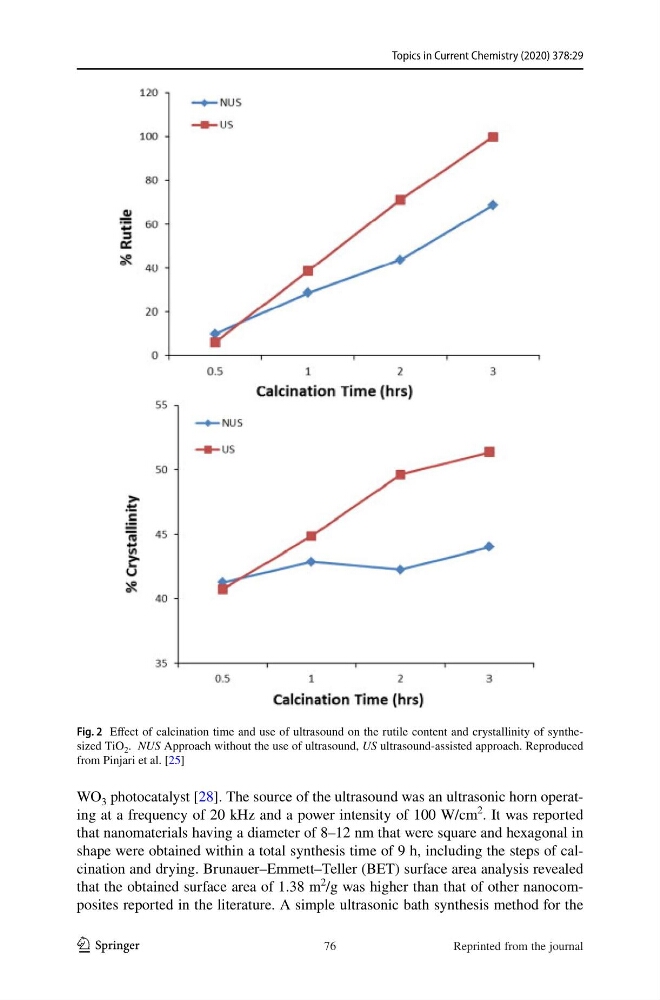
Fig. 2 Effect of calcination time and use of ultrasound on the rutile content and crystallinity of synthesized TiO 2 . NUS Approach without the use of ultrasound, US ultrasound-assisted approach. Reproduced
from Pinjari et al. [25]
76
Reprinted from the journal
1 3
WO 3 photocatalyst [28]. The source of the ultrasound was an ultrasonic horn operating at a frequency of 20 kHz and a power intensity of 100 W/cm
2
. It was reported
that nanomaterials having a diameter of 8–12 nm that were square and hexagonal in
shape were obtained within a total synthesis time of 9 h, including the steps of calcination and drying. Brunauer–Emmett–Teller (BET) surface area analysis revealed
that the obtained surface area of 1.38 m
2
/g was higher than that of other nanocomposites reported in the literature. A simple ultrasonic bath synthesis method for the
Fig. 2 Effect of calcination time and use of ultrasound on the rutile content and crystallinity of synthesized TiO 2 . NUS Approach without the use of ultrasound, US ultrasound-assisted approach. Reproduced
from Pinjari et al. [25]
76
Reprinted from the journal