

Topics in Current Chemistry (2020) 378:2
1 3
nanosheets (Fig. 11ii). In 2004, Suzuki and Yoshikawa expanded the analysis by
proposing that the presence of water molecules is crucial [100], expressing the formula as H 2 Ti 3 O 7 .nH 2 O, and showed that these moieties of the crystallographic water
play a role in the interlayer spacing of titanate layers of the NTB’s wall.
In general, this synthetic process involves two main steps, the first being a conventional solid-state reaction between TiO 2 and sodium ions in basic solution, forming layered structures peeled from the initial particles. The second step involves the
ion exchange during the acid treatment, HCl in almost all reported cases. Two factors are important regarding the formation of the alkali metal stabilized nanotubes:
(1) how the nanosheets are formed from the spherical (in most cases) nanoparticles, and (2) how the nanosheets are converted to NTBs. Regarding the first aspect,
Nakahira et al. showed by TEM observation (Fig. 12i) in 2010 that the formation by
surface exfoliation of the nanosheets and their rolling/wrapping to NTBs take place
on the surface, using as raw material an anatase-type titanium dioxide, and they proposed the entire process by various characterizations [102]. Bavykin et al. presented
three different possible mechanisms of the conversion of the nanosheets to open-end
multi-wall NTB, resulting in differently structured tubular shapes (Fig. 12ii) [103].
After the first reports of the TiNTBs, an intense research effort was focused on
tuning different parameters during synthesis in order to control the structural and
morphological features, the homogeneity and purity of the formed TiNTBs, as well
as to decrease the synthesis temperature and duration [100, 102–110]. However,
some arguments were derived. More details regarding titania NTBs obtained by
hydrothermal-based synthesis can be found in the review article reported in 2011 by
Wong et al. [111]. In many of the reports regarding the synthesis of the 1-D nanotubular structures, US irradiation was applied at different stages of the process, but
without analyzing the possible role. It is feasible to believe that US led to specific
effects that were not explored. Sonication can also help the characterization and separation of the TiNTBs. Interestingly, Bavykin et al. showed that US irradiation can
be beneficial in order to distinguish the nature of the high observed pore volume by
separating the agglomerates into individual NTBs [103].
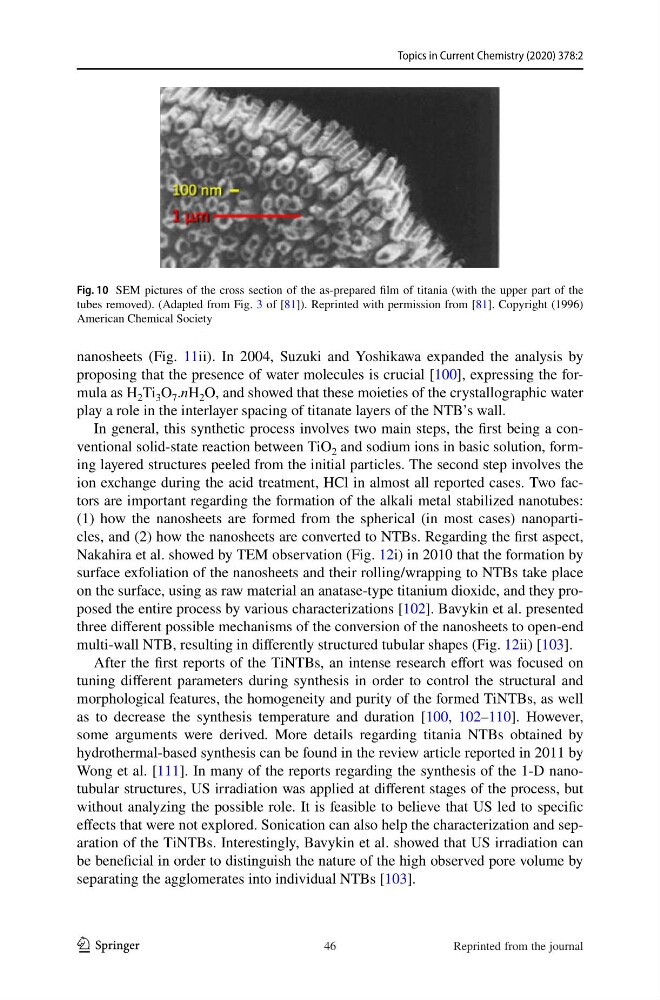
Fig. 10 SEM pictures of the cross section of the as-prepared film of titania (with the upper part of the
tubes removed). (Adapted from Fig. 3 of [81]). Reprinted with permission from [81]. Copyright (1996)
American Chemical Society
46
Reprinted from the journal
1 3
nanosheets (Fig. 11ii). In 2004, Suzuki and Yoshikawa expanded the analysis by
proposing that the presence of water molecules is crucial [100], expressing the formula as H 2 Ti 3 O 7 .nH 2 O, and showed that these moieties of the crystallographic water
play a role in the interlayer spacing of titanate layers of the NTB’s wall.
In general, this synthetic process involves two main steps, the first being a conventional solid-state reaction between TiO 2 and sodium ions in basic solution, forming layered structures peeled from the initial particles. The second step involves the
ion exchange during the acid treatment, HCl in almost all reported cases. Two factors are important regarding the formation of the alkali metal stabilized nanotubes:
(1) how the nanosheets are formed from the spherical (in most cases) nanoparticles, and (2) how the nanosheets are converted to NTBs. Regarding the first aspect,
Nakahira et al. showed by TEM observation (Fig. 12i) in 2010 that the formation by
surface exfoliation of the nanosheets and their rolling/wrapping to NTBs take place
on the surface, using as raw material an anatase-type titanium dioxide, and they proposed the entire process by various characterizations [102]. Bavykin et al. presented
three different possible mechanisms of the conversion of the nanosheets to open-end
multi-wall NTB, resulting in differently structured tubular shapes (Fig. 12ii) [103].
After the first reports of the TiNTBs, an intense research effort was focused on
tuning different parameters during synthesis in order to control the structural and
morphological features, the homogeneity and purity of the formed TiNTBs, as well
as to decrease the synthesis temperature and duration [100, 102–110]. However,
some arguments were derived. More details regarding titania NTBs obtained by
hydrothermal-based synthesis can be found in the review article reported in 2011 by
Wong et al. [111]. In many of the reports regarding the synthesis of the 1-D nanotubular structures, US irradiation was applied at different stages of the process, but
without analyzing the possible role. It is feasible to believe that US led to specific
effects that were not explored. Sonication can also help the characterization and separation of the TiNTBs. Interestingly, Bavykin et al. showed that US irradiation can
be beneficial in order to distinguish the nature of the high observed pore volume by
separating the agglomerates into individual NTBs [103].
Fig. 10 SEM pictures of the cross section of the as-prepared film of titania (with the upper part of the
tubes removed). (Adapted from Fig. 3 of [81]). Reprinted with permission from [81]. Copyright (1996)
American Chemical Society
46
Reprinted from the journal