

1 3
Topics in Current Chemistry (2020) 378:2
The focus of the following part is on how the sonication can play a vital role for
the manipulation of the TiNTBs’ important factors like size, shape, porosity, peeling
of the nanosheets, and more, as well as how the process can be achieved faster with
a more environmental and energy-friendly manner. The photocatalytic activities and
the involved mechanisms, if reported, are also introduced and discussed.
2.2.2 1D Titania by Ultrasound Irradiation
In 2001, Zhu et al. [112] demonstrated that the utilization of low-frequency US can
promote the formation of 1-D titanate nanoparticles. The one-pot synthesis of the
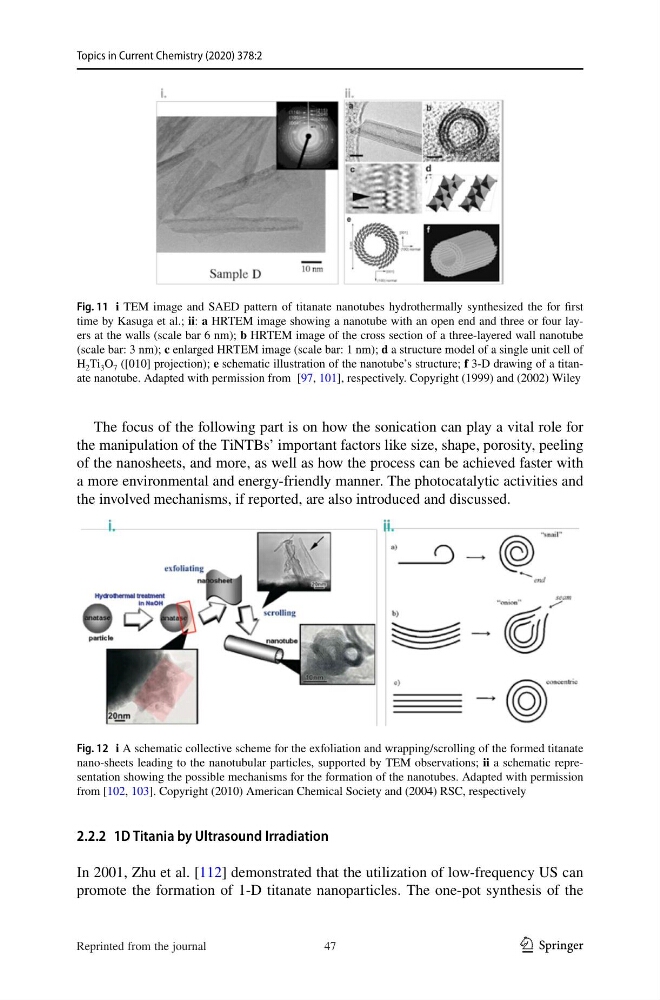
Fig. 11 i TEM image and SAED pattern of titanate nanotubes hydrothermally synthesized the for first
time by Kasuga et al.; ii: a HRTEM image showing a nanotube with an open end and three or four layers at the walls (scale bar 6 nm); b HRTEM image of the cross section of a three-layered wall nanotube
(scale bar: 3 nm); c enlarged HRTEM image (scale bar: 1 nm); d a structure model of a single unit cell of
H 2 Ti 3 O 7 ([010] projection); e schematic illustration of the nanotube’s structure; f 3-D drawing of a titanate nanotube. Adapted with permission from [97, 101], respectively. Copyright (1999) and (2002) Wiley
Fig. 12 i A schematic collective scheme for the exfoliation and wrapping/scrolling of the formed titanate
nano-sheets leading to the nanotubular particles, supported by TEM observations; ii a schematic representation showing the possible mechanisms for the formation of the nanotubes. Adapted with permission
from [102, 103]. Copyright (2010) American Chemical Society and (2004) RSC, respectively
47
Reprinted from the journal
Topics in Current Chemistry (2020) 378:2
The focus of the following part is on how the sonication can play a vital role for
the manipulation of the TiNTBs’ important factors like size, shape, porosity, peeling
of the nanosheets, and more, as well as how the process can be achieved faster with
a more environmental and energy-friendly manner. The photocatalytic activities and
the involved mechanisms, if reported, are also introduced and discussed.
2.2.2 1D Titania by Ultrasound Irradiation
In 2001, Zhu et al. [112] demonstrated that the utilization of low-frequency US can
promote the formation of 1-D titanate nanoparticles. The one-pot synthesis of the
Fig. 11 i TEM image and SAED pattern of titanate nanotubes hydrothermally synthesized the for first
time by Kasuga et al.; ii: a HRTEM image showing a nanotube with an open end and three or four layers at the walls (scale bar 6 nm); b HRTEM image of the cross section of a three-layered wall nanotube
(scale bar: 3 nm); c enlarged HRTEM image (scale bar: 1 nm); d a structure model of a single unit cell of
H 2 Ti 3 O 7 ([010] projection); e schematic illustration of the nanotube’s structure; f 3-D drawing of a titanate nanotube. Adapted with permission from [97, 101], respectively. Copyright (1999) and (2002) Wiley
Fig. 12 i A schematic collective scheme for the exfoliation and wrapping/scrolling of the formed titanate
nano-sheets leading to the nanotubular particles, supported by TEM observations; ii a schematic representation showing the possible mechanisms for the formation of the nanotubes. Adapted with permission
from [102, 103]. Copyright (2010) American Chemical Society and (2004) RSC, respectively
47
Reprinted from the journal