

1 3
Topics in Current Chemistry (2020) 378:2
2.2 1‑D Particles
2.2.1 1‑D Titanium Oxide and Titania
In the literature, various different names/terminologies are used for the characterization of the structure and shape of the 1-D synthesized materials, like fibers, whiskers, nanotubules, fibrils, nanocable, rods, nanowires, belts, since the definition and
nomenclature are not well stablished [93]. The geometrical shapes of the titanium
oxides that are more widely accepted, reported as a characteristic based on electron
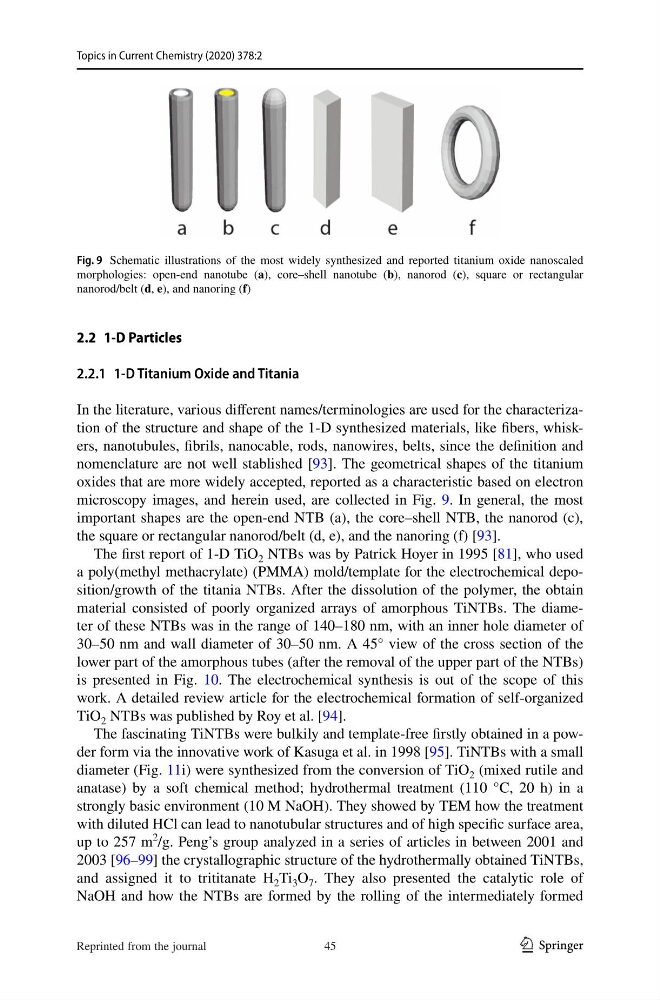
microscopy images, and herein used, are collected in Fig. 9. In general, the most
important shapes are the open-end NTB (a), the core–shell NTB, the nanorod (c),
the square or rectangular nanorod/belt (d, e), and the nanoring (f) [93].
The first report of 1-D TiO 2 NTBs was by Patrick Hoyer in 1995 [81], who used
a poly(methyl methacrylate) (PMMA) mold/template for the electrochemical deposition/growth of the titania NTBs. After the dissolution of the polymer, the obtain
material consisted of poorly organized arrays of amorphous TiNTBs. The diameter of these NTBs was in the range of 140–180 nm, with an inner hole diameter of
30–50 nm and wall diameter of 30–50 nm. A 45° view of the cross section of the
lower part of the amorphous tubes (after the removal of the upper part of the NTBs)
is presented in Fig. 10. The electrochemical synthesis is out of the scope of this
work. A detailed review article for the electrochemical formation of self-organized
TiO 2 NTBs was published by Roy et al. [94].
The fascinating TiNTBs were bulkily and template-free firstly obtained in a powder form via the innovative work of Kasuga et al. in 1998 [95]. TiNTBs with a small
diameter (Fig. 11i) were synthesized from the conversion of TiO 2 (mixed rutile and
anatase) by a soft chemical method; hydrothermal treatment (110 °C, 20 h) in a
strongly basic environment (10 M NaOH). They showed by TEM how the treatment
with diluted HCl can lead to nanotubular structures and of high specific surface area,
up to 257 m
2
/g. Peng’s group analyzed in a series of articles in between 2001 and
2003 [96–99] the crystallographic structure of the hydrothermally obtained TiNTBs,
and assigned it to trititanate H 2 Ti 3 O 7 . They also presented the catalytic role of
NaOH and how the NTBs are formed by the rolling of the intermediately formed
Fig. 9 Schematic illustrations of the most widely synthesized and reported titanium oxide nanoscaled
morphologies: open-end nanotube (a), core–shell nanotube (b), nanorod (c), square or rectangular
nanorod/belt (d, e), and nanoring (f)
45
Reprinted from the journal
Topics in Current Chemistry (2020) 378:2
2.2 1‑D Particles
2.2.1 1‑D Titanium Oxide and Titania
In the literature, various different names/terminologies are used for the characterization of the structure and shape of the 1-D synthesized materials, like fibers, whiskers, nanotubules, fibrils, nanocable, rods, nanowires, belts, since the definition and
nomenclature are not well stablished [93]. The geometrical shapes of the titanium
oxides that are more widely accepted, reported as a characteristic based on electron
microscopy images, and herein used, are collected in Fig. 9. In general, the most
important shapes are the open-end NTB (a), the core–shell NTB, the nanorod (c),
the square or rectangular nanorod/belt (d, e), and the nanoring (f) [93].
The first report of 1-D TiO 2 NTBs was by Patrick Hoyer in 1995 [81], who used
a poly(methyl methacrylate) (PMMA) mold/template for the electrochemical deposition/growth of the titania NTBs. After the dissolution of the polymer, the obtain
material consisted of poorly organized arrays of amorphous TiNTBs. The diameter of these NTBs was in the range of 140–180 nm, with an inner hole diameter of
30–50 nm and wall diameter of 30–50 nm. A 45° view of the cross section of the
lower part of the amorphous tubes (after the removal of the upper part of the NTBs)
is presented in Fig. 10. The electrochemical synthesis is out of the scope of this
work. A detailed review article for the electrochemical formation of self-organized
TiO 2 NTBs was published by Roy et al. [94].
The fascinating TiNTBs were bulkily and template-free firstly obtained in a powder form via the innovative work of Kasuga et al. in 1998 [95]. TiNTBs with a small
diameter (Fig. 11i) were synthesized from the conversion of TiO 2 (mixed rutile and
anatase) by a soft chemical method; hydrothermal treatment (110 °C, 20 h) in a
strongly basic environment (10 M NaOH). They showed by TEM how the treatment
with diluted HCl can lead to nanotubular structures and of high specific surface area,
up to 257 m
2
/g. Peng’s group analyzed in a series of articles in between 2001 and
2003 [96–99] the crystallographic structure of the hydrothermally obtained TiNTBs,
and assigned it to trititanate H 2 Ti 3 O 7 . They also presented the catalytic role of
NaOH and how the NTBs are formed by the rolling of the intermediately formed
Fig. 9 Schematic illustrations of the most widely synthesized and reported titanium oxide nanoscaled
morphologies: open-end nanotube (a), core–shell nanotube (b), nanorod (c), square or rectangular
nanorod/belt (d, e), and nanoring (f)
45
Reprinted from the journal