

Topics in Current Chemistry (2019) 377:22
1 3
specular reflection [91]). Those photons that are transmitted through a filling element may interact with other elements, until they are absorbed or they reach the
reactor walls.
To compute the LSRPA, information regarding the radiation flux incident at the
reactor windows and the optical properties of the coated filling material is needed.
As stated for the other reactor configurations in previous sections, the incident
radiation flux can be determined experimentally or through lamp emission (or solar
emission) models. The absorption properties of the coated filling material can be
assessed experimentally, as described in Sect. 3.1.2 for wall reactors, or by empirical correlations [97]. To compute the reflection of the photons at the coated surface, different models can be adopted, taking into account the characteristics of the
materials, especially the surface roughness. Diffuse reflection and specular reflection
models have been frequently applied.
Changrani and Raupp [99] used Monte Carlo simulations to solve a three-dimensional radiation model in an annular reactor filled with TiO 2 -coated reticulated foam.
Two approaches were used to determine the photon flight length inside the reactor:
(1) a “spatial” approach that tracks the flight of a photon in a predetermined reticulate structure; (2) a “temporal” approach that generates the random porous structure
of the reticulate as the photon flies into it. Although both approaches rendered similar results, the latter was more efficient in terms of computational effort.
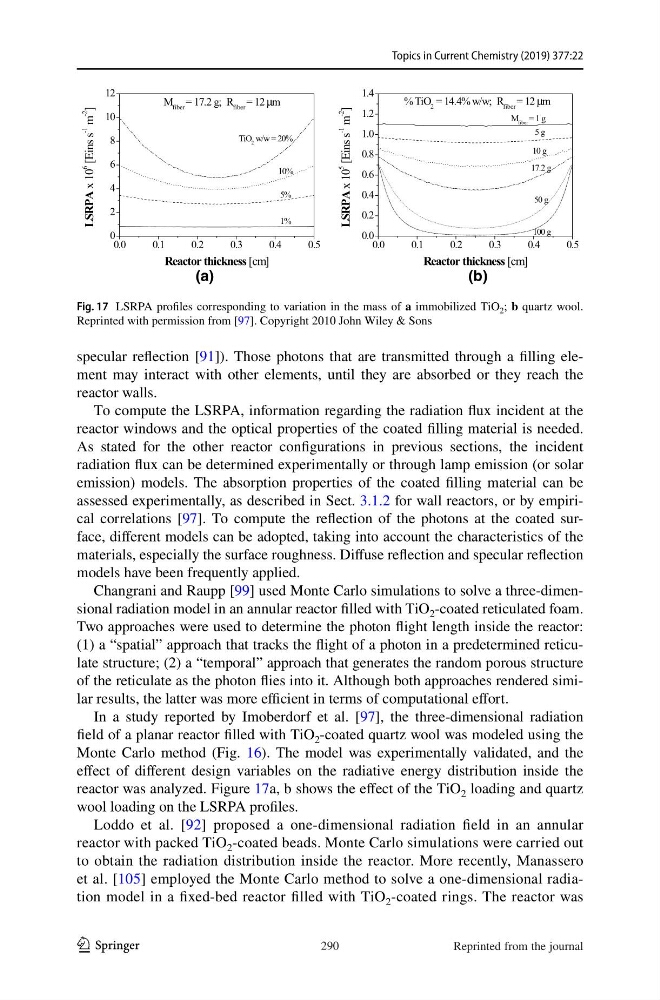
In a study reported by Imoberdorf et al. [97], the three-dimensional radiation
field of a planar reactor filled with TiO 2 -coated quartz wool was modeled using the
Monte Carlo method (Fig. 16). The model was experimentally validated, and the
effect of different design variables on the radiative energy distribution inside the
reactor was analyzed. Figure 17a, b shows the effect of the TiO 2 loading and quartz
wool loading on the LSRPA profiles.
Loddo et al. [92] proposed a one-dimensional radiation field in an annular
reactor with packed TiO 2 -coated beads. Monte Carlo simulations were carried out
to obtain the radiation distribution inside the reactor. More recently, Manassero
et al. [105] employed the Monte Carlo method to solve a one-dimensional radiation model in a fixed-bed reactor filled with TiO 2 -coated rings. The reactor was
(a)
(b)
0.0
0 .1
0.2
0 .3
0.4
0 .5
0
2
4
6
8
10
12
1%
5%
10%
M fiber = 17.2 g; R fiber = 12 µm
LSRPA x 10
6
[Eins s
-1
m
-2
]
Reactor thickness [cm]
TiO 2 w/w = 20%
0.0
0 .1
0.2
0 .3
0.4
0 .5
0.0
0.2
0.4
0.6
0.8
1.0
1.2
1.4
100 g
50 g
17.2 g
10 g
5 g
M fiber = 1 g
LSRPA x 10
5
[Eins s
-1
m
-2
]
Reactor thickness [cm]
% TiO 2 = 14.4% w/w; R fiber = 12 µm
Fig. 17 LSRPA profiles corresponding to variation in the mass of a immobilized TiO 2 ; b quartz wool.
Reprinted with permission from [97]. Copyright 2010 John Wiley & Sons
290
Reprinted from the journal
1 3
specular reflection [91]). Those photons that are transmitted through a filling element may interact with other elements, until they are absorbed or they reach the
reactor walls.
To compute the LSRPA, information regarding the radiation flux incident at the
reactor windows and the optical properties of the coated filling material is needed.
As stated for the other reactor configurations in previous sections, the incident
radiation flux can be determined experimentally or through lamp emission (or solar
emission) models. The absorption properties of the coated filling material can be
assessed experimentally, as described in Sect. 3.1.2 for wall reactors, or by empirical correlations [97]. To compute the reflection of the photons at the coated surface, different models can be adopted, taking into account the characteristics of the
materials, especially the surface roughness. Diffuse reflection and specular reflection
models have been frequently applied.
Changrani and Raupp [99] used Monte Carlo simulations to solve a three-dimensional radiation model in an annular reactor filled with TiO 2 -coated reticulated foam.
Two approaches were used to determine the photon flight length inside the reactor:
(1) a “spatial” approach that tracks the flight of a photon in a predetermined reticulate structure; (2) a “temporal” approach that generates the random porous structure
of the reticulate as the photon flies into it. Although both approaches rendered similar results, the latter was more efficient in terms of computational effort.
In a study reported by Imoberdorf et al. [97], the three-dimensional radiation
field of a planar reactor filled with TiO 2 -coated quartz wool was modeled using the
Monte Carlo method (Fig. 16). The model was experimentally validated, and the
effect of different design variables on the radiative energy distribution inside the
reactor was analyzed. Figure 17a, b shows the effect of the TiO 2 loading and quartz
wool loading on the LSRPA profiles.
Loddo et al. [92] proposed a one-dimensional radiation field in an annular
reactor with packed TiO 2 -coated beads. Monte Carlo simulations were carried out
to obtain the radiation distribution inside the reactor. More recently, Manassero
et al. [105] employed the Monte Carlo method to solve a one-dimensional radiation model in a fixed-bed reactor filled with TiO 2 -coated rings. The reactor was
(a)
(b)
0.0
0 .1
0.2
0 .3
0.4
0 .5
0
2
4
6
8
10
12
1%
5%
10%
M fiber = 17.2 g; R fiber = 12 µm
LSRPA x 10
6
[Eins s
-1
m
-2
]
Reactor thickness [cm]
TiO 2 w/w = 20%
0.0
0 .1
0.2
0 .3
0.4
0 .5
0.0
0.2
0.4
0.6
0.8
1.0
1.2
1.4
100 g
50 g
17.2 g
10 g
5 g
M fiber = 1 g
LSRPA x 10
5
[Eins s
-1
m
-2
]
Reactor thickness [cm]
% TiO 2 = 14.4% w/w; R fiber = 12 µm
Fig. 17 LSRPA profiles corresponding to variation in the mass of a immobilized TiO 2 ; b quartz wool.
Reprinted with permission from [97]. Copyright 2010 John Wiley & Sons
290
Reprinted from the journal