

1 3
Topics in Current Chemistry (2019) 377:22
supported on an inert material employed to fill the reactor volume. This configuration can reduce diffusion limitations by improving the mixing of reactants. Additionally, it can provide higher photocatalytic surface area and more uniform radiation
distribution inside the reactor. Typical catalyst supports reported in the literature
include glass beads [91–96], quartz wool [97, 98], foams [99–101], and glass rings
[102–105].
5.1 Evaluation of Photon Absorption
In fixed-bed photocatalytic reactors, a thin layer of catalyst is immobilized on the
surface of the filling material. Therefore, it is appropriate to refer to the photon
absorption rate per unit area of irradiated catalyst-coated surface, and calculate the
LSRPA to assess radiation absorption inside the reactors. Because of the inherent
differences in the filling (nature of the material, shape, size, packing, surface-to-volume ratio, etc.), it is not possible to develop a radiation model valid for every fixedbed reactor [97].
Various one-, two-, and three-dimensional models with different degrees of simplification have been reported for the assessment of radiation distribution in this type
of reactor. Most of them employed the Monte Carlo method to obtain the numerical solution of the models. Monte Carlo simulations inside fixed-bed reactors basically consider that photons travel with a linear trajectory in the aqueous or gas phase
until they reach an element of the filling, or the reactor walls. Those photons that
reach the filling can be absorbed by the catalyst film, reflected, or transmitted. The
absorbed photons are stored in a spatial cell, the trajectory ends, and a new photon
bundle is considered. On the other hand, if the photons are reflected, the new direction is determined by considering a reflection model (the simplest model considers
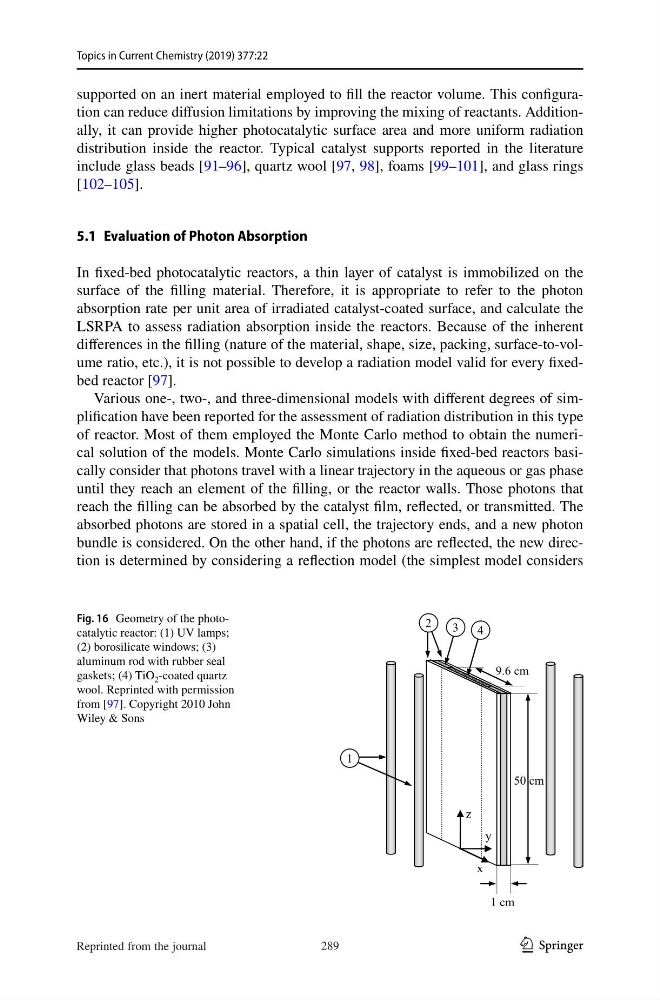
Fig. 16 Geometry of the photocatalytic reactor: (1) UV lamps;
(2) borosilicate windows; (3)
aluminum rod with rubber seal
gaskets; (4) TiO 2 -coated quartz
wool. Reprinted with permission
from [97]. Copyright 2010 John
Wiley & Sons
4
2
1
1 cm
50 cm
9.6 cm
3
z
y
x
289
Reprinted from the journal
Topics in Current Chemistry (2019) 377:22
supported on an inert material employed to fill the reactor volume. This configuration can reduce diffusion limitations by improving the mixing of reactants. Additionally, it can provide higher photocatalytic surface area and more uniform radiation
distribution inside the reactor. Typical catalyst supports reported in the literature
include glass beads [91–96], quartz wool [97, 98], foams [99–101], and glass rings
[102–105].
5.1 Evaluation of Photon Absorption
In fixed-bed photocatalytic reactors, a thin layer of catalyst is immobilized on the
surface of the filling material. Therefore, it is appropriate to refer to the photon
absorption rate per unit area of irradiated catalyst-coated surface, and calculate the
LSRPA to assess radiation absorption inside the reactors. Because of the inherent
differences in the filling (nature of the material, shape, size, packing, surface-to-volume ratio, etc.), it is not possible to develop a radiation model valid for every fixedbed reactor [97].
Various one-, two-, and three-dimensional models with different degrees of simplification have been reported for the assessment of radiation distribution in this type
of reactor. Most of them employed the Monte Carlo method to obtain the numerical solution of the models. Monte Carlo simulations inside fixed-bed reactors basically consider that photons travel with a linear trajectory in the aqueous or gas phase
until they reach an element of the filling, or the reactor walls. Those photons that
reach the filling can be absorbed by the catalyst film, reflected, or transmitted. The
absorbed photons are stored in a spatial cell, the trajectory ends, and a new photon
bundle is considered. On the other hand, if the photons are reflected, the new direction is determined by considering a reflection model (the simplest model considers
Fig. 16 Geometry of the photocatalytic reactor: (1) UV lamps;
(2) borosilicate windows; (3)
aluminum rod with rubber seal
gaskets; (4) TiO 2 -coated quartz
wool. Reprinted with permission
from [97]. Copyright 2010 John
Wiley & Sons
4
2
1
1 cm
50 cm
9.6 cm
3
z
y
x
289
Reprinted from the journal