

Topics in Current Chemistry (2019) 377:22
1 3
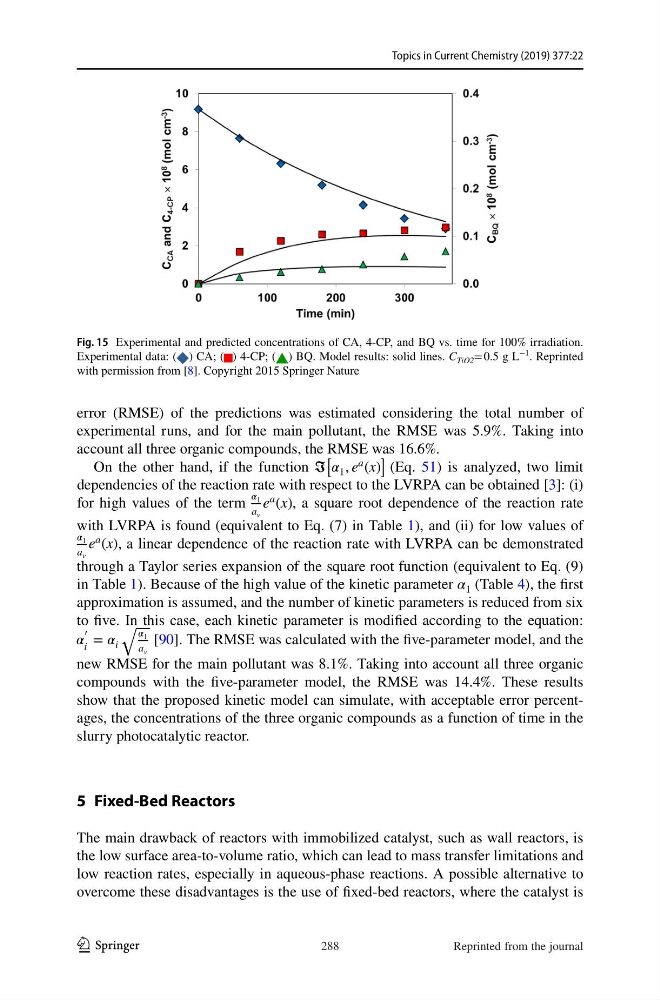
error (RMSE) of the predictions was estimated considering the total number of
experimental runs, and for the main pollutant, the RMSE was 5.9%. Taking into
account all three organic compounds, the RMSE was 16.6%.
On the other hand, if the function ℑ
1 , e
a (x)
(Eq. 51) is analyzed, two limit
dependencies of the reaction rate with respect to the LVRPA can be obtained [3]: (i)
for high values of the term
1
a v
e
a (x) , a square root dependence of the reaction rate
with LVRPA is found (equivalent to Eq. (7) in Table 1), and (ii) for low values of
1
a v
e
a (x) , a linear dependence of the reaction rate with LVRPA can be demonstrated
through a Taylor series expansion of the square root function (equivalent to Eq. (9)
in Table 1). Because of the high value of the kinetic parameter α 1 (Table 4), the first
approximation is assumed, and the number of kinetic parameters is reduced from six
to five. In this case, each kinetic parameter is modified according to the equation:
�
i
= i
√
1
a v
[90]. The RMSE was calculated with the five-parameter model, and the
new RMSE for the main pollutant was 8.1%. Taking into account all three organic
compounds with the five-parameter model, the RMSE was 14.4%. These results
show that the proposed kinetic model can simulate, with acceptable error percentages, the concentrations of the three organic compounds as a function of time in the
slurry photocatalytic reactor.
5 Fixed‑Bed Reactors
The main drawback of reactors with immobilized catalyst, such as wall reactors, is
the low surface area-to-volume ratio, which can lead to mass transfer limitations and
low reaction rates, especially in aqueous-phase reactions. A possible alternative to
overcome these disadvantages is the use of fixed-bed reactors, where the catalyst is
Fig. 15 Experimental and predicted concentrations of CA, 4-CP, and BQ vs. time for 100% irradiation.
Experimental data: ( ) CA; ( ) 4-CP; ( ) BQ. Model results: solid lines. C TiO2 = 0.5 g L
−1 . Reprinted
with permission from [8]. Copyright 2015 Springer Nature
288
Reprinted from the journal
1 3
error (RMSE) of the predictions was estimated considering the total number of
experimental runs, and for the main pollutant, the RMSE was 5.9%. Taking into
account all three organic compounds, the RMSE was 16.6%.
On the other hand, if the function ℑ
1 , e
a (x)
(Eq. 51) is analyzed, two limit
dependencies of the reaction rate with respect to the LVRPA can be obtained [3]: (i)
for high values of the term
1
a v
e
a (x) , a square root dependence of the reaction rate
with LVRPA is found (equivalent to Eq. (7) in Table 1), and (ii) for low values of
1
a v
e
a (x) , a linear dependence of the reaction rate with LVRPA can be demonstrated
through a Taylor series expansion of the square root function (equivalent to Eq. (9)
in Table 1). Because of the high value of the kinetic parameter α 1 (Table 4), the first
approximation is assumed, and the number of kinetic parameters is reduced from six
to five. In this case, each kinetic parameter is modified according to the equation:
�
i
= i
√
1
a v
[90]. The RMSE was calculated with the five-parameter model, and the
new RMSE for the main pollutant was 8.1%. Taking into account all three organic
compounds with the five-parameter model, the RMSE was 14.4%. These results
show that the proposed kinetic model can simulate, with acceptable error percentages, the concentrations of the three organic compounds as a function of time in the
slurry photocatalytic reactor.
5 Fixed‑Bed Reactors
The main drawback of reactors with immobilized catalyst, such as wall reactors, is
the low surface area-to-volume ratio, which can lead to mass transfer limitations and
low reaction rates, especially in aqueous-phase reactions. A possible alternative to
overcome these disadvantages is the use of fixed-bed reactors, where the catalyst is
Fig. 15 Experimental and predicted concentrations of CA, 4-CP, and BQ vs. time for 100% irradiation.
Experimental data: ( ) CA; ( ) 4-CP; ( ) BQ. Model results: solid lines. C TiO2 = 0.5 g L
−1 . Reprinted
with permission from [8]. Copyright 2015 Springer Nature
288
Reprinted from the journal