

Topics in Current Chemistry (2019) 377:22
1 3
3.1.3 Local Surface Rate of Photon Absorption (LSRPA)
Applying a local radiative energy balance in an immobilized layer of photocatalyst, the
spectral LSRPA can be calculated according to [27, 40]:
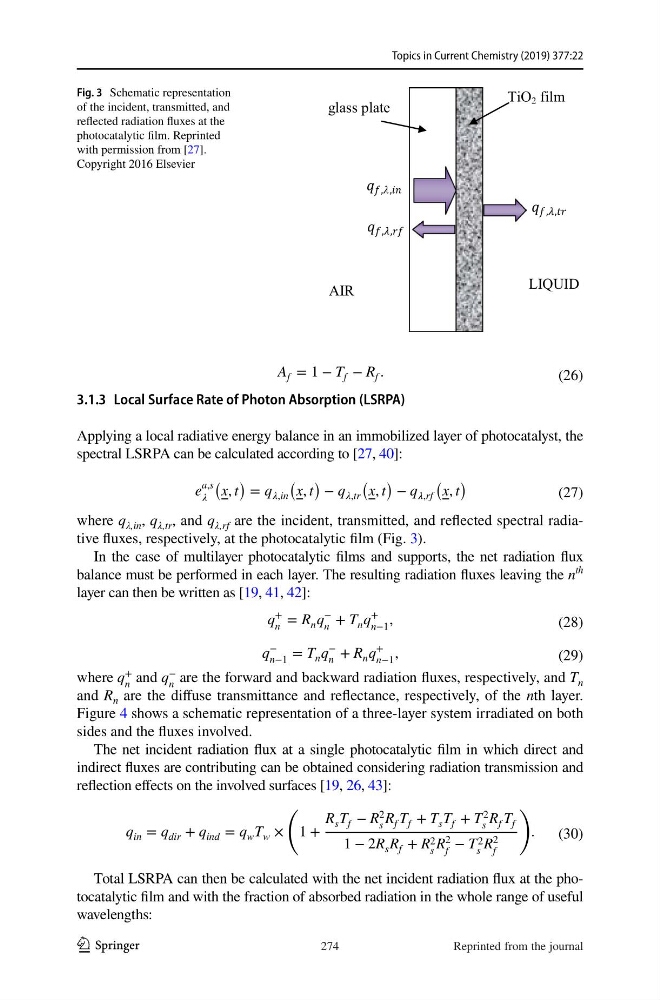
where q λ,in , q λ,tr , and q λ,rf are the incident, transmitted, and reflected spectral radiative fluxes, respectively, at the photocatalytic film (Fig. 3).
In the case of multilayer photocatalytic films and supports, the net radiation flux
balance must be performed in each layer. The resulting radiation fluxes leaving the n
th
layer can then be written as [19, 41, 42]:
where q
+
n and q
−
n are the forward and backward radiation fluxes, respectively, and T n
and R n are the diffuse transmittance and reflectance, respectively, of the nth layer.
Figure 4 shows a schematic representation of a three-layer system irradiated on both
sides and the fluxes involved.
The net incident radiation flux at a single photocatalytic film in which direct and
indirect fluxes are contributing can be obtained considering radiation transmission and
reflection effects on the involved surfaces [19, 26, 43]:
Total LSRPA can then be calculated with the net incident radiation flux at the photocatalytic film and with the fraction of absorbed radiation in the whole range of useful
wavelengths:
(26)
A f = 1 − T f − R f .
(27)
e
a,s
x, t
= q ,in
x, t
− q ,tr
x, t
− q ,rf
x, t
(28)
q
+
n
= R n q
−
n
+ T n q
+
n−1
,
(29)
q
−
n−1
= T n q
−
n
+ R n q
+
n−1
,
(30)
q in = q dir + q ind = q w T w ×
1 +
R s T f − R
2
s R f T f + T s T f + T
2
s R f T f
1 − 2R s R f + R 2
s
R
2
f
− T 2
s
R
2
f
.
Fig. 3 Schematic representation
of the incident, transmitted, and
reflected radiation fluxes at the
photocatalytic film. Reprinted
with permission from [27].
Copyright 2016 Elsevier
, ,
, ,
, ,
TiO 2 film
glass plate
AIR
LIQUID
274
Reprinted from the journal
1 3
3.1.3 Local Surface Rate of Photon Absorption (LSRPA)
Applying a local radiative energy balance in an immobilized layer of photocatalyst, the
spectral LSRPA can be calculated according to [27, 40]:
where q λ,in , q λ,tr , and q λ,rf are the incident, transmitted, and reflected spectral radiative fluxes, respectively, at the photocatalytic film (Fig. 3).
In the case of multilayer photocatalytic films and supports, the net radiation flux
balance must be performed in each layer. The resulting radiation fluxes leaving the n
th
layer can then be written as [19, 41, 42]:
where q
+
n and q
−
n are the forward and backward radiation fluxes, respectively, and T n
and R n are the diffuse transmittance and reflectance, respectively, of the nth layer.
Figure 4 shows a schematic representation of a three-layer system irradiated on both
sides and the fluxes involved.
The net incident radiation flux at a single photocatalytic film in which direct and
indirect fluxes are contributing can be obtained considering radiation transmission and
reflection effects on the involved surfaces [19, 26, 43]:
Total LSRPA can then be calculated with the net incident radiation flux at the photocatalytic film and with the fraction of absorbed radiation in the whole range of useful
wavelengths:
(26)
A f = 1 − T f − R f .
(27)
e
a,s
x, t
= q ,in
x, t
− q ,tr
x, t
− q ,rf
x, t
(28)
q
+
n
= R n q
−
n
+ T n q
+
n−1
,
(29)
q
−
n−1
= T n q
−
n
+ R n q
+
n−1
,
(30)
q in = q dir + q ind = q w T w ×
1 +
R s T f − R
2
s R f T f + T s T f + T
2
s R f T f
1 − 2R s R f + R 2
s
R
2
f
− T 2
s
R
2
f
.
Fig. 3 Schematic representation
of the incident, transmitted, and
reflected radiation fluxes at the
photocatalytic film. Reprinted
with permission from [27].
Copyright 2016 Elsevier
, ,
, ,
, ,
TiO 2 film
glass plate
AIR
LIQUID
274
Reprinted from the journal