

1 3
Topics in Current Chemistry (2019) 377:22
by the surface emission lamp model [19]. Also, multiphysics or computational fluid
dynamics (CFD) software, such as COMSOL Multiphysics
®
or ANSYS Fluent, is
used to simulate the radiation field in the reacting system. The ray optics module
of COMSOL Multiphysics
®
treats the radiation field as rays that reflect and refract
at surfaces [36]. ANSYS Fluent, on the other hand, can apply the discrete ordinary
method (DOM) to solve the radiation field in photoreactors. In the case of a non-participating domain, such as non-absorbing gases or liquids, it allows one to calculate
the incident radiation flux on the catalytic wall [37].
3.1.2 Optical Properties
To evaluate the LSRPA on the photocatalytic walls, the optical properties of the wall
are also necessary. Measurements and further calculations are frequently involved in
determining the absorbed radiation fraction by the photocatalyst-immobilized film.
Experimental determinations include the measurement of the diffuse transmittance (T)
and reflectance (R) of the immobilized system (photocatalytic film + support) and the
inert support alone in a spectroradiometer equipped with an integrating sphere reflectance attachment [38, 39]. Then, applying the ray-tracing method, the optical properties
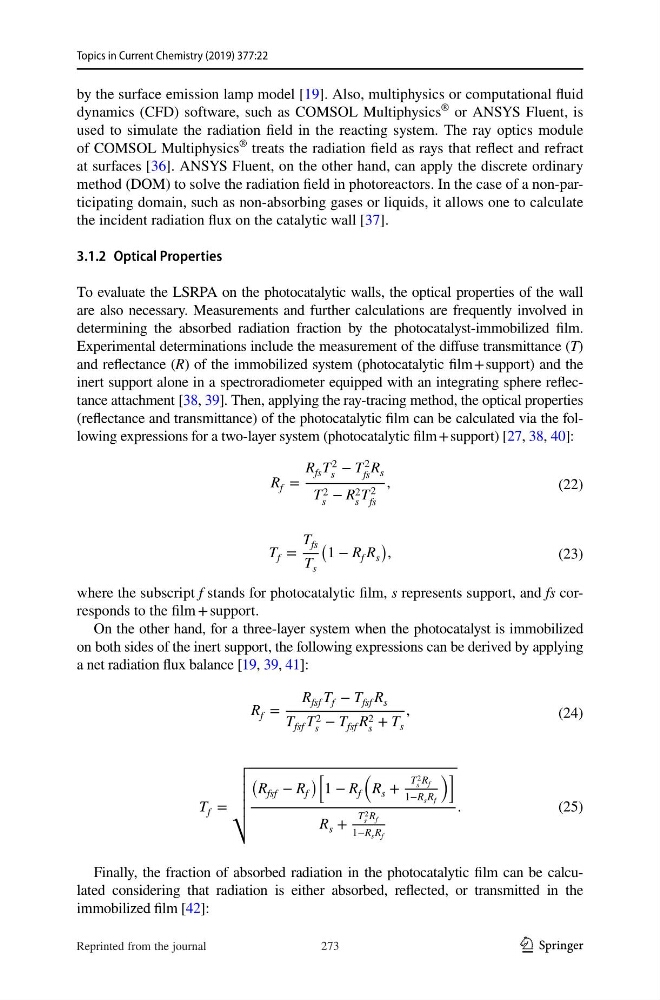
(reflectance and transmittance) of the photocatalytic film can be calculated via the following expressions for a two-layer system (photocatalytic film + support) [27, 38, 40]:
where the subscript f stands for photocatalytic film, s represents support, and fs corresponds to the film + support.
On the other hand, for a three-layer system when the photocatalyst is immobilized
on both sides of the inert support, the following expressions can be derived by applying
a net radiation flux balance [19, 39, 41]:
Finally, the fraction of absorbed radiation in the photocatalytic film can be calculated considering that radiation is either absorbed, reflected, or transmitted in the
immobilized film [42]:
(22)
R f =
R fs T 2
s
− T
2
fs
R s
T 2
s − R 2
s T
2
fs
,
(23)
T f =
T fs
T s
1 − R f R s
,
(24)
R f =
R fsf T f − T fsf R s
T fsf T 2
s
− T fsf R 2
s
+ T s
,
(25)
T f =
√
√
√
√
√
√
√
R fsf − R f
1 − R f
R s +
T 2
s R f
1−R s R f
R s +
T 2
s R f
1−R s R f
.
273
Reprinted from the journal
Topics in Current Chemistry (2019) 377:22
by the surface emission lamp model [19]. Also, multiphysics or computational fluid
dynamics (CFD) software, such as COMSOL Multiphysics
®
or ANSYS Fluent, is
used to simulate the radiation field in the reacting system. The ray optics module
of COMSOL Multiphysics
®
treats the radiation field as rays that reflect and refract
at surfaces [36]. ANSYS Fluent, on the other hand, can apply the discrete ordinary
method (DOM) to solve the radiation field in photoreactors. In the case of a non-participating domain, such as non-absorbing gases or liquids, it allows one to calculate
the incident radiation flux on the catalytic wall [37].
3.1.2 Optical Properties
To evaluate the LSRPA on the photocatalytic walls, the optical properties of the wall
are also necessary. Measurements and further calculations are frequently involved in
determining the absorbed radiation fraction by the photocatalyst-immobilized film.
Experimental determinations include the measurement of the diffuse transmittance (T)
and reflectance (R) of the immobilized system (photocatalytic film + support) and the
inert support alone in a spectroradiometer equipped with an integrating sphere reflectance attachment [38, 39]. Then, applying the ray-tracing method, the optical properties
(reflectance and transmittance) of the photocatalytic film can be calculated via the following expressions for a two-layer system (photocatalytic film + support) [27, 38, 40]:
where the subscript f stands for photocatalytic film, s represents support, and fs corresponds to the film + support.
On the other hand, for a three-layer system when the photocatalyst is immobilized
on both sides of the inert support, the following expressions can be derived by applying
a net radiation flux balance [19, 39, 41]:
Finally, the fraction of absorbed radiation in the photocatalytic film can be calculated considering that radiation is either absorbed, reflected, or transmitted in the
immobilized film [42]:
(22)
R f =
R fs T 2
s
− T
2
fs
R s
T 2
s − R 2
s T
2
fs
,
(23)
T f =
T fs
T s
1 − R f R s
,
(24)
R f =
R fsf T f − T fsf R s
T fsf T 2
s
− T fsf R 2
s
+ T s
,
(25)
T f =
√
√
√
√
√
√
√
R fsf − R f
1 − R f
R s +
T 2
s R f
1−R s R f
R s +
T 2
s R f
1−R s R f
.
273
Reprinted from the journal