

Topics in Current Chemistry (2019) 377:27
1 3
redistribution of charge under visible-light irradiation. The contribution of alloying
and plasmonic effects was confirmed by assessing the performance of samples with
various composition of the alloy nanoparticles (Au 2 Pd 1 /CNS, AuPd/CNS, Au 1 Pd 2 /
CNS, and Au 1 Pd 2 /CNS) and the physically mixed counterpart catalysts (Au 2 + Pd 1 /
CNS, Au + Pd/CNS, and Au 1 + Pd 2 /CNS).
Considering that Pd is the active phase, a decrease in activity with increasing
Au content could be expected. However, the positive alloying and plasmonic effect
was confirmed by the enhancement achieved by the AuPd-based catalysts. Samples Au + Pd/CNS and AuPd/CNS,displayed the best performances among physically mixed and alloy catalysts, respectively. The comparison between Pd/CNS and
Au + Pd/CNS revealed an increasing rate of 24.8%, which corresponds to the plasmonic effect. The increasing rate in the case of the alloy catalysts was of 143.2%,
indicating that the alloy effect is much more important than the plasmonic effect.
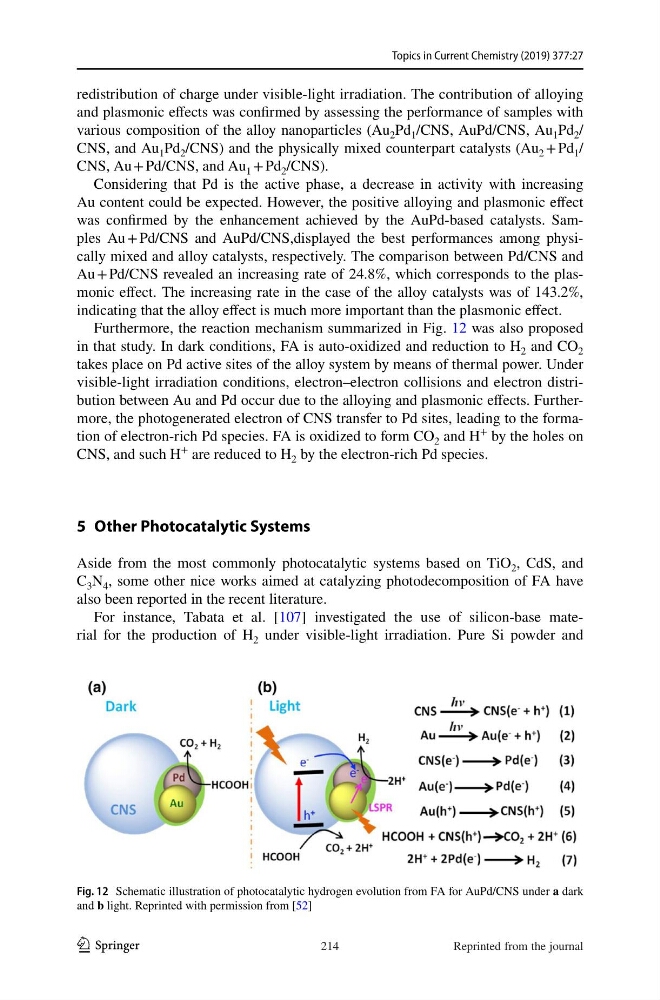
Furthermore, the reaction mechanism summarized in Fig. 12 was also proposed
in that study. In dark conditions, FA is auto-oxidized and reduction to H 2 and CO 2
takes place on Pd active sites of the alloy system by means of thermal power. Under
visible-light irradiation conditions, electron–electron collisions and electron distribution between Au and Pd occur due to the alloying and plasmonic effects. Furthermore, the photogenerated electron of CNS transfer to Pd sites, leading to the formation of electron-rich Pd species. FA is oxidized to form CO 2 and H
+
by the holes on
CNS, and such H
+
are reduced to H 2 by the electron-rich Pd species.
5 Other Photocatalytic Systems
Aside from the most commonly photocatalytic systems based on TiO 2 , CdS, and
C 3 N 4 , some other nice works aimed at catalyzing photodecomposition of FA have
also been reported in the recent literature.
For instance, Tabata et al. [107] investigated the use of silicon-base material for the production of H 2 under visible-light irradiation. Pure Si powder and
Fig. 12 Schematic illustration of photocatalytic hydrogen evolution from FA for AuPd/CNS under a dark
and b light. Reprinted with permission from [52]
214
Reprinted from the journal
1 3
redistribution of charge under visible-light irradiation. The contribution of alloying
and plasmonic effects was confirmed by assessing the performance of samples with
various composition of the alloy nanoparticles (Au 2 Pd 1 /CNS, AuPd/CNS, Au 1 Pd 2 /
CNS, and Au 1 Pd 2 /CNS) and the physically mixed counterpart catalysts (Au 2 + Pd 1 /
CNS, Au + Pd/CNS, and Au 1 + Pd 2 /CNS).
Considering that Pd is the active phase, a decrease in activity with increasing
Au content could be expected. However, the positive alloying and plasmonic effect
was confirmed by the enhancement achieved by the AuPd-based catalysts. Samples Au + Pd/CNS and AuPd/CNS,displayed the best performances among physically mixed and alloy catalysts, respectively. The comparison between Pd/CNS and
Au + Pd/CNS revealed an increasing rate of 24.8%, which corresponds to the plasmonic effect. The increasing rate in the case of the alloy catalysts was of 143.2%,
indicating that the alloy effect is much more important than the plasmonic effect.
Furthermore, the reaction mechanism summarized in Fig. 12 was also proposed
in that study. In dark conditions, FA is auto-oxidized and reduction to H 2 and CO 2
takes place on Pd active sites of the alloy system by means of thermal power. Under
visible-light irradiation conditions, electron–electron collisions and electron distribution between Au and Pd occur due to the alloying and plasmonic effects. Furthermore, the photogenerated electron of CNS transfer to Pd sites, leading to the formation of electron-rich Pd species. FA is oxidized to form CO 2 and H
+
by the holes on
CNS, and such H
+
are reduced to H 2 by the electron-rich Pd species.
5 Other Photocatalytic Systems
Aside from the most commonly photocatalytic systems based on TiO 2 , CdS, and
C 3 N 4 , some other nice works aimed at catalyzing photodecomposition of FA have
also been reported in the recent literature.
For instance, Tabata et al. [107] investigated the use of silicon-base material for the production of H 2 under visible-light irradiation. Pure Si powder and
Fig. 12 Schematic illustration of photocatalytic hydrogen evolution from FA for AuPd/CNS under a dark
and b light. Reprinted with permission from [52]
214
Reprinted from the journal