

1 3
Topics in Current Chemistry (2019) 377:27
Such high energy electrons can migrate to Pd active sites and result in enhanced
photocatalytic performances. For the preparation of catalysts, carbon nitride nanospheres were first synthetized from cyanamide using SiO 2 as a template. They were
subsequently impregnated with HAuCl 4 and H 2 PdCl 4 at various mole ratios (i.e. 1:0,
2:1, 1:1, 1:2, and 0:1) to achieve different compositions of the alloy nanoparticles.
The resulting photocatalysts were denoted as Au/CNS, Au 2 Pd 1 /CNS, AuPd/CNS,
Au 1 Pd 2 /CNS and Pd/CNS, respectively, according to the composition of the nanoparticles. A sample prepared from bulk C 3 N 4 (AuPd/Bulk CN) was also prepared as
a reference material. TEM analysis revealed that the average size of g-C 3 N 4 nanospheres and AuPd nanoparticles was 20 and 3 nm, respectively. Once again, the fine
distribution of AuPd nanoparticles on the nanospheres was attributed to the anchoring effect of the uncondensed amine groups on the surface g-C 3 N 4 . XPS analysis
confirmed the strong interaction and distribution of charge from Au to Pd in the
AuPd nanoparticles, as well as electron donation from the support to Pd species. As
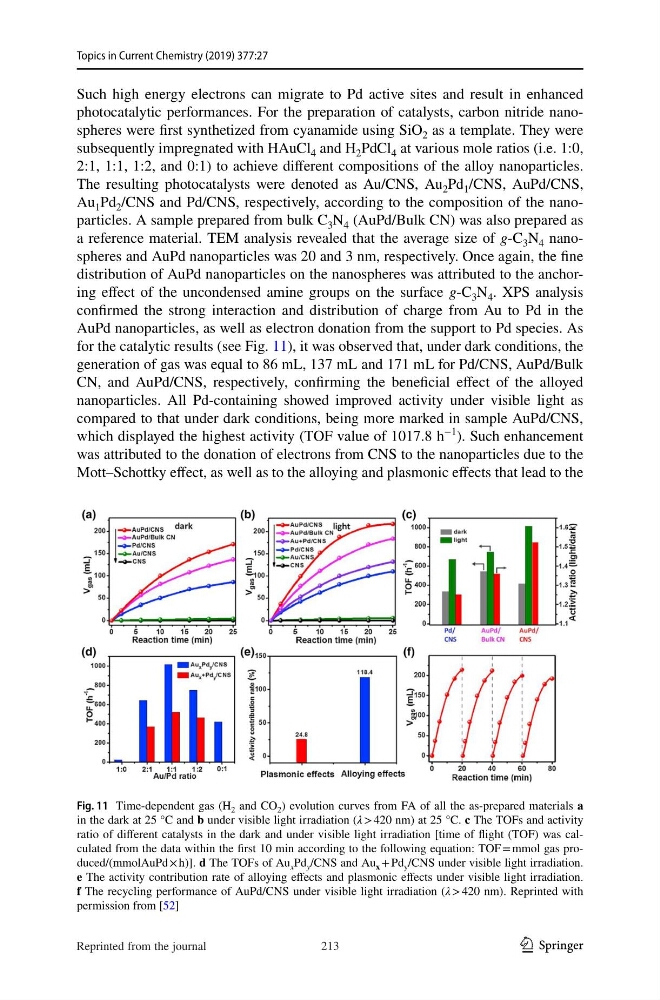
for the catalytic results (see Fig. 11), it was observed that, under dark conditions, the
generation of gas was equal to 86 mL, 137 mL and 171 mL for Pd/CNS, AuPd/Bulk
CN, and AuPd/CNS, respectively, confirming the beneficial effect of the alloyed
nanoparticles. All Pd-containing showed improved activity under visible light as
compared to that under dark conditions, being more marked in sample AuPd/CNS,
which displayed the highest activity (TOF value of 1017.8 h
−1
). Such enhancement
was attributed to the donation of electrons from CNS to the nanoparticles due to the
Mott–Schottky effect, as well as to the alloying and plasmonic effects that lead to the
Fig. 11 Time-dependent gas (H 2 and CO 2 ) evolution curves from FA of all the as-prepared materials a
in the dark at 25 °C and b under visible light irradiation (λ > 420 nm) at 25 °C. c The TOFs and activity
ratio of different catalysts in the dark and under visible light irradiation [time of flight (TOF) was calculated from the data within the first 10 min according to the following equation: TOF = mmol gas produced/(mmolAuPd × h)]. d The TOFs of Au x Pd y /CNS and Au x + Pd y /CNS under visible light irradiation.
e The activity contribution rate of alloying effects and plasmonic effects under visible light irradiation.
f The recycling performance of AuPd/CNS under visible light irradiation (λ > 420 nm). Reprinted with
permission from [52]
213
Reprinted from the journal
Topics in Current Chemistry (2019) 377:27
Such high energy electrons can migrate to Pd active sites and result in enhanced
photocatalytic performances. For the preparation of catalysts, carbon nitride nanospheres were first synthetized from cyanamide using SiO 2 as a template. They were
subsequently impregnated with HAuCl 4 and H 2 PdCl 4 at various mole ratios (i.e. 1:0,
2:1, 1:1, 1:2, and 0:1) to achieve different compositions of the alloy nanoparticles.
The resulting photocatalysts were denoted as Au/CNS, Au 2 Pd 1 /CNS, AuPd/CNS,
Au 1 Pd 2 /CNS and Pd/CNS, respectively, according to the composition of the nanoparticles. A sample prepared from bulk C 3 N 4 (AuPd/Bulk CN) was also prepared as
a reference material. TEM analysis revealed that the average size of g-C 3 N 4 nanospheres and AuPd nanoparticles was 20 and 3 nm, respectively. Once again, the fine
distribution of AuPd nanoparticles on the nanospheres was attributed to the anchoring effect of the uncondensed amine groups on the surface g-C 3 N 4 . XPS analysis
confirmed the strong interaction and distribution of charge from Au to Pd in the
AuPd nanoparticles, as well as electron donation from the support to Pd species. As
for the catalytic results (see Fig. 11), it was observed that, under dark conditions, the
generation of gas was equal to 86 mL, 137 mL and 171 mL for Pd/CNS, AuPd/Bulk
CN, and AuPd/CNS, respectively, confirming the beneficial effect of the alloyed
nanoparticles. All Pd-containing showed improved activity under visible light as
compared to that under dark conditions, being more marked in sample AuPd/CNS,
which displayed the highest activity (TOF value of 1017.8 h
−1
). Such enhancement
was attributed to the donation of electrons from CNS to the nanoparticles due to the
Mott–Schottky effect, as well as to the alloying and plasmonic effects that lead to the
Fig. 11 Time-dependent gas (H 2 and CO 2 ) evolution curves from FA of all the as-prepared materials a
in the dark at 25 °C and b under visible light irradiation (λ > 420 nm) at 25 °C. c The TOFs and activity
ratio of different catalysts in the dark and under visible light irradiation [time of flight (TOF) was calculated from the data within the first 10 min according to the following equation: TOF = mmol gas produced/(mmolAuPd × h)]. d The TOFs of Au x Pd y /CNS and Au x + Pd y /CNS under visible light irradiation.
e The activity contribution rate of alloying effects and plasmonic effects under visible light irradiation.
f The recycling performance of AuPd/CNS under visible light irradiation (λ > 420 nm). Reprinted with
permission from [52]
213
Reprinted from the journal