

Topics in Current Chemistry (2019) 377:27
1 3
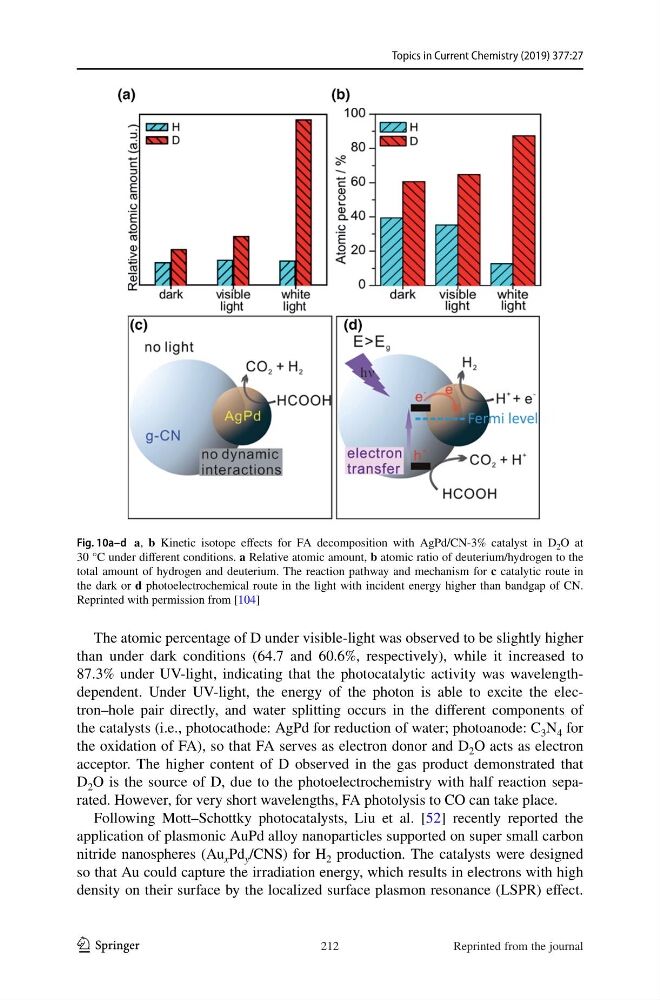
The atomic percentage of D under visible-light was observed to be slightly higher
than under dark conditions (64.7 and 60.6%, respectively), while it increased to
87.3% under UV-light, indicating that the photocatalytic activity was wavelengthdependent. Under UV-light, the energy of the photon is able to excite the electron–hole pair directly, and water splitting occurs in the different components of
the catalysts (i.e., photocathode: AgPd for reduction of water; photoanode: C 3 N 4 for
the oxidation of FA), so that FA serves as electron donor and D 2 O acts as electron
acceptor. The higher content of D observed in the gas product demonstrated that
D 2 O is the source of D, due to the photoelectrochemistry with half reaction separated. However, for very short wavelengths, FA photolysis to CO can take place.
Following Mott–Schottky photocatalysts, Liu et al. [52] recently reported the
application of plasmonic AuPd alloy nanoparticles supported on super small carbon
nitride nanospheres (Au x Pd y /CNS) for H 2 production. The catalysts were designed
so that Au could capture the irradiation energy, which results in electrons with high
density on their surface by the localized surface plasmon resonance (LSPR) effect.
Fig. 10a–d a, b Kinetic isotope effects for FA decomposition with AgPd/CN-3% catalyst in D 2 O at
30 °C under different conditions. a Relative atomic amount, b atomic ratio of deuterium/hydrogen to the
total amount of hydrogen and deuterium. The reaction pathway and mechanism for c catalytic route in
the dark or d photoelectrochemical route in the light with incident energy higher than bandgap of CN.
Reprinted with permission from [104]
212
Reprinted from the journal
1 3
The atomic percentage of D under visible-light was observed to be slightly higher
than under dark conditions (64.7 and 60.6%, respectively), while it increased to
87.3% under UV-light, indicating that the photocatalytic activity was wavelengthdependent. Under UV-light, the energy of the photon is able to excite the electron–hole pair directly, and water splitting occurs in the different components of
the catalysts (i.e., photocathode: AgPd for reduction of water; photoanode: C 3 N 4 for
the oxidation of FA), so that FA serves as electron donor and D 2 O acts as electron
acceptor. The higher content of D observed in the gas product demonstrated that
D 2 O is the source of D, due to the photoelectrochemistry with half reaction separated. However, for very short wavelengths, FA photolysis to CO can take place.
Following Mott–Schottky photocatalysts, Liu et al. [52] recently reported the
application of plasmonic AuPd alloy nanoparticles supported on super small carbon
nitride nanospheres (Au x Pd y /CNS) for H 2 production. The catalysts were designed
so that Au could capture the irradiation energy, which results in electrons with high
density on their surface by the localized surface plasmon resonance (LSPR) effect.
Fig. 10a–d a, b Kinetic isotope effects for FA decomposition with AgPd/CN-3% catalyst in D 2 O at
30 °C under different conditions. a Relative atomic amount, b atomic ratio of deuterium/hydrogen to the
total amount of hydrogen and deuterium. The reaction pathway and mechanism for c catalytic route in
the dark or d photoelectrochemical route in the light with incident energy higher than bandgap of CN.
Reprinted with permission from [104]
212
Reprinted from the journal