

1 3
Topics in Current Chemistry (2019) 377:27
Mott–Schottky heterojunction, creating electron-rich Pd species that are favorable
for facilitating the O–H cleavage and strengthening the adsorption of formate.
From its side, the support serves as a proton scavenger for the dissociation of
O–H, forming protonated g-C 3 N 4 , which facilitates the production of H 2 and CO 2
via β-hydride elimination of Pd-formate. The catalytic activity displayed dependence with the composition of the nanoparticles, with initial TOF of 346, 420, 242,
and 105 h
−1
, Pd 7 Ag 3 NWs@g-C 3 N 4 , Pd 5 Ag 5 NWs@g-C 3 N 4 , Pd 3 Ag 7 NWs@gC 3 N 4 and Pd NWs@g-C 3 N 4 , respectively. Furthermore, the performance of some
control samples was also assessed to point out the effect of the Mott–Schottky
heterojunction. The effect of the visible-light intensity on the photocatalytic
activity of Pd 5 Ag 5 NWs@g-C 3 N 4 was also investigated, which showed increasing
dehydrogenation rate with light intensity.
Stucky et al. [104] also investigated AgPd nanocatalysts supported on g-C 3 N 4
(denoted as AgPd/CN). In that case, microsized mesoporous carbon nitride hollow
spheres were synthetized from a melamine–cyanuric acid network, and subsequently
impregnated with K 2 PdCl 4 and AgNO 3 . As indicated by the characterization results,
the resulting nanoparticles had an average size of 7.5 ± 1.0 nm and a Ag/Pd ratio
of 1/1. Comparison with reference samples prepared from SiO 2 and activated carbon demonstrated the vital role of N-functional groups in C 3 N 4 in achieving highly
dispersed alloy AgPd nanoparticles. The electron density enrichment of Pd species
via electron donation from C 3 N 4 and Ag to Pd was also demonstrated by XPS analysis. It was also claimed that the electron density of Pd could be further increased
by photoexcited electron transfer from the semiconductor support, which, in turn,
would suppress recombination of the electron–hole pairs. As a consequence of the
resulting unique electronic features, AgPd/CN displayed much higher activities than
its Ag/CN and Pd/CN counterparts, and activity was further enhanced under visiblelight irradiation. H/D isotope experiments were also followed using D 2 O to investigate the contribution of the semiconductor and the direction of the charge carrier
in components of the photocatalysts. The results of the relative atomic amount and
atomic ratio of H and D in the gas produced from FA decomposition at 30 °C is
depicted in Fig. 10.
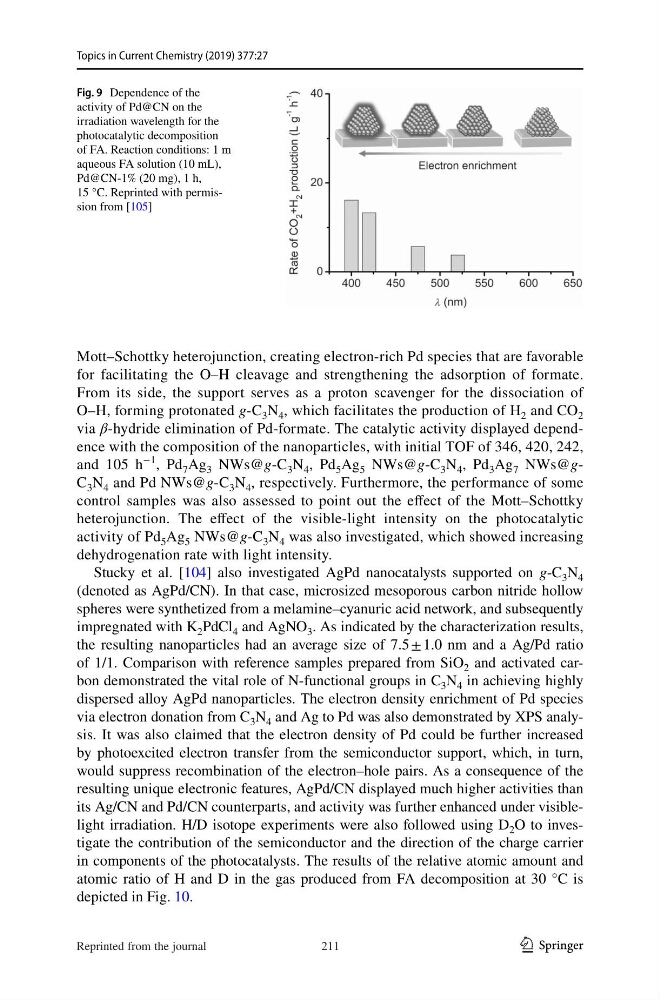
Fig. 9 Dependence of the
activity of Pd@CN on the
irradiation wavelength for the
photocatalytic decomposition
of FA. Reaction conditions: 1 m
aqueous FA solution (10 mL),
Pd@CN-1% (20 mg), 1 h,
15 °C. Reprinted with permission from [105]
211
Reprinted from the journal
Topics in Current Chemistry (2019) 377:27
Mott–Schottky heterojunction, creating electron-rich Pd species that are favorable
for facilitating the O–H cleavage and strengthening the adsorption of formate.
From its side, the support serves as a proton scavenger for the dissociation of
O–H, forming protonated g-C 3 N 4 , which facilitates the production of H 2 and CO 2
via β-hydride elimination of Pd-formate. The catalytic activity displayed dependence with the composition of the nanoparticles, with initial TOF of 346, 420, 242,
and 105 h
−1
, Pd 7 Ag 3 NWs@g-C 3 N 4 , Pd 5 Ag 5 NWs@g-C 3 N 4 , Pd 3 Ag 7 NWs@gC 3 N 4 and Pd NWs@g-C 3 N 4 , respectively. Furthermore, the performance of some
control samples was also assessed to point out the effect of the Mott–Schottky
heterojunction. The effect of the visible-light intensity on the photocatalytic
activity of Pd 5 Ag 5 NWs@g-C 3 N 4 was also investigated, which showed increasing
dehydrogenation rate with light intensity.
Stucky et al. [104] also investigated AgPd nanocatalysts supported on g-C 3 N 4
(denoted as AgPd/CN). In that case, microsized mesoporous carbon nitride hollow
spheres were synthetized from a melamine–cyanuric acid network, and subsequently
impregnated with K 2 PdCl 4 and AgNO 3 . As indicated by the characterization results,
the resulting nanoparticles had an average size of 7.5 ± 1.0 nm and a Ag/Pd ratio
of 1/1. Comparison with reference samples prepared from SiO 2 and activated carbon demonstrated the vital role of N-functional groups in C 3 N 4 in achieving highly
dispersed alloy AgPd nanoparticles. The electron density enrichment of Pd species
via electron donation from C 3 N 4 and Ag to Pd was also demonstrated by XPS analysis. It was also claimed that the electron density of Pd could be further increased
by photoexcited electron transfer from the semiconductor support, which, in turn,
would suppress recombination of the electron–hole pairs. As a consequence of the
resulting unique electronic features, AgPd/CN displayed much higher activities than
its Ag/CN and Pd/CN counterparts, and activity was further enhanced under visiblelight irradiation. H/D isotope experiments were also followed using D 2 O to investigate the contribution of the semiconductor and the direction of the charge carrier
in components of the photocatalysts. The results of the relative atomic amount and
atomic ratio of H and D in the gas produced from FA decomposition at 30 °C is
depicted in Fig. 10.
Fig. 9 Dependence of the
activity of Pd@CN on the
irradiation wavelength for the
photocatalytic decomposition
of FA. Reaction conditions: 1 m
aqueous FA solution (10 mL),
Pd@CN-1% (20 mg), 1 h,
15 °C. Reprinted with permission from [105]
211
Reprinted from the journal